If your vinyl deck feels soft or spongy underfoot, the most likely cause is water in the plywood substrate beneath the membrane. A vinyl membrane is non-porous, so once water gets underneath it, the wood cannot dry out. The surface can look perfect while the deck below it deteriorates. Sponginess is the signal to get the deck assessed, not to resurface it.
This is the failure mode homeowners catch last, because every other deck problem announces itself. A tear is visible. A bubble is visible. Rot under an intact membrane is not, and the same waterproofing layer that protects the structure also conceals what is happening to it. Water usually enters somewhere small and specific, most often a wall or door termination, a railing post penetration, or a lifted edge, then travels along the plywood and stays there. By the time the surface tells you anything, the substrate has usually been wet for a long time. The good news is that the early signals are reliable if you know what you are checking for.
How can you tell if your deck is rotting?
Three signals appear before any visible membrane damage: the deck feels soft underfoot, the area smells musty, and anything left on the surface stays damp longer than it should. None of the three requires a tool, and all three are worth acting on.
- It gives underfoot. A sound deck feels solid. A deck with a wet substrate feels like standing on a wet sponge, and the feeling is usually localised to one area rather than the whole surface. Walk the deck slowly in bare feet or soft shoes, paying attention near walls, doors, drains and railing posts.
- A musty or earthy smell. Wood decay produces a distinct damp smell that is strongest close to the deck surface, near the door threshold, or in the room directly below.
- Things stay wet. An outdoor rug, planter base or door mat that is still damp two days after rain suggests moisture is coming up from below rather than falling from above.
What can you see from outside and underneath?
The most reliable visual evidence of substrate rot is not on the deck at all. It is underneath it. Water that has soaked the plywood has to go somewhere, and it shows up on the surfaces below before it shows up on the membrane above.
- Staining on the soffit or ceiling below. Brown or yellow-edged marks on the underside of a balcony, or on the ceiling of the room beneath, are the single clearest sign. Any discolouration below a deck deserves an assessment.
- Discoloured or soft fascia and rim boards. Check the board that caps the outside edge of the deck frame. Dark streaks, paint lifting, or wood that dents under thumb pressure indicate water travelling to the edge.
- Efflorescence or rust streaks. White chalky deposits or rust trails below the deck line mean water is moving through the assembly.
- Membrane lifting at the edge or a wall. A membrane separating from the substrate has lost its bond, and a lost bond usually means moisture got between the two.
- A visible sag. Any dip or dished area in a deck that used to be flat is a structural signal, not a cosmetic one.
If you find staining below, treat it as the priority signal. It means water has already passed through the sheathing. Our guides on where vinyl deck leaks start, railing post leaks and leaks at the sliding door cover the three entry points that most often produce it.
Why does the membrane hide the damage?
A vinyl deck membrane is a vapour barrier as well as a waterproofing layer, and that is exactly why hidden rot is possible. The material is non-porous by design. Water that gets above the membrane runs off. Water that gets below it has no path back out.
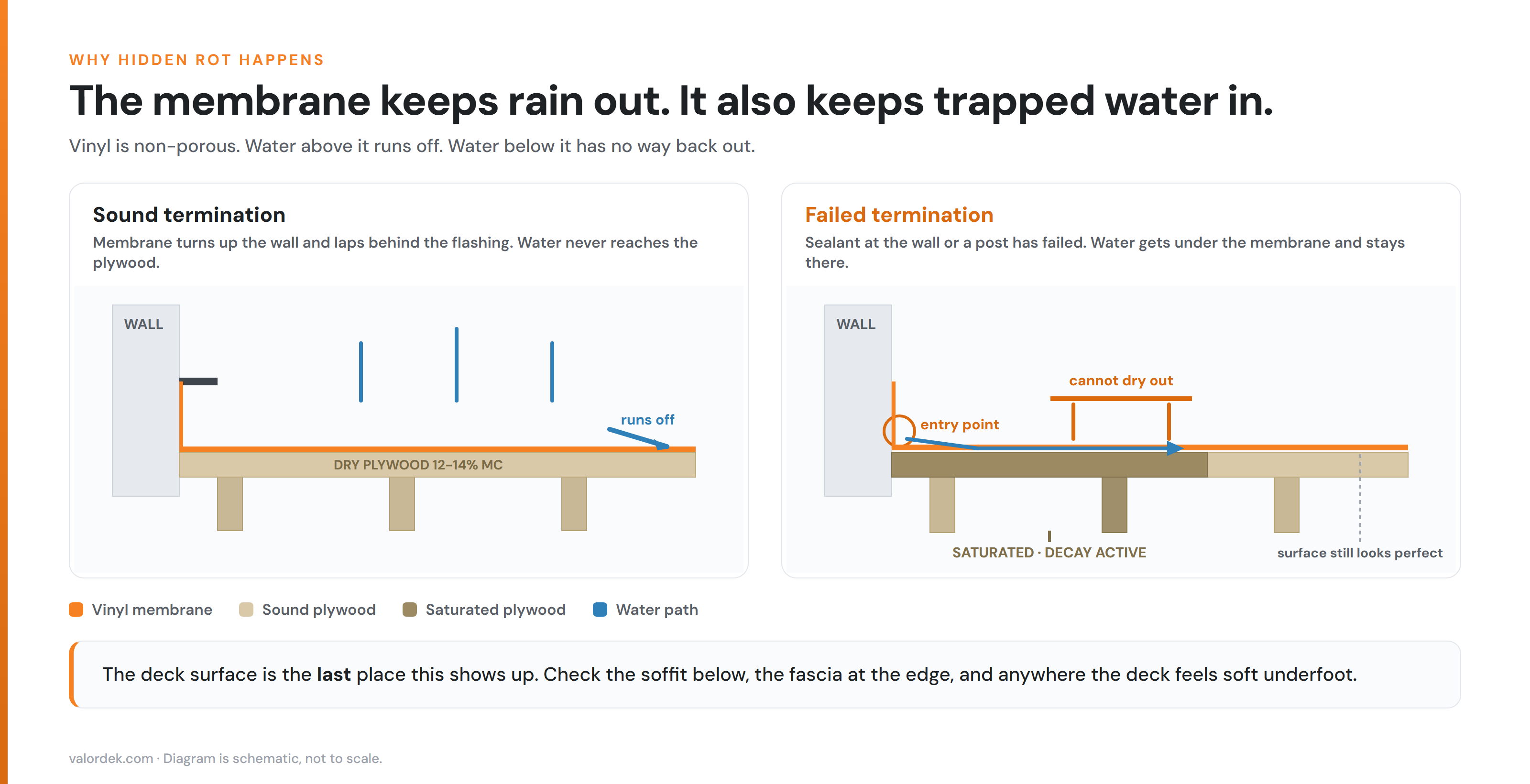
An uncovered wood deck gets wet and then dries between rainfalls. A membrane-covered deck with a compromised termination gets wet underneath and stays wet, because the covering that keeps rain out also keeps trapped moisture in. The substrate sits at a moisture content where decay fungi are active, and it stays there through every season. That is why a small unrepaired detail can produce structural damage while the deck still looks new, and why the deck surface is the last place the problem shows up.
This is not an argument against membranes. A correctly installed and correctly terminated membrane is the reason the plywood stays dry for decades. It is an argument for taking the entry points seriously, since most balcony waterproofing failures begin at a detail rather than in the open field of the deck.
What is it, if it is not rot?
A deck that bounces is not the same as a deck that is spongy, and the distinction matters. Bounce is deflection across a span. Sponginess is compression underfoot in one place. Being honest about this saves people an unnecessary panic.
| What you feel | Where | Most likely cause |
|---|---|---|
| Springy or bouncy across the whole deck | Middle of the span, worst at the centre | Joist span or spacing, a framing question, not moisture |
| Soft and compressible in one spot | Near a wall, door, drain or post | Wet or decayed substrate |
| A small raised bubble or wrinkle | Anywhere on the field | Usually adhesive or thermal movement, often not a defect |
| A dished or sagging area | Anywhere | Structural. Get it looked at promptly |
If the deck feels uniformly springy rather than locally soft, the question is framing rather than waterproofing. If you have a raised bubble instead of a soft spot, read why vinyl decks bubble and wrinkle first, because that is frequently normal and needs no intervention at all.
What does a professional assessment involve?
An assessor is trying to answer one question: how far has the water travelled? That determines whether this is a detail repair, a partial rebuild, or a full deck replacement, and it cannot be answered from the surface.
- Moisture readings. A pin or pinless meter is used through the deck edge and at suspect areas. Sound construction plywood sits around 12 to 14 percent moisture content. Sustained readings well above that indicate active wetting.
- Edge probe. The exposed edge of the sheathing is probed at the fascia, where decay usually reaches first and where it can be checked without cutting the membrane.
- Underside inspection. Soffit, joists and beams are examined from below wherever there is access.
- Termination inspection. Wall flashings, door thresholds, drains and railing posts are checked, because finding the entry point matters as much as measuring the damage.
- A test cut, only if needed. If the readings and probe are inconclusive, a small section of membrane is lifted to inspect the plywood directly and then properly repaired.
Authorized Valordek dealers provide this assessment as part of quoting the work, so establishing whether you have a problem generally costs nothing.
Why finding it early changes the number
Substrate rot is the one deck problem where waiting reliably multiplies the cost, because the scope grows with the water. A membrane replacement is a surface job. Once the plywood is gone, the same deck becomes a carpentry job. Once the joists are affected, it becomes a structural one.
Industry repair guidance in the Lower Mainland is consistent on the pattern: a modest waterproofing repair caught early routinely prevents a structural repair costing tens of thousands, and documented strata cases show early intervention measured in low thousands against eventual per-unit costs in the $20,000 to $50,000 range once decay reached the framing. The membrane itself starts at $3.74 per square foot. Framing does not.
If your deck is at the age where this is a live question, our guide to how long vinyl decking lasts sets realistic expectations, and the repair versus replacement guide covers what happens once an assessment has told you where you stand. For the product itself, see our vinyl decking systems and the balcony application that most of this work involves.
What to do this week
- Walk the deck slowly and note any area that gives underfoot.
- Look at the ceiling or soffit directly below for staining.
- Press the fascia board at the deck edge with your thumb.
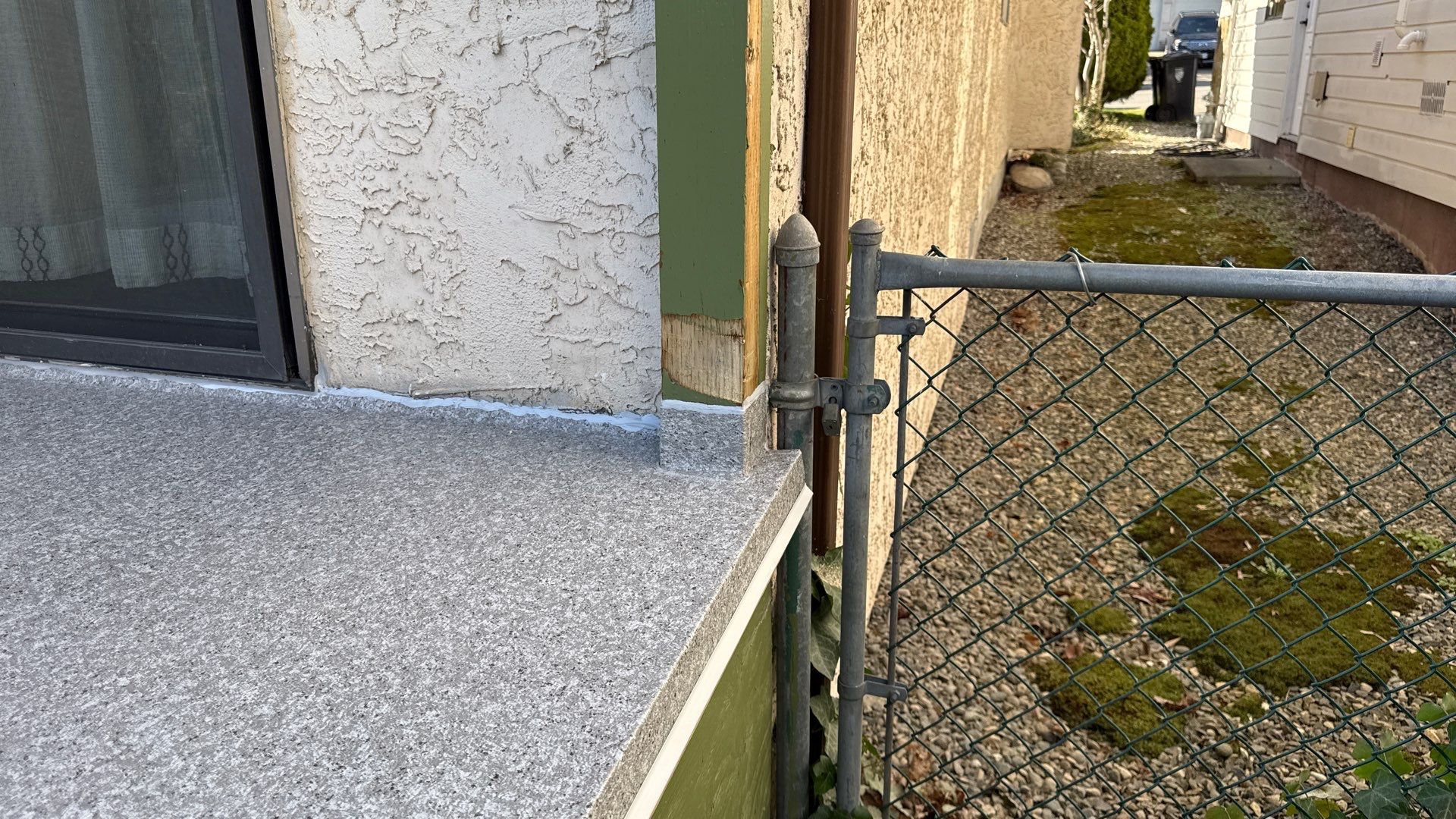
- Check the seal where the deck meets the wall, the door threshold, and the base of each railing post.
- If any of those raise a question, book an assessment rather than a repair. You cannot price a fix you have not measured.
A spongy deck is not proof of a failed membrane, and it is not a reason to panic. It is a reason to look underneath.
Frequently Asked Questions
How do you tell if your deck is rotting?
Check for three things: areas that feel soft or spongy underfoot, a musty smell near the deck or the room below, and staining on the soffit or ceiling underneath. On a vinyl deck the surface often looks perfect while the plywood below decays, so the underside is the more reliable place to look.
Why does my deck feel bouncy?
Bounce across a whole deck is usually joist span or spacing, a framing characteristic rather than water damage. Rot feels different. It is localised softness that compresses underfoot in one spot, typically near a wall, door, drain or railing post. Uniform springiness points to framing. Local sponginess points to moisture.
Can you fix a spongy vinyl deck without replacing it?
Only after an assessment. If the sponginess is wet but sound plywood caught early, the repair can be limited to the entry point and the affected area. If the sheathing has decayed, no surface repair will hold, because a new membrane bonded to rotten plywood fails at the substrate. Measure before pricing.
How long does a vinyl deck membrane last?
A properly installed vinyl membrane commonly lasts 15 to 25 years, and Valordek warrants both of its membranes for 15 years of waterproofing plus 5 years of appearance. Substrate rot is almost never caused by the membrane wearing out. It is caused by an unrepaired termination detail.
Does water under a vinyl deck dry out on its own?
No. A vinyl membrane is non-porous, so it functions as a vapour barrier. Water that gets beneath it has no path to evaporate and the plywood stays at a moisture content where decay continues. This is the reason a small unrepaired leak can cause structural damage while the deck surface still looks new.
What moisture reading indicates a problem in deck plywood?
Sound construction plywood typically reads around 12 to 14 percent moisture content. Sustained readings well above that range indicate active wetting rather than normal seasonal variation. A single high reading after heavy rain is less meaningful than a consistently elevated one in the same location.