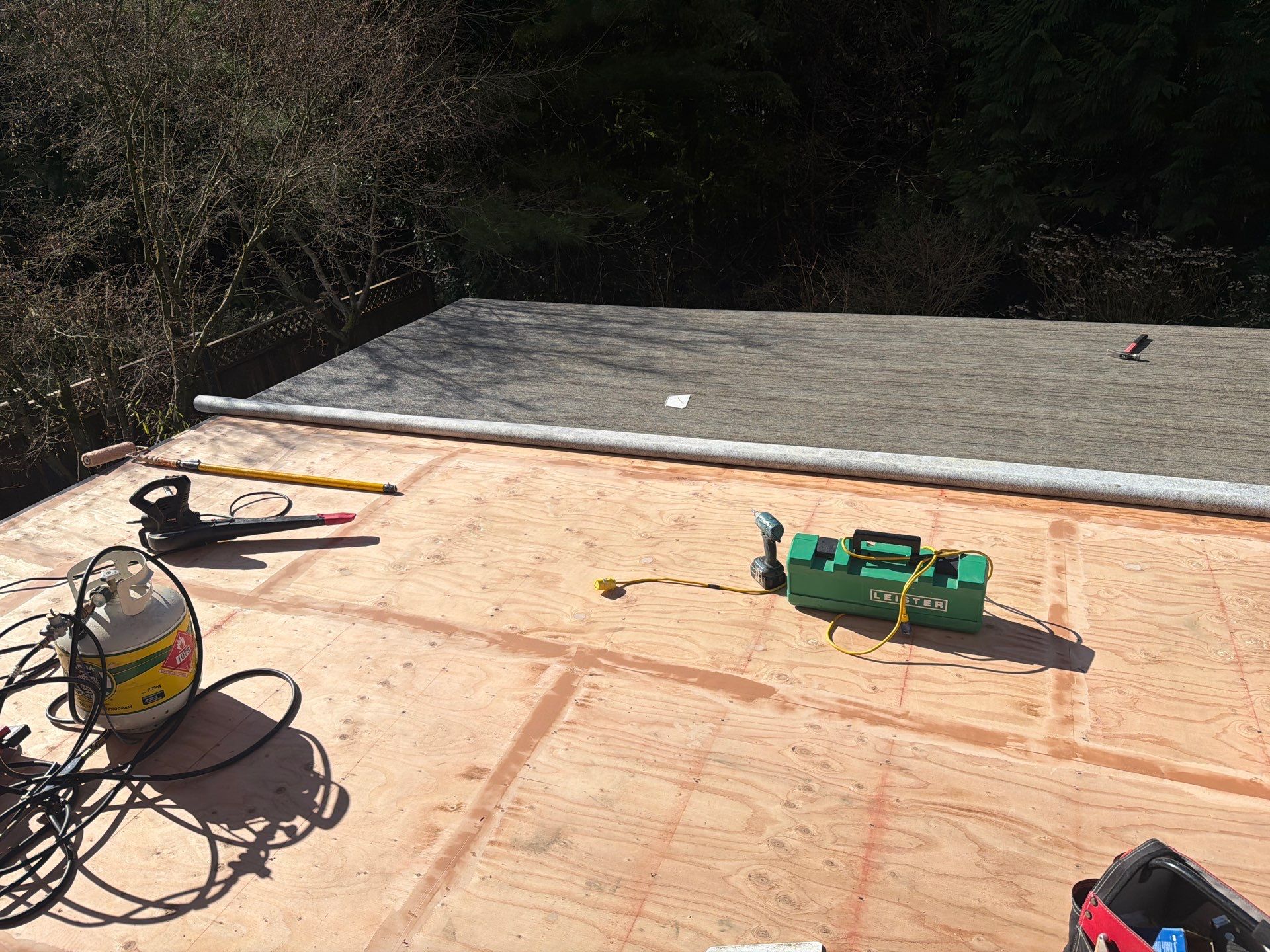
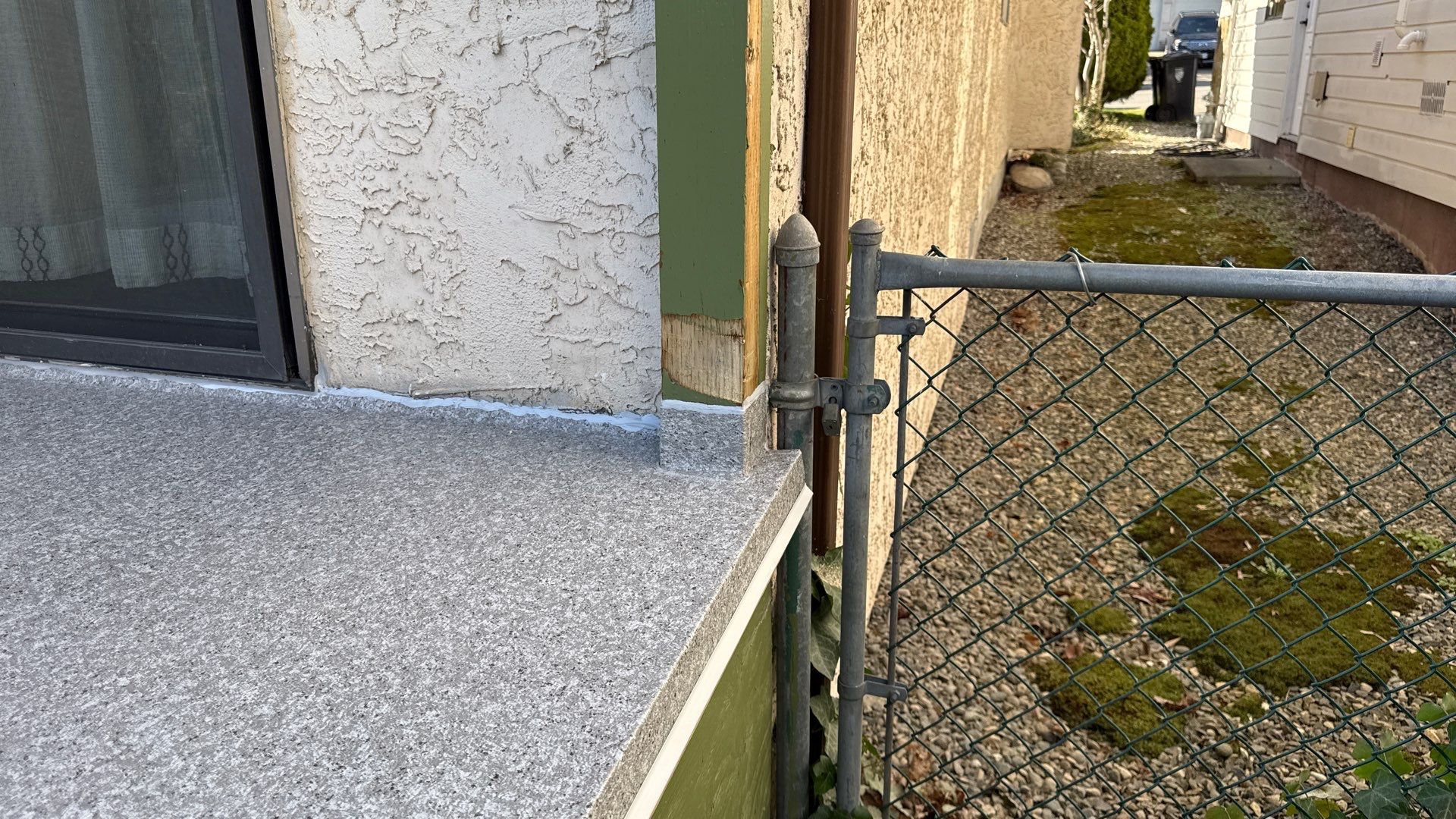
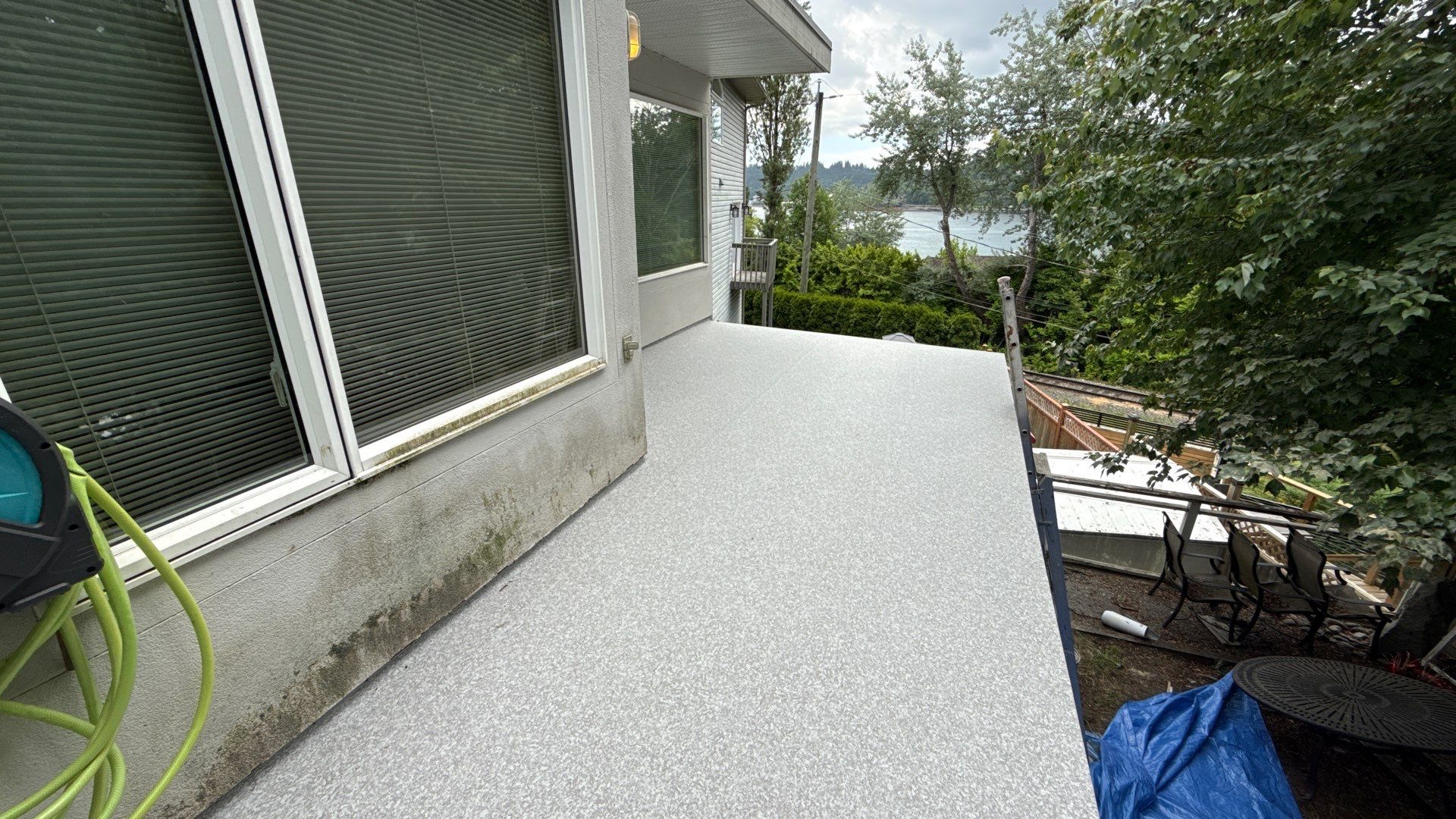
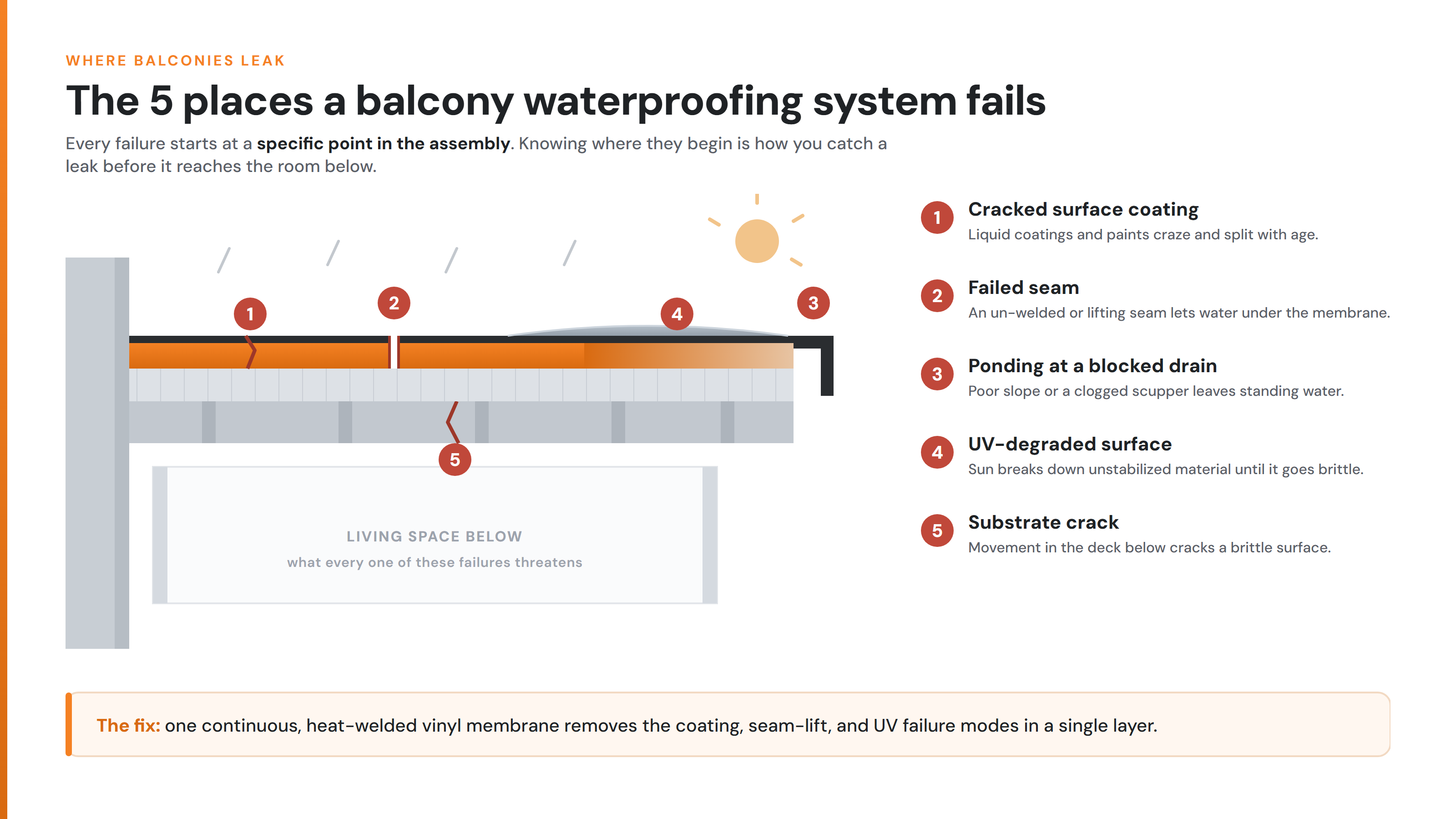
Most balcony leaks trace back to five common waterproofing failures: cracked coatings, failed seams, poor drainage, UV degradation, and substrate movement. According to building envelope research, water infiltration causes over 75% of all building envelope warranty claims in coastal climates. Every one of these failures is preventable with the right vinyl deck membrane system.
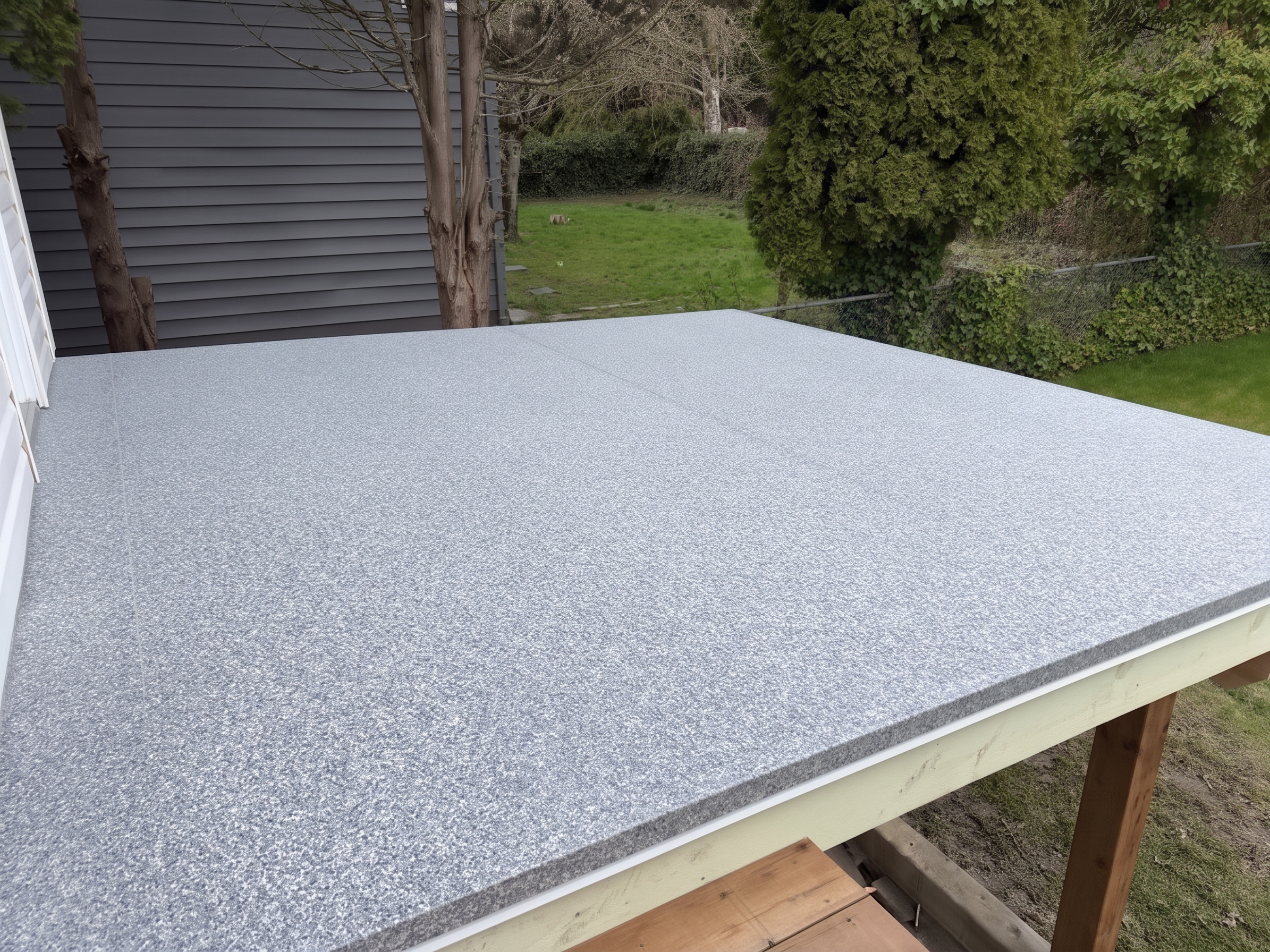
Why Balcony Leaks Are More Serious Than They Look
Water infiltration through a balcony surface causes an average of $3,000 to $10,000 in remediation costs per affected unit in multi-family buildings, according to restoration industry estimates. That figure does not include the waterproofing repair itself. It covers only the damage that the leak leaves behind.
A small puddle on your balcony might not seem urgent. But water on a balcony does not just sit on the surface. It finds every crack, seam, and gap in the waterproofing and travels downward into the structure below.
That is what makes balcony waterproofing different from ground-level decking. Your balcony sits above something: a living room, a bedroom, a carport, a walkway. When waterproofing fails, the damage goes vertical.
Structural damage compounds quickly. According to the National Research Council of Canada, prolonged moisture exposure in wood-frame assemblies can reduce structural load capacity by 20% or more within 5 years. Plywood substructures absorb water, swell, delaminate, and eventually rot. By the time you see a stain on the ceiling below, the substructure has often been deteriorating for months.
Mould becomes a health issue. Trapped moisture between the balcony membrane and the ceiling below creates ideal conditions for mould growth. Health Canada classifies indoor mould exposure as a respiratory health hazard, and mould remediation in a single unit typically runs $3,000 to $10,000 before addressing the waterproofing failure that caused it.
Liability escalates in multi-family properties. If you are a property manager or strata council member, a balcony leak is not just a maintenance ticket. It is a potential liability issue affecting the unit below, common areas, and building insurance. For the rules on who is responsible in a BC strata, see our guide to strata balcony waterproofing in BC. The longer the leak goes unaddressed, the larger the claim.
The takeaway: a $500 problem this year becomes a $15,000 problem in three years if left unaddressed. The five failure modes below explain exactly why balconies leak and how to identify which one is affecting yours.
1. Cracked or Deteriorated Coatings
Deck paints and elastomeric coatings are the most common first-time waterproofing solutions, and they fail within 3 to 5 years in Canadian climates with freeze-thaw cycles. Building science research consistently shows that thin-film coatings on exterior horizontal surfaces have the shortest service life of any waterproofing method.
These coatings are inexpensive, easy to apply, and widely available at hardware stores. They are also the most frequent failure point on aging balconies.
Why it fails: Coatings are thin film systems, typically 10 to 20 mils thick. They bond to the substrate surface but lack the structural thickness to bridge cracks that develop as the substrate shifts with temperature changes. Acrylic and elastomeric coatings lose elasticity as UV radiation breaks down the polymer chains. Once the coating cracks, water has a direct path to the substrate.
How to spot it: Look for hairline cracks in the surface, especially at inside corners, along edges, and around drain locations. Peeling, flaking, or chalking on the surface are late-stage signs. If you can scrape the coating off with a fingernail, it has already lost adhesion.
2. Failed Seams and Joints
Seam failures account for roughly 35% of all waterproofing callbacks on balcony projects, according to construction industry data. Any waterproofing system with seams is only as strong as its weakest joint.
Sheet membranes applied with adhesive tape, caulked joints, and overlap seams that rely on sealant all share the same vulnerability: the seam is a different material than the membrane, and it ages differently.
Why it fails: Temperature cycling is the primary driver. A balcony surface in direct sun can reach 60 to 70 degrees Celsius in summer and drop below -20 degrees Celsius in winter. That thermal movement repeatedly stresses seam connections. Adhesive-based seams have a finite number of expansion cycles before they fail. Sealants dry out. Adhesive tapes lose bond strength. Overlap joints peel back when exposed to standing water.
How to spot it: Run your fingers along all seams and edges. If you can lift the edge of a membrane or feel a gap at a joint, water is getting through. Bubbling or ridging along seam lines is another indicator. Pay particular attention to wall-to-floor transitions, drain collars, and railing post penetrations. These are the highest-stress joints on any balcony. The wall transition is the most commonly traced origin of the three, and where deck leaks actually start explains how that detail fails and what a correct one looks like. Post penetrations are the second most common, and they announce themselves differently: why balconies leak around railing posts covers the rust streaks and sealant cracks that give them away.
3. Inadequate Drainage and Standing Water
The International Building Code requires a minimum slope of 2% (1/4 inch per foot) for waterproof deck surfaces, yet many balconies either were not built to this standard or have settled over time. Standing water is the number one amplifier of every other failure mode on this list, which is why proper deck drainage matters as much as the membrane itself.
Water that does not drain is water that finds a way through. Flat or poorly sloped balconies allow water to pond after rain, accelerating the deterioration of every waterproofing material it contacts.
Why it fails: Ponded water increases hydrostatic pressure on the membrane surface. Even waterproof materials can allow moisture vapour transmission under sustained hydrostatic load. More practically, standing water accelerates UV degradation (acting as a lens), promotes algae growth that deteriorates coatings, and freezes in winter. Ice expansion exerts approximately 30,000 psi of pressure, enough to crack any rigid waterproofing material.
How to spot it: After a rainstorm, walk your balcony and look for areas where water collects and does not drain within 48 hours. Check that scuppers and drains are clear of debris. If you see algae growth, dark staining, or mineral deposits in specific areas, those are chronic ponding zones.
4. UV Degradation of Non-UV-Resistant Materials
Research from the National Institute of Standards and Technology (NIST) shows that non-UV-stabilized PVC loses up to 40% of its tensile strength after just 3 years of direct sun exposure. Ultraviolet radiation is the silent killer of balcony waterproofing because, unlike rain and temperature, UV damage is cumulative and invisible until the material fails.
Rubber membranes, bituminous (tar-based) products, and generic PVC sheets without UV stabilizers all break down under sustained sun exposure. South-facing and west-facing balconies receive the highest UV loads.
Why it fails: UV radiation breaks molecular bonds in polymer materials. Without UV stabilizers and screening compounds built into the material at the manufacturing stage, the surface degrades from the top down. You will see chalking, colour fade, and surface crazing before the material eventually cracks through its full thickness.
How to spot it: Check the balcony surface in areas that receive the most direct sunlight. If the surface colour has faded significantly compared to shaded areas, or if the material feels chalky or powdery to the touch, UV degradation is underway. Brittleness is the final stage before cracking.
5. Substrate Movement and Settling
Buildings settle an average of 5 to 10 millimetres in the first 5 years after construction, according to structural engineering data, and that movement is enough to crack any rigid waterproofing material bonded to the surface. This failure mode is especially common in new construction and in older buildings where foundation shift has created uneven planes across the balcony.
Wood framing shrinks as it dries. Concrete settles unevenly. Temperature changes cause expansion and contraction across every material in the assembly.
Why it fails: Rigid coatings and cementitious waterproofing systems cannot accommodate substrate movement. A crack in the substrate becomes a crack in the waterproofing. Even small movements of 1 to 2 millimetres are enough to fracture thin-film coatings and rigid membranes.
How to spot it: Look for cracks that follow a straight line across the balcony surface, often running parallel to the building wall or perpendicular to the longest dimension. These are structural cracks caused by substrate movement, not surface wear. If you see a crack in the waterproofing that aligns with a crack in the concrete or plywood below, substrate movement is the root cause.
Signs Your Balcony Waterproofing Needs Replacement
Not sure whether your balcony needs a patch or a full replacement? Use this checklist. If you check three or more items, it is time to replace the waterproofing system entirely rather than attempt another repair.
- Water stains or dampness on the ceiling below the balcony
- Visible cracks in the surface coating or membrane
- Peeling, bubbling, or delamination at edges or seams
- Standing water that does not drain within 48 hours after rain
- Surface feels chalky, powdery, or brittle in sun-exposed areas
- Mould or musty smell in the room directly below the balcony
- Existing waterproofing is more than 5 years old (for coatings) or more than 10 years old (for membranes)
- Previous patch repairs have failed or leaks have returned
- Soft spots in the plywood substrate when you walk on it
If the substrate itself is compromised (soft, spongy, or visibly rotted), you will need substrate repair before any new waterproofing system can be installed. A qualified contractor can assess substrate condition and recommend whether partial or full replacement is needed. If you are weighing a repair against a full redo, our guide on resurfacing versus replacing a deck walks through the decision.
Why Vinyl Membrane Solves These Five Failures
Each of the failure modes above points to a specific material limitation that vinyl deck membrane is engineered to address. Here is how vinyl membrane handles each one.
Continuous waterproof surface with no gaps. Unlike coatings that rely on thin-film adhesion, vinyl membrane is a sheet system that covers the entire balcony surface as a continuous waterproof layer. There are no gaps, joints, or exposed substrate areas where water can penetrate.
Heat-welded seams that become one piece. Valordek vinyl uses hot-air welding to fuse seams on the Smooth-Back (60mil) product line. The welded joint is the same PVC material as the membrane itself, which means it shares the same lifespan, flexibility, and UV resistance. Unlike adhesive tape or caulk joints, a heat-welded PVC seam does not degrade separately from the membrane. According to PVC welding industry data, properly heat-welded PVC seams retain over 95% of the parent material's tensile strength.
UV-stabilized PVC rated from -40 degrees C to 80 degrees C. Valordek vinyl is manufactured with UV screens and stabilizers built into the PVC compound, not applied as a surface treatment. This means UV protection extends through the full thickness of the material. The -40 to 80 degree Celsius operating range covers the full spectrum of Canadian climate conditions.
Flexible material that moves with the substrate. At 60 to 68 mil thickness, vinyl membrane has enough structural body to bridge minor substrate cracks while maintaining the flexibility to accommodate thermal expansion and building settling. Where rigid coatings crack, vinyl flexes.
Integrated drainage compatibility. Vinyl membrane works with PVC-coated scuppers, drains, and overflow drains that are welded directly into the membrane surface. These are not add-on accessories sealed with caulk. They are integrated into the waterproof envelope using the same heat-welding technique as the seams. This is the standard approach for vinyl decking on balconies over living space.
Comparing Balcony Waterproofing Methods
| Feature | Vinyl Membrane | Liquid Coating | Rubber (EPDM) Membrane | Torch-On (Modified Bitumen) |
|---|---|---|---|---|
| Lifespan | 15 years (warranted) | 3 to 5 years | 10 to 20 years | 15 to 25 years |
| Waterproofing quality | Excellent. Continuous sheet, heat-welded seams | Fair. Thin film, cracks over time | Good. Sheet system, adhesive seams | Good. Fused layers, heavy |
| UV resistance | High. Stabilizers built into PVC | Low to moderate. Degrades in 2 to 4 years | Low. Requires protective UV coating | Moderate. Granule surface provides some protection |
| Material cost | Starting at $3.74/sq ft | $1 to $3/sq ft | $3 to $6/sq ft | $4 to $8/sq ft |
| Aesthetics | Wood-look, stone-look, classic patterns (12 colours) | Paint-like finish, limited options | Black or grey, utilitarian | Black or grey, industrial |
| DIY-friendly | Yes (Fuzzy-Back, adhesive-applied) | Yes | Moderate (large heavy sheets) | No. Open flame, professional only |
| Fire rating | Class A and C available (Smooth-Back) | Not typically rated | Not typically rated | Class A available |
| Seam integrity | Heat-welded (permanent, 95%+ tensile strength) | No seams (single coat) | Adhesive or tape (weakest point) | Torch-fused (good but rigid) |
| Flexibility | High. Accommodates substrate movement | Low. Cracks with movement | High. Very elastic | Low to moderate. Stiffens in cold |
For a deeper look at one of these alternatives, see our vinyl vs rubber deck membrane comparison.
How to Choose the Right Waterproofing Solution
The right choice depends on three factors: how long you need the solution to last, your budget, and whether aesthetics matter.
If you need a long-term fix (10+ years): Vinyl membrane or torch-on bitumen are your strongest options. Vinyl offers better aesthetics and flexibility at a lower material cost ($3.74/sq ft versus $4 to $8/sq ft). Torch-on is more common on large commercial flat roofs but requires professional installation with an open flame, which is not suitable for all balcony situations, particularly in multi-family buildings.
If you are on a tight budget: Liquid coatings are the lowest upfront cost at $1 to $3/sq ft, but expect to reapply every 3 to 5 years. Over a 15-year period, the total cost of three to five coating applications typically exceeds the one-time cost of a vinyl membrane installation. You can compare the numbers with our cost calculator and the full vinyl decking cost guide. The math favours vinyl after the second recoating cycle.
If aesthetics matter: Vinyl membrane is the only waterproofing method that doubles as a finished walking surface with decorative patterns. Valordek offers 12 colours across Wood Look, Stone Look, and Classic style lines, and you can preview any of them on your own deck or browse the range on the products hub. Every other option on this list either looks utilitarian (rubber, torch-on) or requires a separate finish layer over top.
If you want to do it yourself: Valordek Fuzzy-Back (68mil) vinyl membrane is designed for adhesive application by homeowners with basic tools. The substrate must be clean, dry, and in good condition (5/8 tongue-and-groove plywood or untreated concrete). Liquid coatings are also DIY-friendly. Torch-on and heat-welded membranes require professional installation. Valordek Smooth-Back (60mil) uses hot-air welding and should be installed by an authorized dealer.
Frequently Asked Questions
How do I know if my balcony is leaking?
The most reliable sign is water staining or dampness on the ceiling directly below the balcony. Other indicators include a musty smell in the room below, peeling paint on the underside of the balcony structure, and visible mould growth. According to the Insurance Bureau of Canada, water damage is the leading cause of home insurance claims nationally, and slow balcony leaks are a common contributor. If you suspect a slow leak, place a piece of plastic sheeting on the ceiling below and check it after the next rainstorm.
Can I waterproof my balcony myself?
Yes, depending on the system you choose. Adhesive-applied vinyl membranes like Valordek Fuzzy-Back (68mil) are designed to be DIY-friendly for homeowners with basic tool skills. Liquid coatings are also simple to apply. Heat-welded membrane systems and torch-on applications require professional installation. If your plywood substrate needs repair or replacement, hiring a contractor is recommended regardless of the waterproofing method. Valordek vinyl membrane starts at $3.74/sq ft for the material.
How much does it cost to fix a leaking balcony?
Costs depend on the extent of damage. A vinyl membrane replacement on a 100 sq ft balcony with a sound substrate runs approximately $800 to $1,500 in materials (Valordek vinyl starts at $3.74/sq ft plus adhesive, trim, and accessories). Professional labour adds $500 to $2,000 for a standard balcony. If the substrate needs repair, add $1,500 to $5,000 depending on the scope. The most expensive scenario involves a leak that has been ignored for years, requiring substructure replacement, mould remediation, and interior repairs, which can reach $15,000 to $25,000. Estimate your own project with the cost calculator.
What is the best waterproofing for a balcony?
For balconies above living space in Canadian climates, vinyl deck membrane offers the strongest combination of waterproofing performance, UV resistance, flexibility, and aesthetics. Valordek vinyl is CCMC-approved, Intertek-tested, and exceeds code standard 37.54.95. The key advantages are continuous coverage with no gaps, heat-welded seams that maintain 95%+ tensile strength, UV-stabilized PVC rated from -40C to 80C, and flexibility that handles freeze-thaw cycles without cracking.
How long does balcony waterproofing last?
Lifespan depends entirely on the material. Liquid coatings last 3 to 5 years before reapplication. Rubber (EPDM) membranes last 10 to 20 years depending on UV exposure. Valordek vinyl deck membranes carry a 15-year waterproofing warranty (both Fuzzy-Back, 68mil, and Smooth-Back, 60mil), plus 5 years of appearance coverage on both lines, as detailed in our warranty. Torch-on modified bitumen lasts 15 to 25 years on flat surfaces. For the full breakdown, see how long vinyl decking lasts. Annual inspection extends the service life of every waterproofing system.