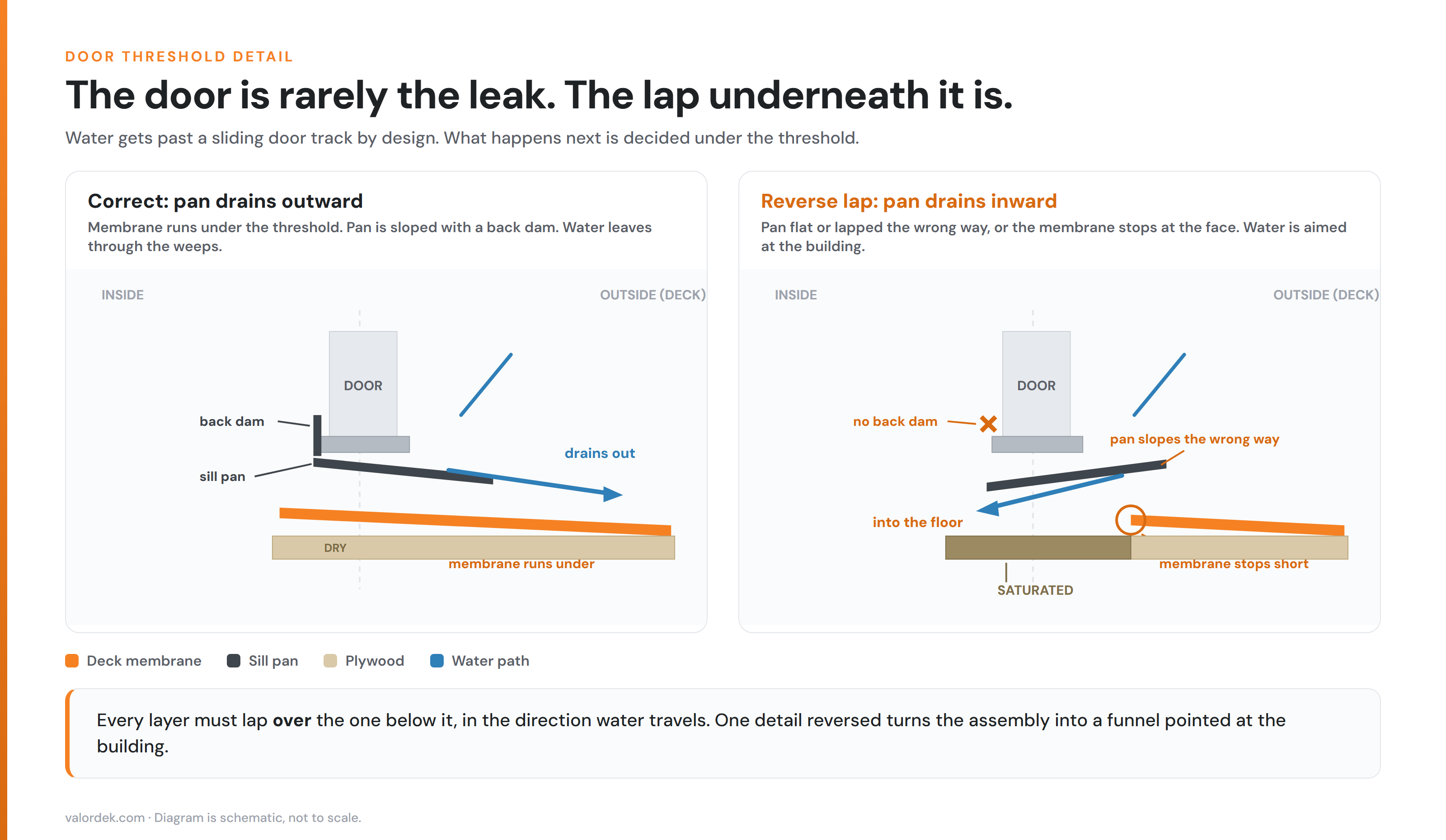
A balcony that leaks at the sliding door is usually not leaking through the door. It is leaking under the threshold. Water passes the door track by design, and a waterproof sill pan beneath it is supposed to catch that water and drain it back outside. When the pan is missing, unsloped, or lapped the wrong way, the water goes into the floor instead. The door can be in perfect condition throughout.
This matters because the wrong diagnosis is expensive. Homeowners replace a patio door, the leak continues, and only then does anyone lift the threshold. The door is the visible thing at the scene, so it gets blamed. In reality the door threshold is one of the three places balcony leaks reliably begin, alongside the wall termination and railing post penetrations, and it is the hardest of the three to diagnose from above. The membrane can be sound and the door can be new while a detail you cannot see quietly drains into the room below.
Why is water coming in under my door?
Sliding doors are not watertight, and they are not designed to be. Wind-driven rain gets past the outer track on almost every patio door ever made. That is expected behaviour, which is why the assembly underneath is what actually keeps water out of the building.
A correctly built threshold has three parts working together:
- The deck membrane, which continues under the door rather than stopping at the front face of the threshold.
- A sill pan, a waterproof tray under the door with upturned edges at the back and sides, sloped so that anything landing in it runs outward.
- Weep holes in the door track that let water in the track escape to the outside.
Water gets in, lands in the pan, and leaves through the weeps and over the membrane. When all three are right, a door that lets water past its track still never wets the structure. When any one of them is wrong, that same ordinary amount of water ends up in the plywood.
The four ways a door threshold fails
Nearly every door-threshold leak traces to one of four details, and none of them is the door itself.
| Failure | What went wrong | Typical symptom |
|---|---|---|
| No sill pan | Door set directly on sheathing with sealant only | Flooring swells or discolours just inside the door |
| Membrane stops short | Membrane terminated at the face of the threshold instead of continuing under it | Staining on the ceiling below, close to the wall line |
| Reverse lap | Membrane tucked over the pan so water is directed inward rather than out | Leaks only in wind-driven rain, then stops |
| No slope or no back dam | Pan is flat or lacks an upturn, so water sits and wicks inward | Persistent damp at the threshold after every rain |
The reverse lap deserves particular attention because it is invisible and it is common. Waterproofing works on the same principle as roof shingles: every layer must lap over the one below it, in the direction water travels. A single detail lapped the wrong way turns the whole assembly into a funnel pointed at the building. The same mistake at the wall is the leading cause of balcony leaks generally, which we cover in where vinyl deck leaks actually start.
Where are the weep holes on a sliding door, and should I seal them?
Weep holes are small slots along the outer edge of the bottom door track, and sealing them is one of the most damaging things you can do to a leaking door. They are the drain. Closing them turns the track into a reservoir.
This is worth stating plainly because it is such a common reaction. A homeowner sees water at the door, runs a bead of sealant along the outside of the threshold, and the leak gets worse. The sealant blocked the path water was using to get out, so the water backed up and found the next available route, which is into the floor. If you take one practical thing from this article: never caulk across the front of a door threshold or over its weep holes.
To find them, look along the outside face of the bottom track for small rectangular slots, usually two or three. Clear them gently with a thin plastic tool. Debris, moss and old sealant are frequent culprits, and clearing blocked weeps is a genuine fix that costs nothing.
Is it the door or the threshold? How to tell
The pattern of the leak tells you more than the location of the water. Before paying for a door, run through these.
- Does it only leak in wind-driven rain? That points to the pan or lap detail. Straight vertical rain rarely overwhelms a functioning threshold assembly.
- Does the water appear inside while the deck surface stays dry? That is a threshold assembly problem, not a membrane field problem.
- Is there staining on the ceiling below, near the wall? Water is getting past the threshold and into the structure, not just onto the floor.
- Do the weep holes drain? Pour a cup of water into the outer track. If it does not run out within a minute, they are blocked.
- Is the door itself hard to operate, or is the frame visibly distorted? Only then is the door a serious suspect.
If questions one to four point at the threshold and the door still operates normally, replacing the door will not stop the leak. It is the most expensive way to test the wrong hypothesis.
Why this one is the hardest to catch
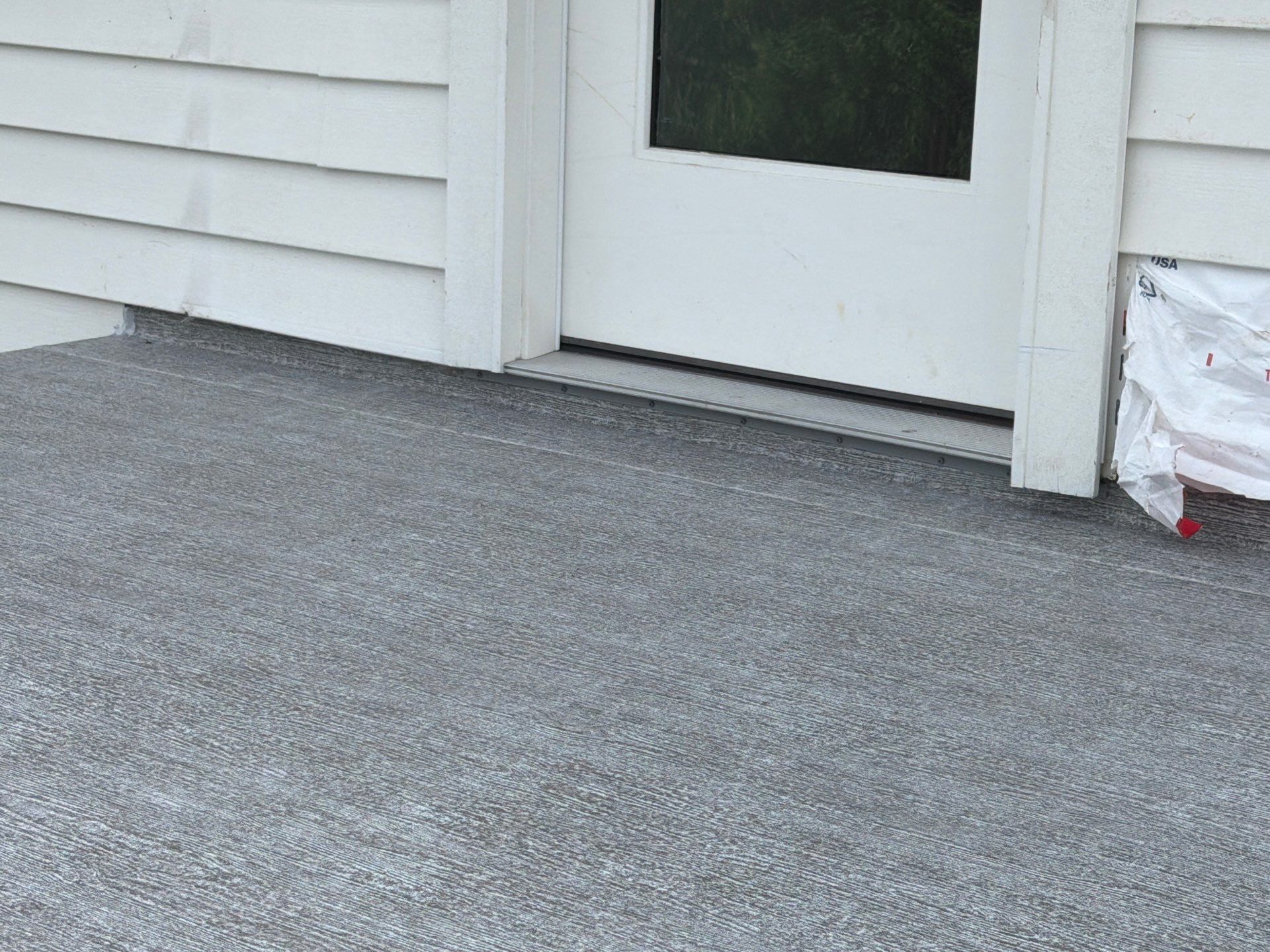
A door threshold leak can run for years without producing a single visible sign on the deck. The membrane looks perfect because it usually is perfect. The damage is happening under the door, in the band of sheathing between the threshold and the deck, and often into the floor structure of the room inside.
That combination, an intact surface hiding a wet substrate, is what makes this failure expensive by the time it is found. A vinyl membrane is non-porous, so the wood underneath cannot dry once water reaches it. Our guide on how to tell if there is rot under your membrane covers the signals worth checking if you suspect the leak has been running a while, particularly softness underfoot near the door and staining on the ceiling below.
Multi-unit buildings feel this hardest, because the water shows up in someone else's home. Documented cases in the industry describe entire lower-floor rooms damaged from door-pan failures on the balcony above, with the balcony surface never showing a mark.
What a proper repair involves
A door threshold leak cannot be fixed with sealant from outside. Sealant on the exposed face treats the symptom and blocks the drainage path. A real repair rebuilds the assembly in the correct order.
- Lift the threshold. The door or its sill is removed so the detail underneath can be seen. Everything before this step is guesswork.
- Assess the sheathing. Wet or decayed plywood is replaced. Bonding a new membrane to compromised substrate fails at the substrate.
- Install or rebuild the pan. A proper sill pan with a back dam, end dams, and slope toward the outside.
- Carry the membrane under the threshold. The deck membrane continues beneath the door and laps correctly with the pan so water always travels outward.
- Reset the door and leave the weeps clear. Sealant belongs at the jambs and back dam, never across the front of the track.
This is detail work, and it is the part of a deck installation where experience shows. If you are having a deck built or replaced, the threshold detail is a fair thing to ask a contractor to explain before you sign. The railing post penetration is the other detail worth asking about, for the same reason.
Preventing it on a new deck
Valordek balcony installations use a 68mil fleece-backed membrane bonded to the substrate and carried through the threshold detail rather than stopped at it. The membrane carries a 15-year waterproofing warranty plus 5-year appearance coverage, and the system is CCMC evaluated and Intertek tested. Materials start at $3.74 per square foot.
What actually determines whether a threshold leaks, though, is the detailing rather than the material. That is why installation matters as much as the product, and why the installation process spends as much time on terminations as on the field of the deck. For the wider picture of what makes balconies fail, see common balcony waterproofing failures and our vinyl decking systems overview.
Frequently Asked Questions
How do I stop water from coming under my sliding glass door?
First check that the weep holes in the outer track are clear, because blocked weeps are the most common and cheapest cause. If they drain freely and water still enters, the problem is the sill pan or membrane under the threshold, which requires lifting the threshold to repair. Do not seal across the front of the track.
Why is water coming in under my door?
Sliding doors are not watertight by design. Wind-driven rain passes the outer track and is meant to be caught by a sloped sill pan and drained back outside through weep holes. Water reaches the floor when that pan is missing, flat, lacks a back dam, or is lapped so it directs water inward instead of out.
Where are the weep holes located on a sliding door?
Weep holes are small rectangular slots along the outside face of the bottom track, usually two or three per door. Test them by pouring a cup of water into the outer track. If it does not drain within about a minute, they are blocked with debris, moss or old sealant and should be cleared.
Can I just caulk the bottom of my sliding door?
No. Sealing across the front of a threshold blocks the weep holes that drain the track, so water backs up and finds its way into the floor instead. This is a frequent reason a minor door leak becomes a structural repair. Sealant belongs at the jambs and back dam, not across the drainage path.
How do I know if it is the door or the waterproofing?
If the leak only appears in wind-driven rain, the deck surface stays dry, and the door still operates normally, the threshold assembly is the likely cause rather than the door. Staining on the ceiling below near the wall line confirms water is entering the structure and not simply pooling on the floor.
How much does it cost to fix a leaking door threshold?
Clearing blocked weep holes costs nothing. Rebuilding a sill pan and threshold detail is a contained repair when the sheathing is still sound. Cost rises sharply once the plywood or floor framing has decayed, which is why a threshold leak is worth diagnosing early rather than sealing over.