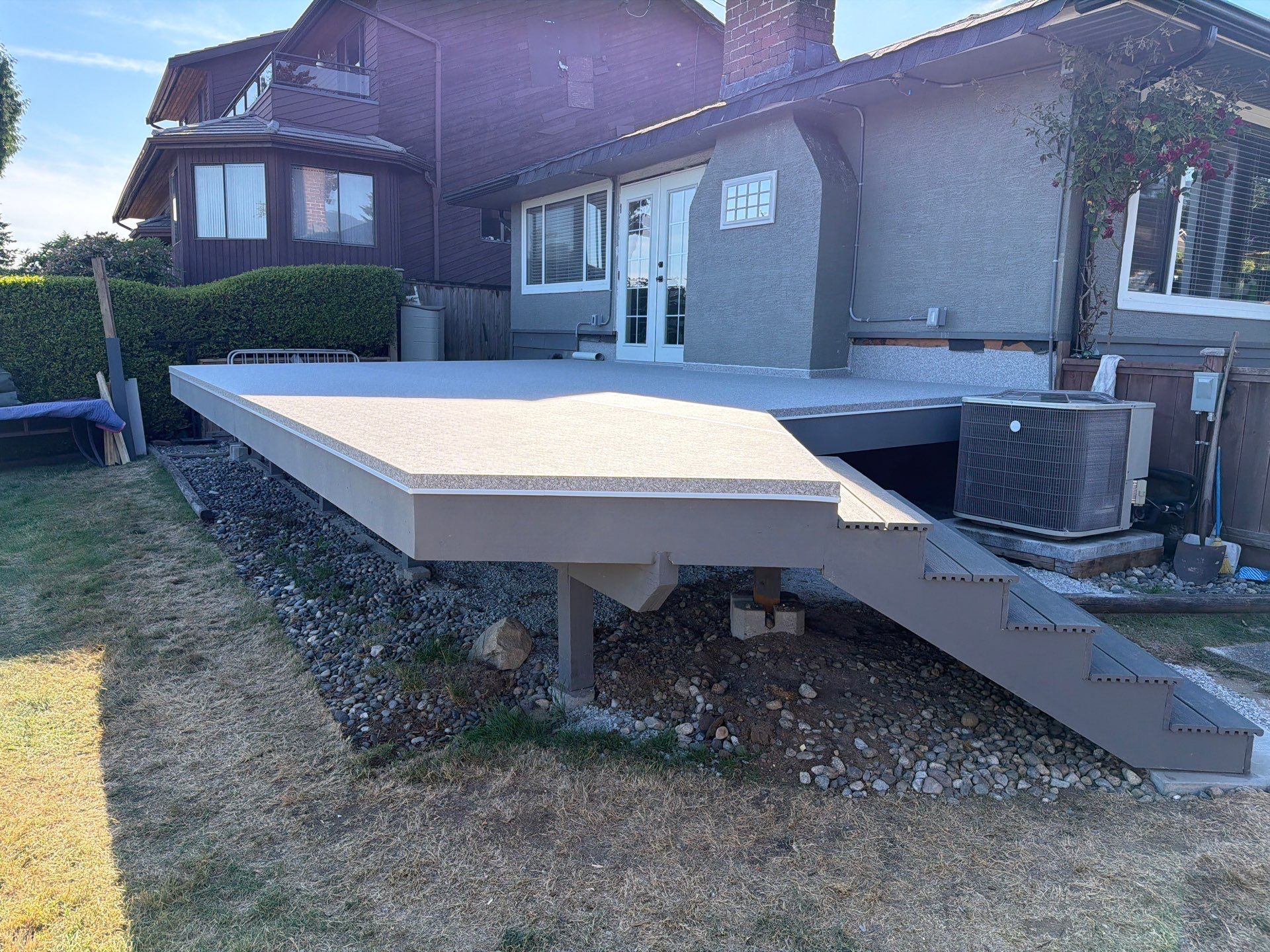
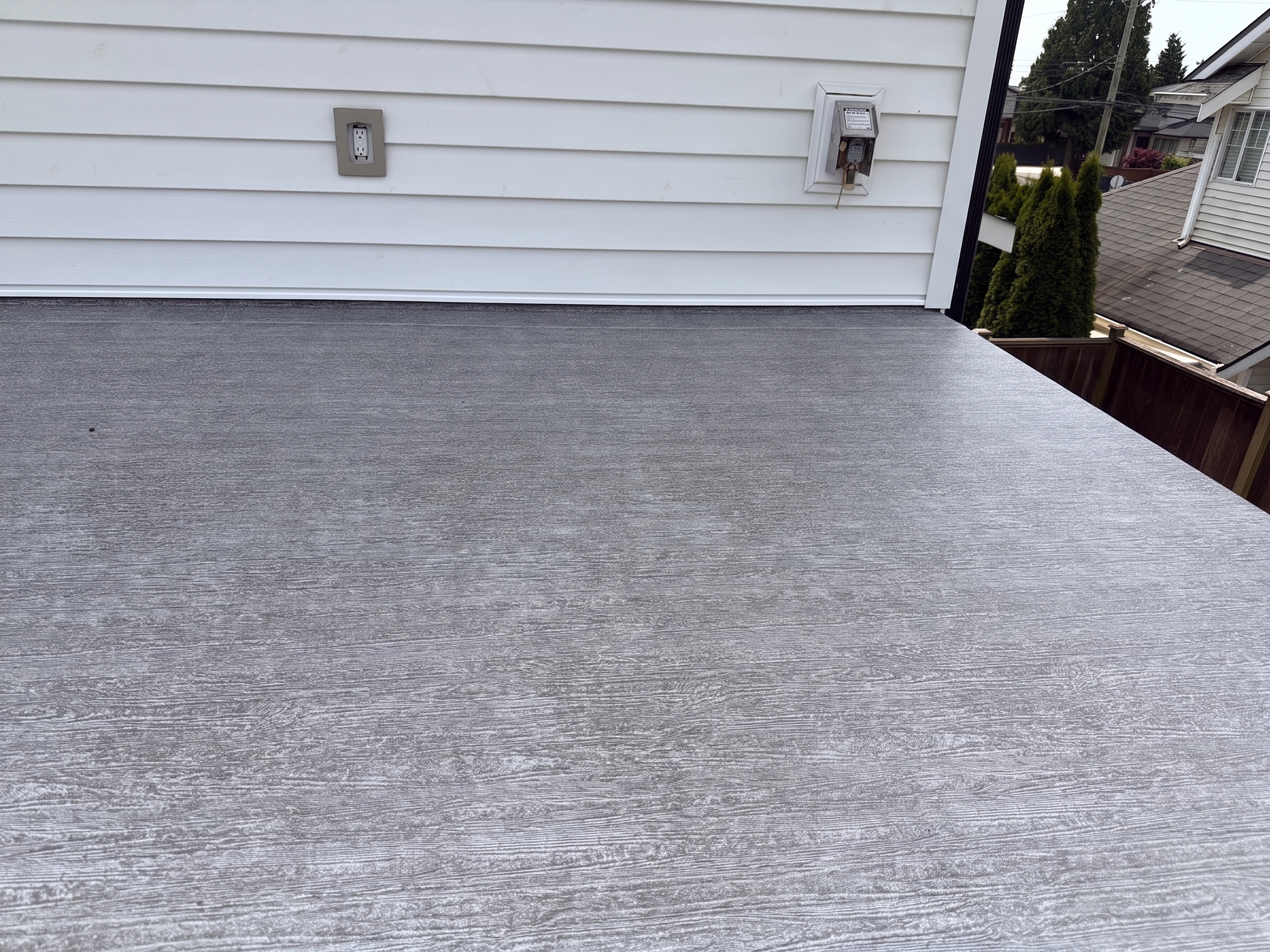
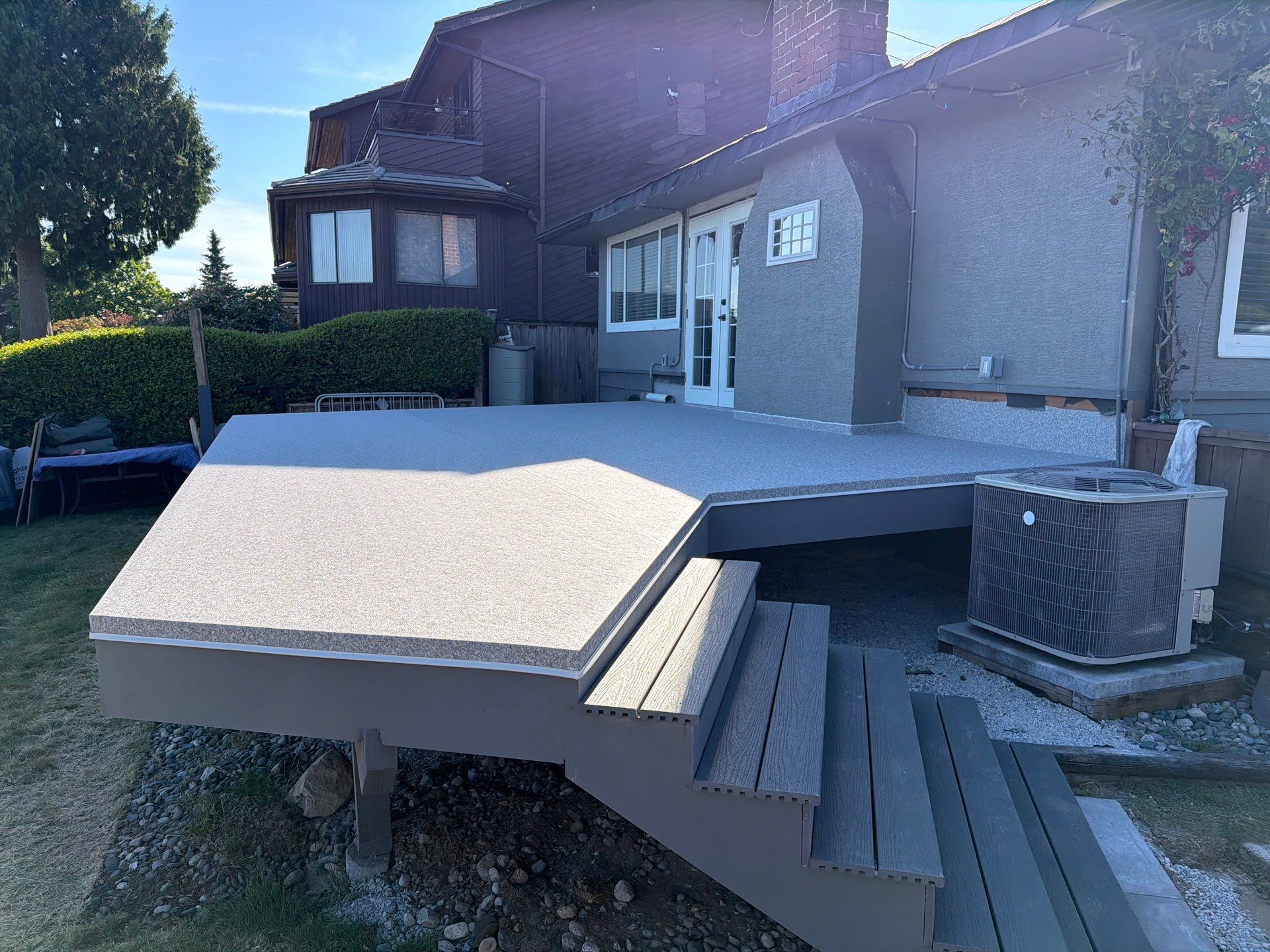
Most bubbling in a new vinyl deck is adhesive off-gassing, and on a Valordek install it flattens on its own within about two weeks. Wrinkles that appear in afternoon heat and lie flat again as the deck cools are normal thermal movement. Bubbles that keep growing, or wrinkles still there when the deck is cool, point to an installation defect.
That distinction matters more than it sounds. A homeowner who panics at week one and starts cutting into a healthy membrane creates the problem they were afraid of. A homeowner who waits six months on a bubble that is actually trapped moisture lets the substrate underneath keep getting wetter. The mechanism under the surface is what separates the two cases, and you can usually identify it without any tools at all. Valordek membranes are rated for service from -40°C to 80°C and carry a 15-year waterproofing warranty, so a correctly installed deck has considerable margin before heat becomes a genuine problem.
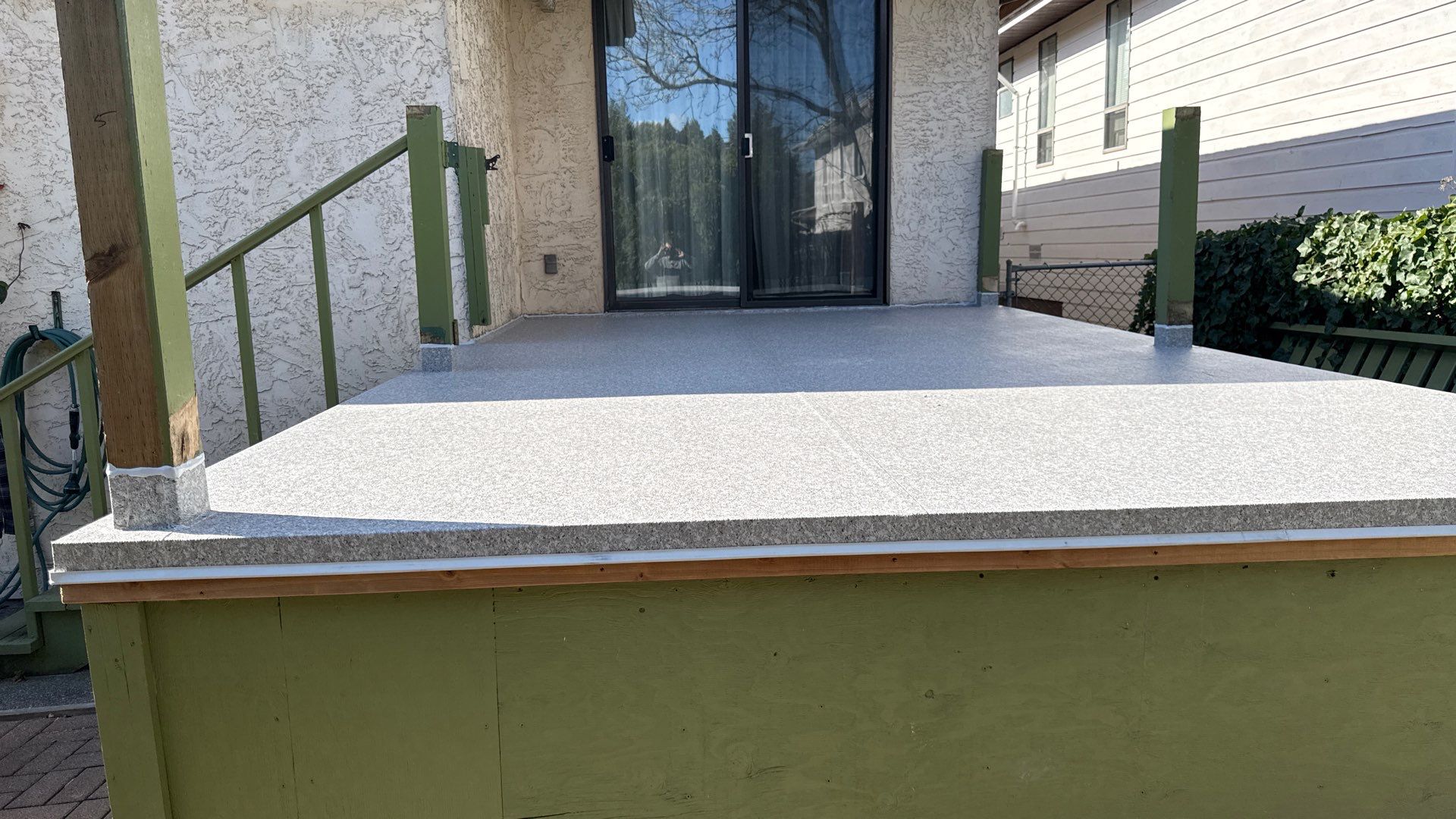
Is bubbling in a new vinyl deck normal?
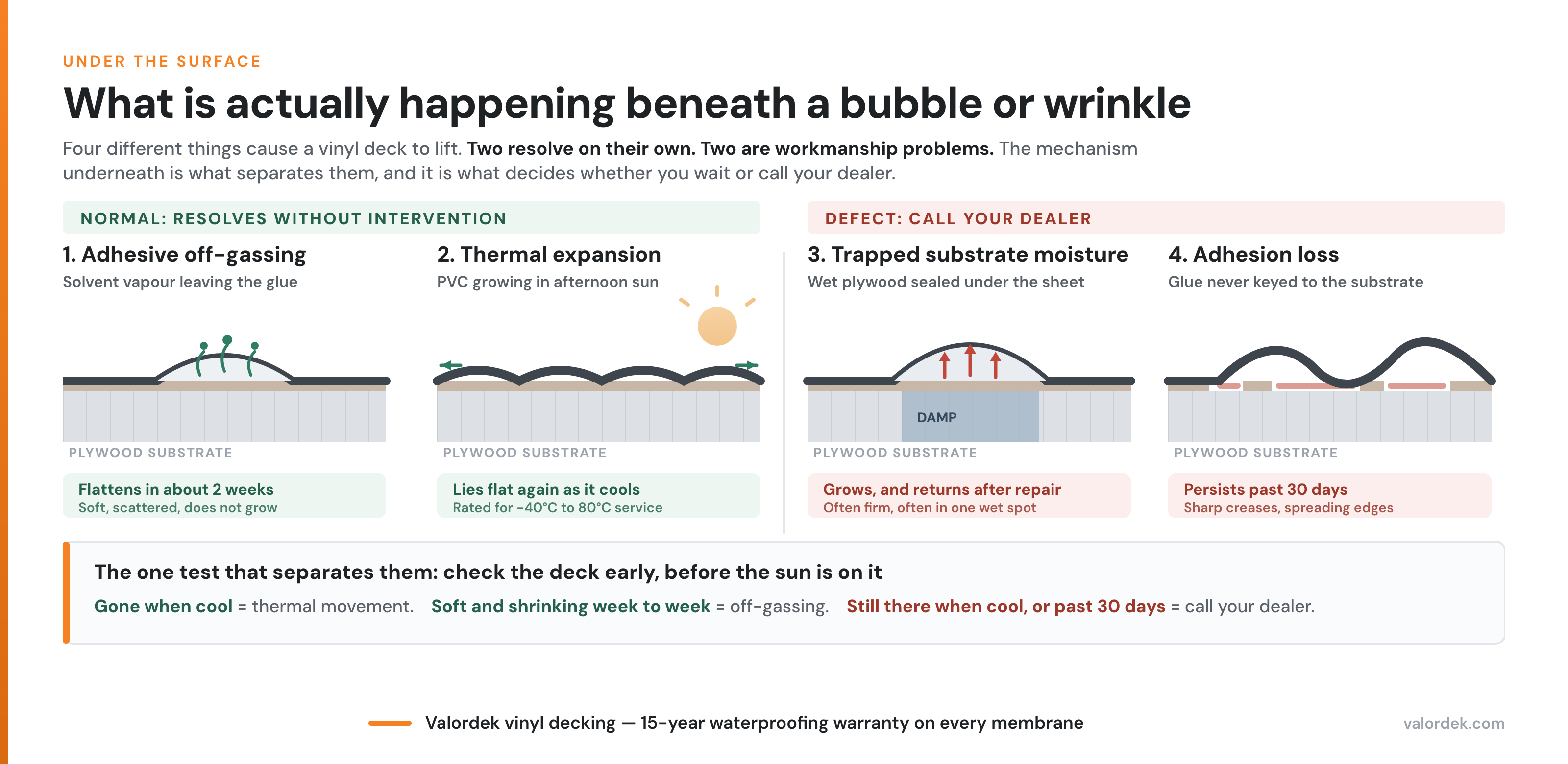
Yes, in the first two weeks after installation, scattered soft bubbles are normal and expected. Vinyl deck membranes are bonded to the substrate with a solvent-based contact adhesive. As that adhesive cures, the remaining solvent turns to vapour and has to escape. Because the membrane above it is waterproof by design, some of that vapour collects into visible domes before it works its way out through the edges and the adhesive itself.
This is a well-understood part of how a bonded membrane cures, and it is temporary. Installers see it on a share of jobs every season, particularly on decks glued in warm weather when solvent evaporates fast.
A benign off-gassing bubble has a recognisable character:
- Soft to the touch. Press it and it moves easily, then returns.
- Scattered, not concentrated. Several small domes across the deck rather than one large one in a single spot.
- Shrinking week over week. This is the single most reliable signal. Photograph it and compare after seven days.
- Not tied to a wet area. It is not sitting at the base of a downspout, under a planter, or at a low point where water collects.
Give it two weeks before doing anything. In the large majority of cases the deck is flat by then, and no intervention was ever needed. Resist the temptation to puncture it. A pinhole in a membrane that was going to heal itself converts a cosmetic issue into a permanent breach of the waterproofing layer, and puncturing the membrane is not covered under warranty.
Why does a vinyl deck wrinkle in hot weather?
PVC expands when it heats and contracts when it cools, and a deck surface in direct August sun runs far hotter than the air temperature around it. A 72-inch-wide sheet that grows even slightly across its width has to put that extra material somewhere, and on a deck it shows up as gentle waviness across the surface.
The defining characteristic of thermal movement is that it reverses. Waviness that appears mid-afternoon and is gone by early morning is the membrane doing exactly what a flexible waterproofing sheet is supposed to do. A rigid surface that could not move would crack instead.
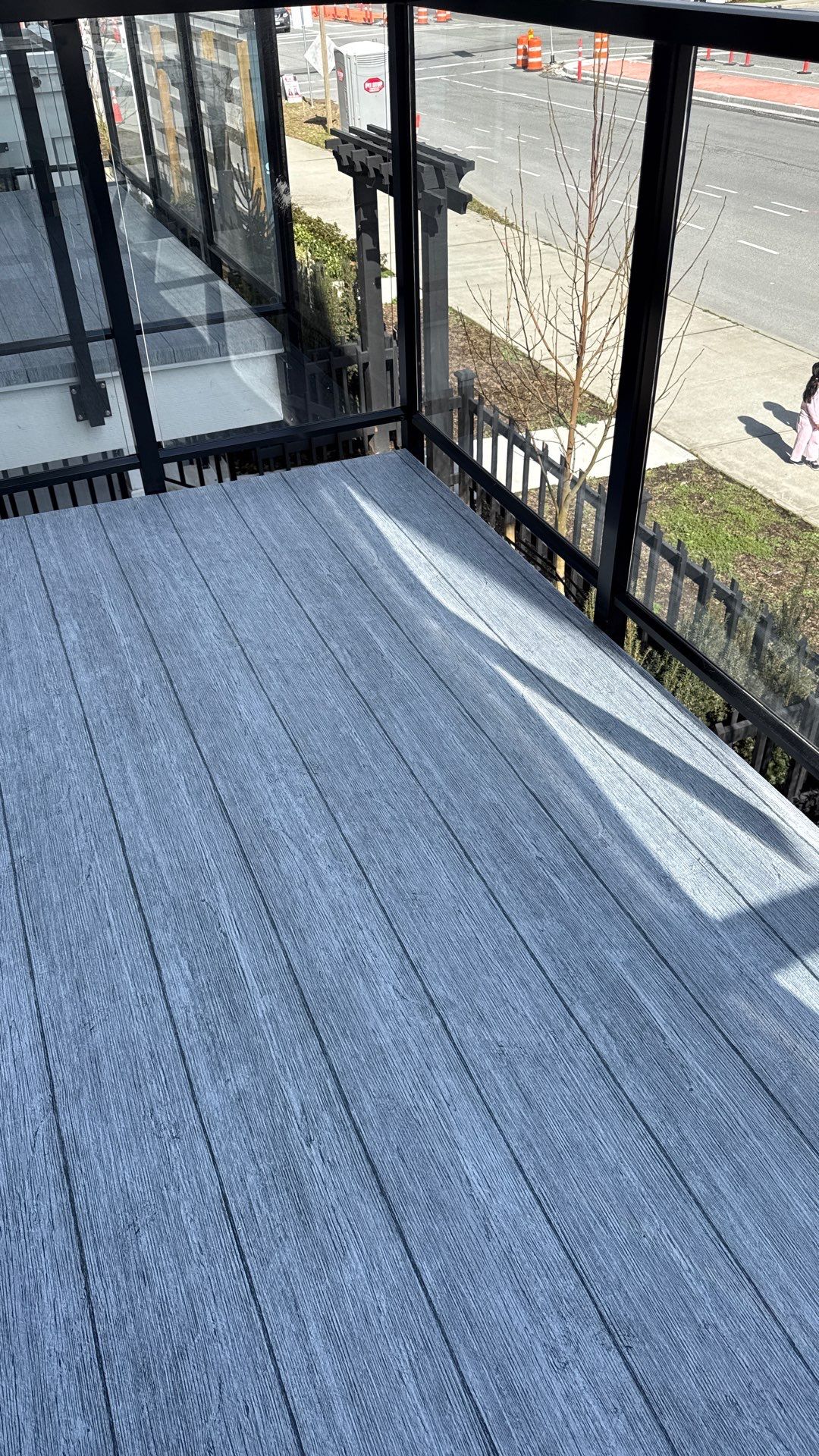
This is also why so many homeowners first notice the issue in July and August. Nothing changed about the deck. The temperature did. If you are already thinking about summer heat and your deck, our summer deck care guide covers the wider seasonal picture.
Here is where we differ from the reassuring answer you may have read elsewhere. Bubbling is usually benign. Wrinkling often is not. A wrinkle that stays put when the deck is cool is not thermal movement, because thermal movement reverses. Persistent wrinkles usually trace back to the membrane being pulled too tight at install, or being laid without enough slack to accommodate normal expansion. That is a workmanship issue, and telling you otherwise would not be doing you a favour.
The test takes no equipment. Look at the deck early in the morning, before the sun reaches it. If the surface is flat, you saw thermal movement. If the wrinkle is still there, book a look.
When bubbling and wrinkling signal a real defect
Three failure modes account for most genuine problems, and each has a distinct signature.
Trapped substrate moisture
If plywood was damp when the membrane went down, that moisture has nowhere to go. It vapourises under summer heat and pushes the membrane up. The tell is a bubble that is firm rather than soft, sits over a specific area rather than scattered, grows over weeks rather than shrinking, and comes back after being repaired. Correct preparation calls for a clean, dry substrate, typically 5/8-inch tongue-and-groove plywood or untreated concrete. Our guide to installing vinyl decking over plywood covers the substrate requirements in detail.
Contaminated or incomplete adhesive coverage
Contact adhesive needs a clean surface to key into. Sawdust, damp patches, or missed areas leave the membrane unbonded in those spots. Unbonded sections lift under thermal cycling, and the lifting spreads outward from the edges of the bare area over time. The signature is sharper creases rather than soft domes, and an affected area that gets larger month over month.
Adhesion loss at seams and terminations
Valordek membranes are joined with heat-welded seams, which fuse two sheets into one continuous surface rather than relying on tape or sealant. A properly welded seam is as strong as the sheet. Lifting along a seam line, or at a wall termination or drain edge, means the detail was not completed correctly, and it deserves attention promptly because those are the points where water enters an assembly. Our post on balcony waterproofing failures explains why terminations are where most leaks begin.
Wait, watch, or call: a decision table
Use this to place what you are seeing. When two rows could apply, treat the more serious one as the answer.
| What you see | Likely cause | Timeline | Waterproofing affected? | What to do |
|---|---|---|---|---|
| Soft scattered bubbles on a deck under 2 weeks old | Adhesive off-gassing | Flattens in about 2 weeks | No | Wait. Photograph and compare weekly |
| Gentle waviness in afternoon sun, flat by morning | Thermal expansion | Reverses daily | No | Wait. Normal within the -40°C to 80°C range |
| Bubbles still present after 30 days | Off-gassing has finished, so something else is driving it | Will not self-resolve | Not yet, but investigate | Call your dealer |
| Firm bubble over one area that grows week to week | Trapped substrate moisture | Worsens with heat | At risk | Call your dealer |
| Wrinkle still there when the deck is cool | Insufficient slack at install | Permanent until corrected | At risk if it creases | Call your dealer |
| Lifting along a seam, wall edge, or drain | Incomplete seam weld or termination detail | Spreads | Yes | Call promptly |
| Any bubble that has been punctured or split | Breached membrane | Immediate | Yes | Call promptly |
What a proper repair looks like
A correct repair does not involve injecting glue through the top of the membrane, and it does not involve a patch laid over the surface with adhesive around the edges. Both leave a seam that is not welded, which is a future leak.
The professional method is to cut the affected section out, correct the underlying cause, and heat-weld a new piece of the same membrane in. Because the replacement is fused rather than glued at the joint, the repaired area is continuous with the original surface. That is the same principle that makes the seams watertight in the first place, and it is why this is dealer work rather than a weekend job. Our vinyl deck repair guide walks through the process in full.
Correcting the cause is the part homeowners most often skip. Welding a fresh patch over plywood that is still wet produces the same bubble again in the next hot spell. The substrate has to be dried and the source of the moisture found first.
How installation prevents this in the first place
Nearly every defect case above traces back to something that happened before the membrane was rolled out. The controllable factors are consistent:
- A dry substrate. Plywood that has been rained on needs to dry before anything is bonded to it, however inconvenient the schedule.
- A clean, sound deck. Sawdust and debris prevent the adhesive from keying. Dips and knot holes need patching so the membrane is supported evenly.
- The correct adhesive for the membrane. Valordek specifies VD 0295, VD 0220 winter grade, or VD 0330 for the 68mil Fuzzy-Back membrane, and Sarnacol 2170 R for the 60mil Smooth-Back. They are not interchangeable, and the warranty is valid only when a Valordek-approved adhesive is used by a certified installer.
- Enough slack for movement. The membrane is laid to sit flat, not stretched taut. Material pulled tight during install has nowhere to go when it warms.
- Properly welded seams and terminations. Every seam heat-welded, every edge and penetration sealed.
If you want to see what a correct sequence looks like before hiring anyone, our guide to how vinyl decking is installed covers it step by step. The specifications behind the material are independently verified: the 68mil Premium Series is CCMC tested and the 60mil Ultra Series is Intertek tested, both exceeding code 37.54.95, with the full details on our certifications page.
What this means for your deck
A bubble is not a verdict. On a deck less than a month old it is usually the adhesive finishing its job, and the correct response is patience and a weekly photo. Heat waviness that disappears overnight is a flexible waterproofing surface behaving exactly as designed.
What deserves a call is anything that persists, grows, or sits at a seam or edge. Those are the cases where waiting costs money, because the substrate underneath keeps absorbing water while the surface looks merely cosmetic. Every Valordek membrane carries a 15-year waterproofing warranty, and genuine installation defects are exactly what a dealer relationship exists to resolve. You can read more about the systems themselves on our vinyl decking hub or the balcony application page.
Frequently asked questions
Is bubbling in a new vinyl deck a defect?
Usually not. Soft, scattered bubbles in the first two weeks are the contact adhesive off-gassing as it cures, and they flatten without intervention. It becomes a defect when bubbles persist beyond 30 days, grow week to week, or feel firm and sit over one area, which suggests trapped substrate moisture instead.
Will bubbles in vinyl decking go away on their own?
Off-gassing bubbles generally disappear within about two weeks as solvent vapour escapes through the adhesive and edges. Photograph the bubble and compare after seven days. If it is visibly smaller, it is resolving normally. If it is the same size or larger after 30 days, it will not self-correct and needs a dealer.
How do you fix bubbles in vinyl decking?
A genuine bubble is repaired by cutting out the affected section, correcting the cause underneath, and heat-welding in a new piece of the same membrane so the repair is continuous with the original surface. Do not puncture or inject adhesive through the top. That breaches the waterproofing layer and voids warranty coverage on that area.
Does heat damage vinyl decking?
No. Valordek membranes are rated for service from -40°C to 80°C, so normal summer heat is well inside the design range. Heat causes visible expansion and gentle waviness that reverses as the deck cools. Direct concentrated heat is different: keep barbecues, fire pits, and hot coals off the membrane surface.
How do you repair a vinyl deck covering?
Repairs are made by cutting back to sound material and heat-welding a matching section in, which fuses the patch into one continuous surface rather than relying on tape or surface adhesive. Because the weld requires the correct equipment and technique, this is dealer work. Surface patches glued at the edges become the next leak.
When should you call your dealer about a bubble or wrinkle?
Call when a bubble is still present after 30 days, is growing, or feels firm over a single area. Call promptly for any lifting at a seam, wall edge, or drain, and for any wrinkle still visible when the deck is cool in the morning. When in doubt, call. An inspection costs nothing compared to a wet substrate.