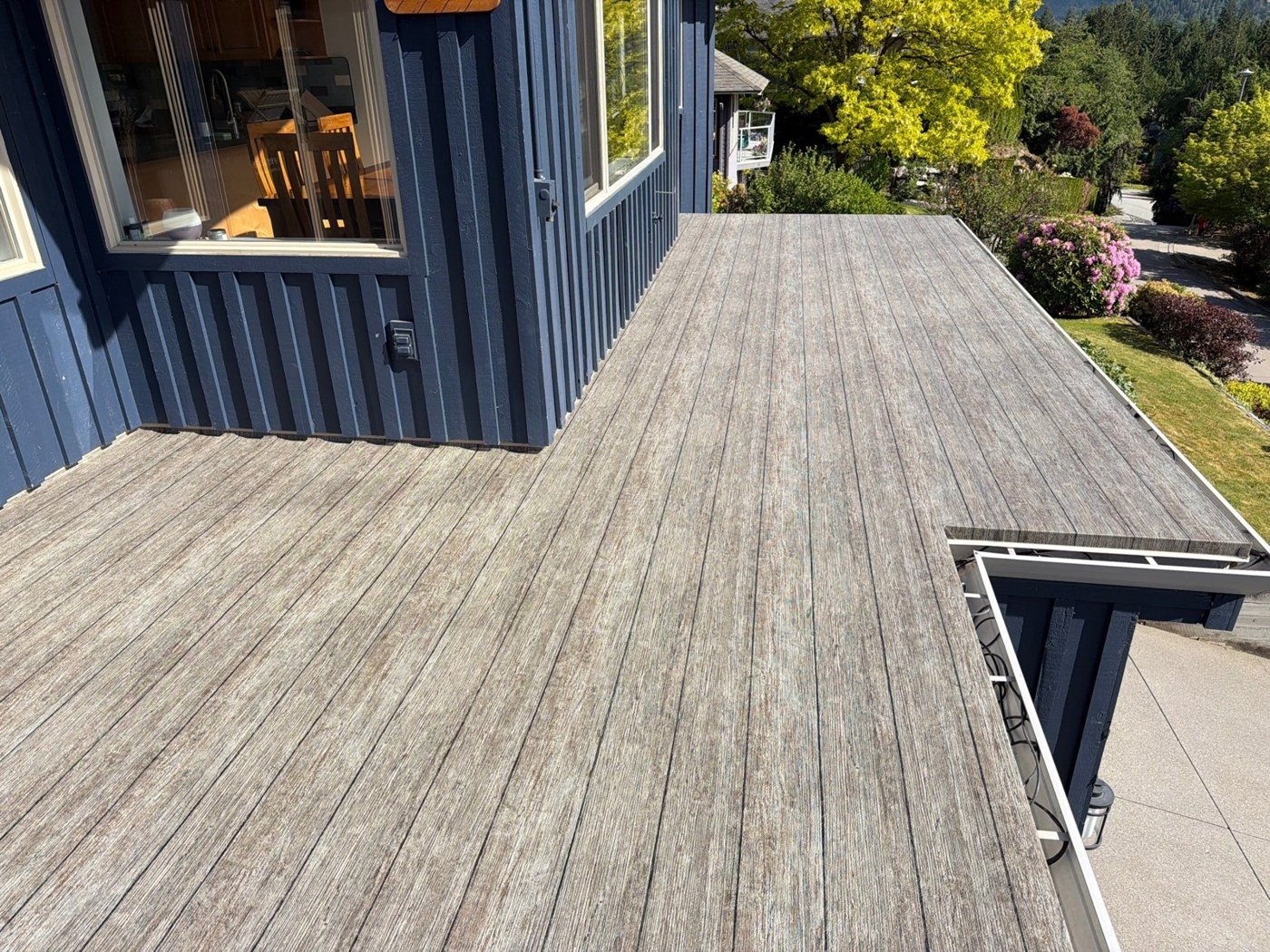
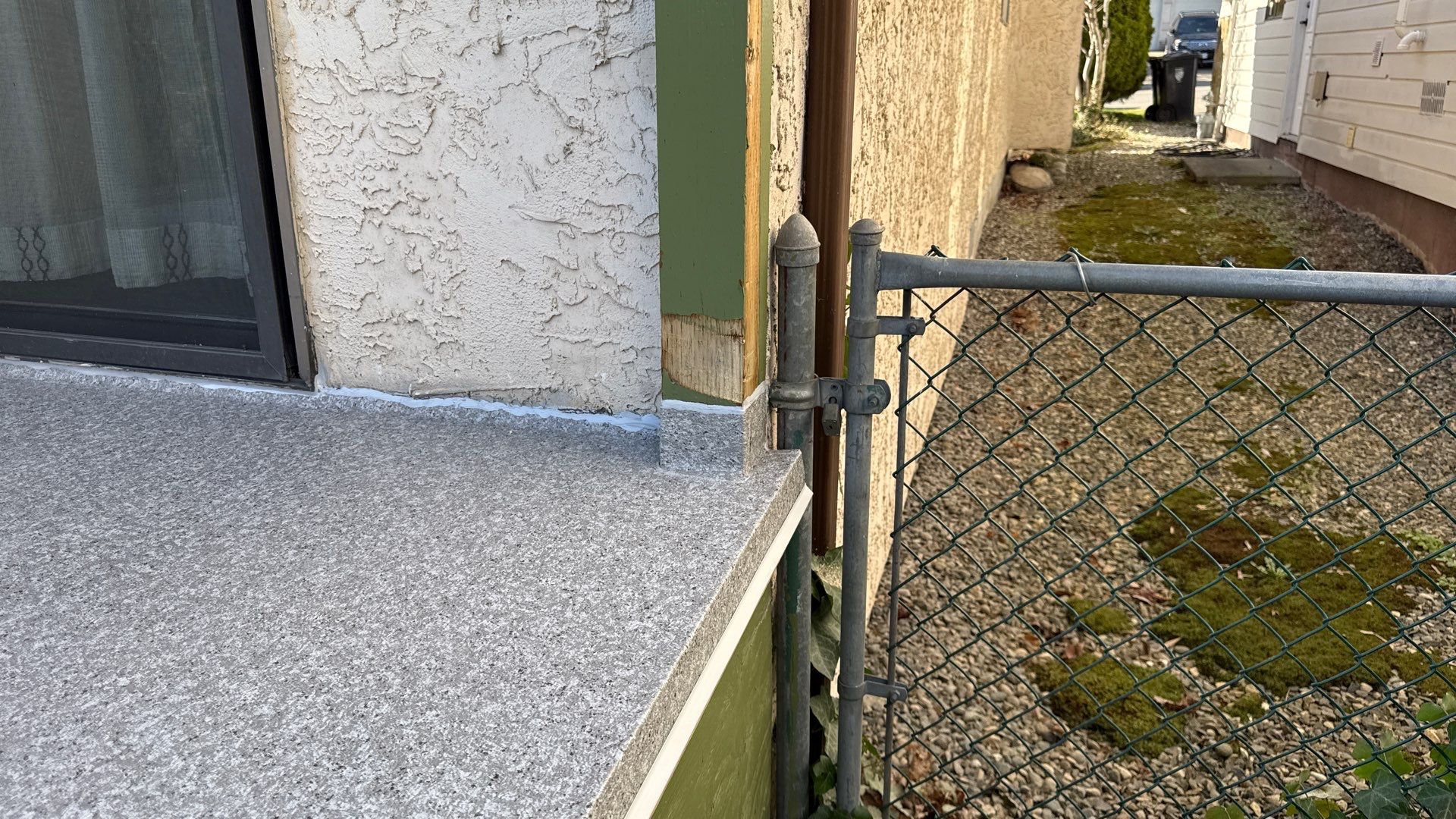
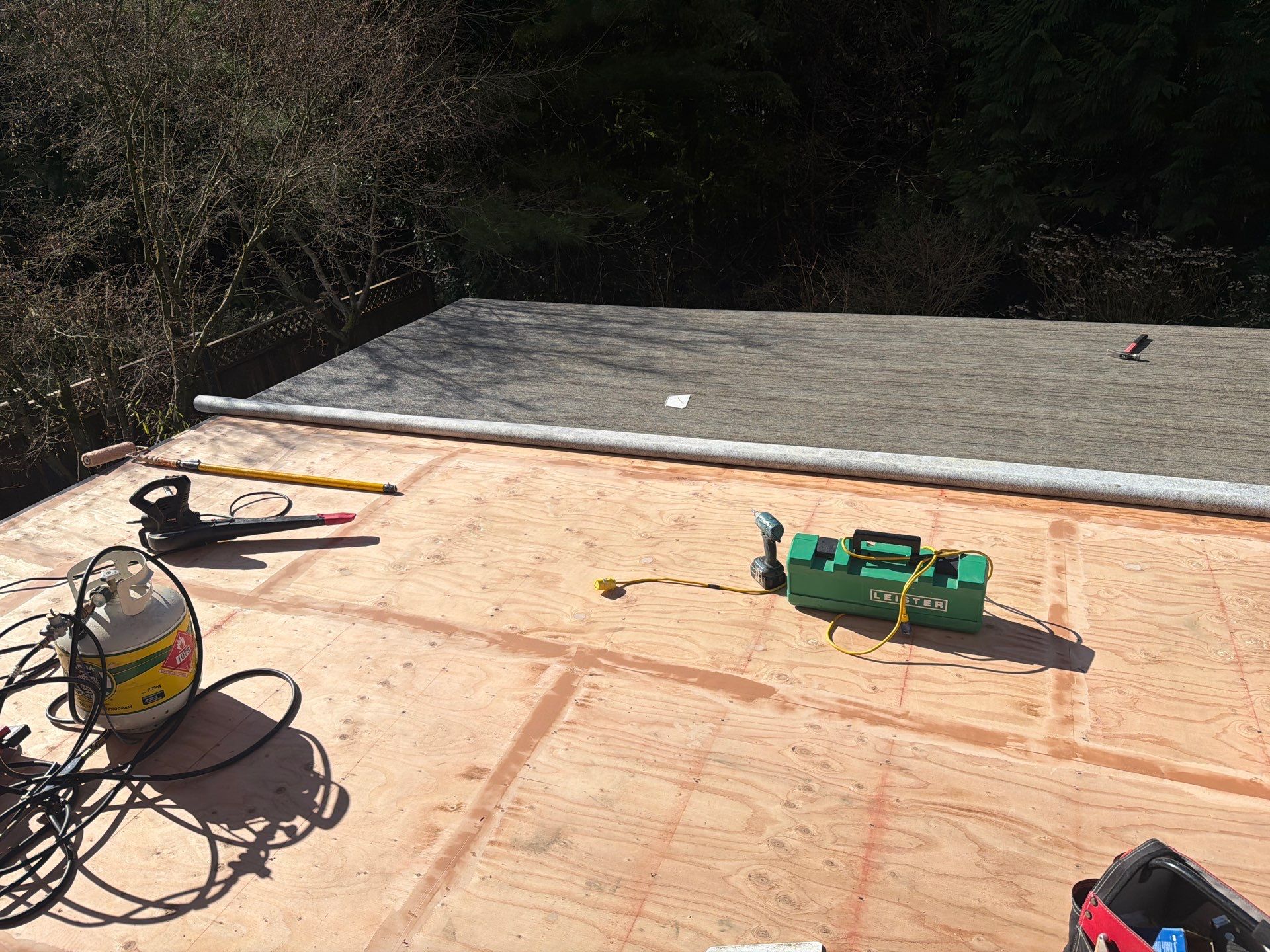
A waterproof deck coating is a liquid applied over a deck surface that cures into a flexible film, typically lasting 5 to 7 years before it needs recoating. A vinyl deck membrane is a factory-made sheet bonded to the substrate with heat-welded seams, and Valordek membranes carry a 15-year waterproofing warranty. Over living space, the membrane is the stronger choice.
That difference in service life is the whole decision in one sentence, but it is not the only thing that separates these two systems. They fail in completely different ways. A coating wears thin gradually and invisibly across the entire surface, so the first sign of failure is usually water appearing in the room below. A bonded sheet membrane fails locally and visibly at a specific point you can find and repair. Understanding that distinction matters more than the upfront price, because it determines whether you find the problem or the problem finds you. This guide compares both systems honestly, including the cases where a coating genuinely is the right call.
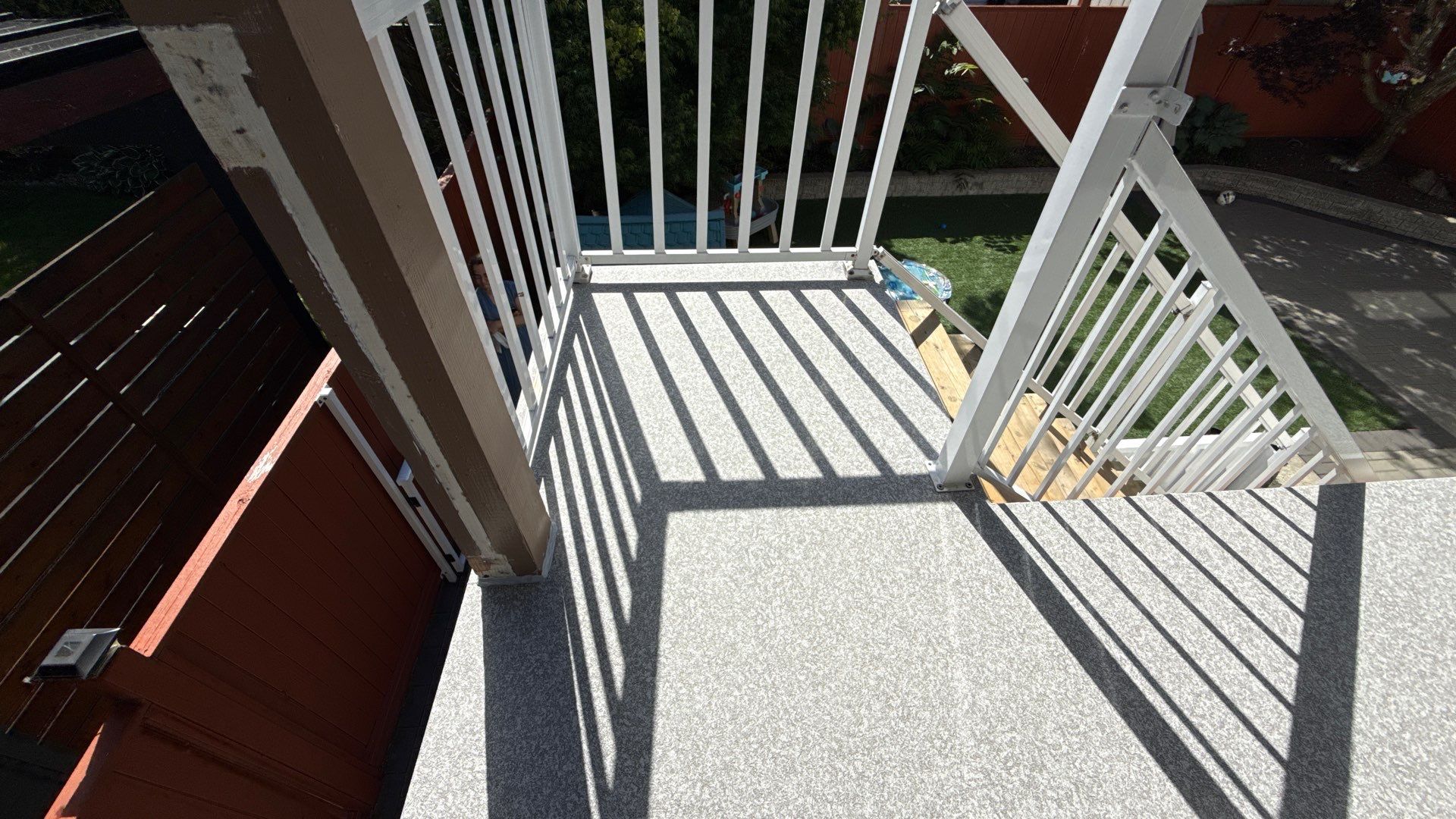
What is a waterproof deck coating?
A waterproof deck coating is a liquid-applied system that cures in place to form a continuous flexible film, usually built up in three to five layers over a primed substrate. Most products fall into one of three chemistries: acrylic, polyurethane, or elastomeric liquid rubber. Some systems embed a fibreglass or polyester fabric between coats to add tensile strength, which is what separates a true walking-deck coating from ordinary deck paint or sealer.
The appeal is real. Coatings apply by roller or spray, which means they follow irregular shapes, wrap around posts and drains, and reach details that sheet goods have to be cut and welded around. They are also the more accessible option for a homeowner willing to do careful prep work.
The limitation is equally real. Because the film is built on site, its thickness varies with application technique. Thin spots concentrate at exactly the places that take the most abuse: traffic paths, door thresholds, and edges. Ultraviolet exposure and foot traffic then erode the film from the top down, which is why every coating manufacturer publishes a recoat interval rather than a lifetime warranty.
What is a vinyl deck membrane?
A vinyl deck membrane is a single-ply PVC sheet manufactured to a controlled thickness, bonded to the substrate with contact adhesive, with adjacent sheets joined by heat welding into one continuous waterproof surface. Valordek produces its membrane in 72-inch wide rolls up to 480 lineal feet, so a typical balcony is covered with very few seams to begin with.
The critical detail is that a heat weld is not a glued joint or a taped lap. Applying hot air melts the PVC on both sheets so they fuse into a single mass of material. A properly executed weld is not a weak point in the system, which is why seam count matters far less than seam quality.
Valordek offers two membranes, and the difference is engineered around application rather than grade. Fuzzy-Back is a 68mil membrane with a fleece backing, used primarily on balconies. Smooth-Back is a 60mil membrane with a PVC backing, used on rooftop decks and patios, and it carries a Class A and Class C fire rating from Intertek testing. Both carry a 15-year waterproofing warranty plus a 5-year appearance warranty, and both are rated for continuous service from -40C to 80C. You can see how the two lines differ in the 60mil versus 68mil thickness comparison.
Waterproof deck coating vs vinyl membrane compared
The table below sets both systems side by side on the factors that actually change the outcome of a project. Prices shown are Valordek membrane material in Canadian dollars.
| Factor | Liquid-applied coating | Bonded vinyl membrane |
|---|---|---|
| Waterproofing method | Film built on site in 3 to 5 coats | Factory-made sheet, heat-welded seams |
| Thickness control | Varies with applicator technique | Consistent 60mil or 68mil throughout |
| Typical service life | 5 to 7 years before recoating | 15-year waterproofing warranty |
| Appearance warranty | Varies by manufacturer | 5 years |
| Failure pattern | Gradual, system-wide, hidden | Localized, visible, repairable |
| Finished surface | Coating is the wear surface | Membrane is the finished floor |
| Temperature range | Varies by chemistry | -40C to 80C |
| Fire rating | Depends on assembly | Class A and C (60mil, Intertek tested) |
| Material cost | Lower upfront | From $3.74 CAD per square foot |
| Recoating required | Yes, on a cycle | No |
| Installation | DIY possible with careful prep | Professional install (heat welding) |
| Complex details | Follows irregular shapes easily | Requires cutting and welding around |
How each system fails, and why it matters more than the price
The most useful question to ask about any waterproofing system is not how long it lasts but how you will find out when it stops working. This is where coatings and membranes diverge sharply, and it is the part most comparison articles leave out.
A liquid coating degrades across its whole surface at once. Ultraviolet light breaks down the binder, foot traffic abrades the film, and thermal cycling works it against the substrate. The coating does not tear open in one obvious place. It thins everywhere and eventually admits water through microscopic pinholes at the points that were thinnest to begin with. Because the failure is diffuse and slow, there is usually no visible surface damage to warn you. The signal arrives as a stain on the ceiling below, by which point water has been tracking through the substrate for some time.
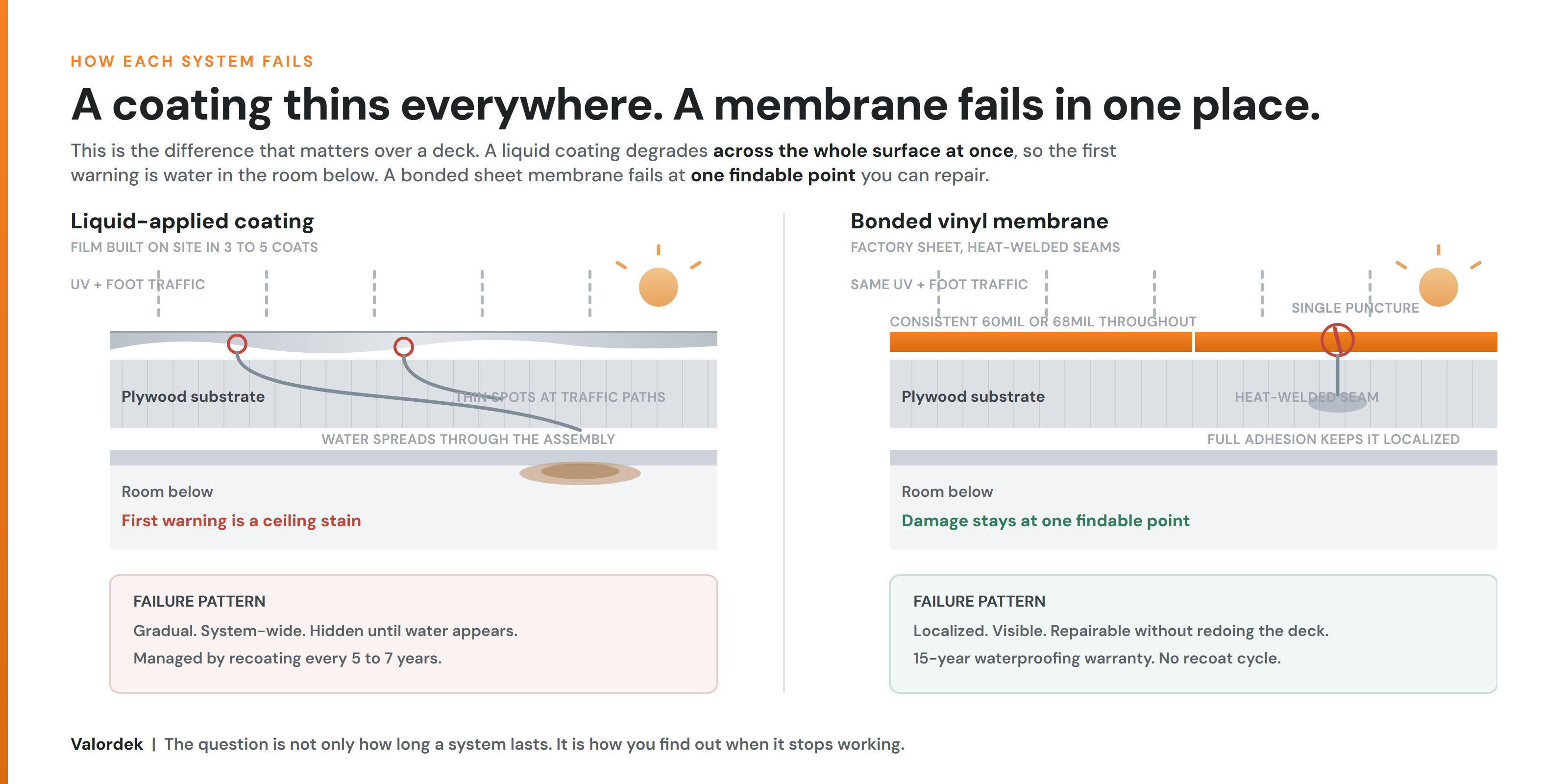
A bonded sheet membrane behaves differently because the waterproofing layer was manufactured at a controlled thickness rather than built on site. When it fails, it fails at an identifiable point: a puncture, a damaged termination, or a badly executed weld. That point is findable and repairable without redoing the entire deck. Our guide to vinyl deck repair covers what that process involves.
The backing material changes the failure behaviour further, which is why Valordek specifies different membranes for different applications. If water does get past a 68mil fleece-backed membrane, the fabric backing wicks it across a wider area. Past a 60mil PVC-backed membrane, water stays localized in one small area and does not spread. On a rooftop deck over occupied space, that containment is precisely why the PVC-backed product is specified.
When a waterproof deck coating is the right choice
A coating is genuinely the better option in several situations, and any honest comparison has to say so.
- Complex geometry. Decks with many penetrations, curves, tight radius corners, or awkward transitions are faster and often better served by a liquid system that simply follows the shape.
- Ground-level decks over nothing. If there is no occupied space below, the consequence of a slow leak is limited to the structure itself, which changes the risk calculation entirely.
- Short holding periods. If a property is being sold within a few years, a coating that performs well for its first cycle may be the rational spend.
- Budget-constrained repairs. A coating costs less upfront, and a deck that gets a working coating now beats a perfect membrane that never gets installed.
- Recoatable maintenance culture. If the owner will genuinely recoat on schedule, a coating system can perform for a long time. The failure mode is neglect, not chemistry.
When you need a membrane instead
The case for a bonded membrane strengthens sharply as the cost of a leak rises. Where the deck sits above living space, a waterproofing failure does not damage the deck, it damages the room underneath, along with insulation, drywall, finishes, and sometimes framing.
Building codes recognise this distinction. Valordek membranes exceed code 37.54.95 for waterproofing, verified through CCMC testing on the 68mil membrane and Intertek testing on the 60mil, and the full detail is on our certifications page. If you are working through code obligations on a specific project, the deck waterproofing code requirements guide covers what applies where.
Specify a membrane when any of the following are true:
- The deck is over living space, a garage, or any conditioned area
- The deck is a balcony or rooftop patio that also serves as the roof below
- The assembly needs a documented fire rating
- The building is a strata or multi-unit property with shared liability for water ingress
- You want the waterproofing and the finished walking surface to be the same layer
That last point is easy to overlook. With a coating, the waterproofing is also the wear surface, so every scratch is a scratch in the waterproofing. A vinyl membrane is manufactured as a finished floor, which is why it does not need anything installed on top of it. For a deeper treatment of the over-living-space case specifically, see waterproofing a deck over living space.
What about waterproof deck coating for plywood?
Plywood is the most common substrate for both systems, and both require the same thing to succeed: a clean, dry, structurally sound deck with correct slope for drainage. Valordek membranes are installed over 5/8-inch tongue-and-groove plywood, bonded with contact adhesive across the full surface rather than mechanically fastened through the waterproofing layer.
Full adhesion matters on plywood specifically. Plywood moves with moisture and temperature, and a fully bonded membrane moves with it instead of bridging across a gap where a void could form. It also means that if water ever does penetrate, it cannot travel laterally between the membrane and the deck looking for somewhere to enter the building. Substrate preparation is covered in detail in our guide to installing vinyl decking over plywood.
Neither system fixes a drainage problem. If water ponds on the deck, it will find the weakest point in whatever you install, so slope and drainage come first. Our deck drainage guide explains how to get that right.
What each system costs over 15 years
Comparing upfront prices makes coatings look decisively cheaper. Comparing service life changes the picture, because the relevant question is what the deck costs over the period you own it, not what it costs on day one.
A coating rated for a 5 to 7 year recoat interval will need two to three recoats across a 15-year window. Each cycle carries not just material cost but surface preparation, cleaning, downtime, and the risk that a missed cycle turns into substrate damage. A Valordek membrane installed once carries a 15-year waterproofing warranty across that same period with no recoating in the schedule.
Valordek prices membrane material at $3.74 CAD per square foot. US buyers should convert at the current rate. You can price a specific deck using our deck cost calculator. For a full breakdown of installed pricing, the vinyl decking cost guide covers what drives the number, and our 10-year total cost of ownership analysis works the maintenance math across decking types.
The honest summary: if the deck is over nothing and you will recoat on schedule, a coating can be the economical answer. If the deck is over a room, the arithmetic that matters is not the price of the surface, it is the price of the ceiling underneath it.
How to choose for your deck
Work through three questions in order.
- What is under the deck? Occupied space moves the decision decisively toward a membrane. Open air below widens the field.
- How long are you keeping the building? A 15-year horizon favours a system with a 15-year warranty. A 3-year horizon may not.
- Will the maintenance actually happen? Coatings work when recoated on schedule and fail when they are not. Be realistic rather than optimistic about this.
If the answers point to a membrane, the next decision is which one, and that follows the application. Balconies take the 68mil Fuzzy-Back membrane, covered on our balcony waterproofing page. Rooftop decks take the 60mil Smooth-Back membrane, covered on the rooftop deck page. Both sit within the broader waterproof decking systems range, and the complete product line is on the vinyl decking hub.
Frequently asked questions
What is the best waterproof deck coating?
The best system depends on what is under the deck. For decks over open ground, a quality polyurethane or reinforced elastomeric coating performs well when recoated every 5 to 7 years. For a deck over living space, a bonded vinyl membrane with heat-welded seams and a 15-year waterproofing warranty is the stronger specification.
How long does deck coating last?
Most liquid-applied deck coatings last 5 to 7 years before requiring a recoat, though ultraviolet exposure and foot traffic can shorten that on high-traffic decks. This is a maintenance interval rather than a failure point. By comparison, Valordek vinyl membranes carry a 15-year waterproofing warranty with no recoating required.
How do you waterproof a deck over living space?
Waterproofing a deck over living space requires a continuous membrane that is also the finished walking surface, correct slope to drains, and sealed terminations where the deck meets walls. Valordek membranes exceed code 37.54.95, verified by CCMC and Intertek testing, and carry a 15-year waterproofing warranty.
How do you waterproof a deck floor?
Start with a clean, dry, structurally sound substrate sloped for drainage, typically 5/8-inch tongue-and-groove plywood. Bond a waterproof layer across the full surface, then seal every edge, penetration, and wall termination. Valordek membranes are adhered with contact adhesive and joined with heat-welded seams into one continuous surface.
How do you waterproof a rooftop deck?
A rooftop deck is the roof of the space below, so it needs a membrane rated for that duty. Valordek specifies the 60mil Smooth-Back membrane for rooftop decks because its PVC backing keeps any water intrusion localized rather than letting it spread, and it carries a Class A and Class C fire rating from Intertek testing.
Can you put a coating over an existing vinyl deck membrane?
Coating over a vinyl membrane is not recommended. The membrane is manufactured as the finished wear surface, and adding a liquid film on top introduces an adhesion layer that can peel and traps moisture between the two systems. If an existing membrane is failing, repair or replacement is the correct route.