Deck waterproofing code requirements vary by jurisdiction, but the core rule is consistent across Canada and the US: any deck built over occupied living space must be waterproofed to a recognized standard. In Canada, that standard is CGSB-37.54 for vinyl roofing and waterproofing membranes, enforced through the National Building Code. In the US, the IRC and IBC require waterproof underlayment for decks over conditioned space, with ASTM testing as the verification path. Valordek vinyl deck membrane is CCMC-tested and Intertek-certified, exceeding code 37.54.95 in both Premium and Ultra series.
If you are specifying a deck waterproofing system or evaluating a contractor's proposal, the question is not whether the product "works." The question is whether it is code-compliant for your specific application. A non-compliant installation will fail inspection, void warranties, complicate insurance claims, and can trigger occupancy issues on multi-unit buildings. This guide explains exactly what codes apply, what they require, and how to verify a product meets them. For Valordek's certified product lines, see the certifications page and the vinyl decking hub.
When does building code require deck waterproofing?
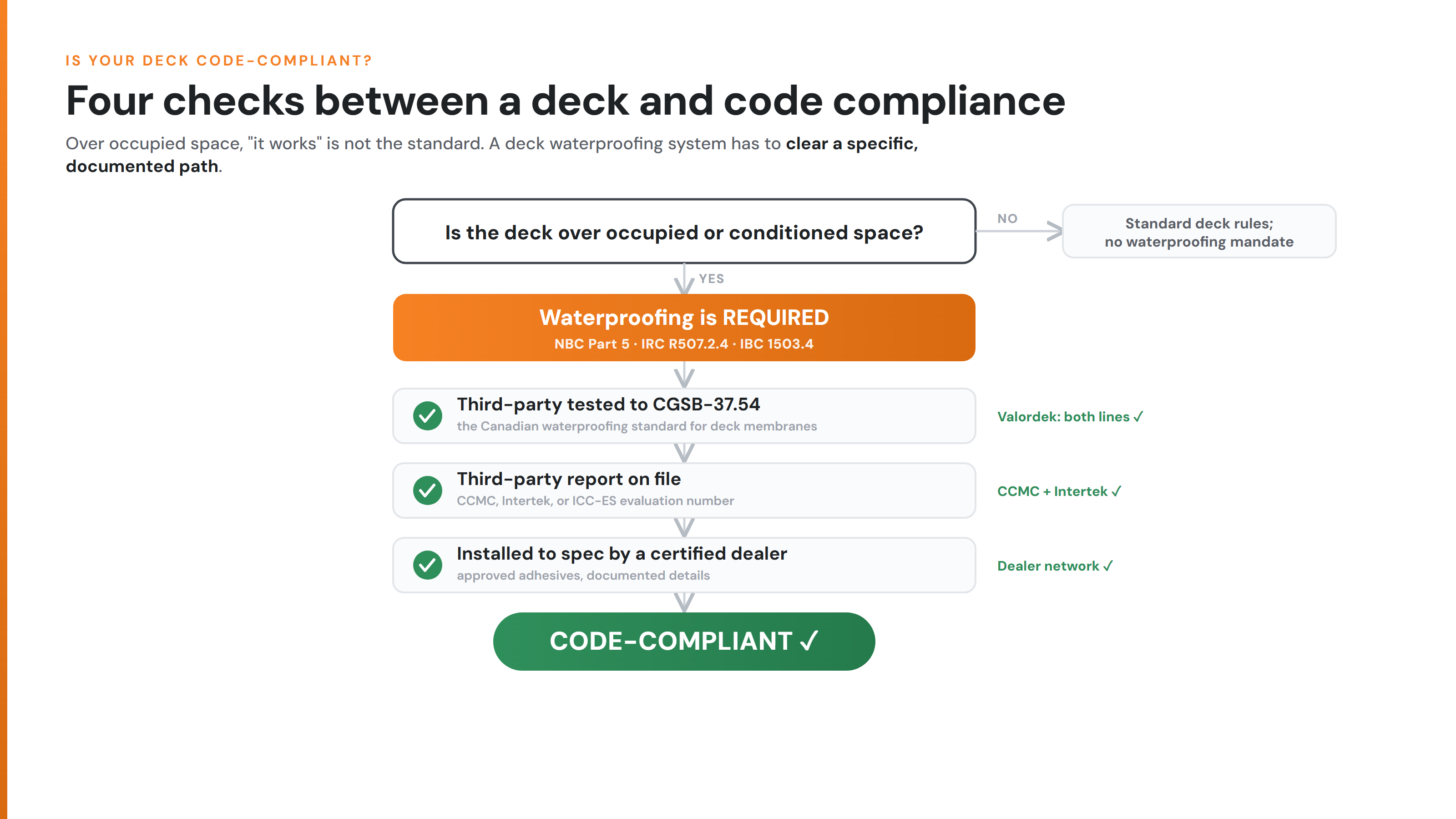
Building code requires deck waterproofing whenever a deck is built over occupied living space. This includes balconies above living units, rooftop patios above conditioned rooms, and elevated decks built directly over a garage or basement. Ground-level decks where water drains harmlessly into soil are not subject to waterproofing requirements. The rule is jurisdiction-agnostic and follows the same logic in Canadian, US, and international codes.
The logic is simple: a deck over occupied space is functionally a roof. The walking surface IS the structural element protecting the room below. Codes therefore treat that surface the same way they treat any roof assembly. Specifically:
- National Building Code of Canada (NBC), Part 5, Environmental Separation. Requires a continuous waterproof barrier on any roof or deck assembly above conditioned space.
- NBC Part 9, Housing and Small Buildings. Requires roofing materials on decks over occupied space to meet recognized standards (CGSB-37.54 is the Canadian standard for vinyl decking membranes).
- International Residential Code (IRC), Section R507. Requires impervious moisture barriers on exterior balconies that overhang interior space.
- International Building Code (IBC), Section 1507. Requires roof-grade waterproofing materials on commercial elevated decks above occupied space.
Provincial codes in Canada (BC Building Code, Alberta Building Code, Ontario Building Code) adopt the NBC with provincial amendments. State and municipal codes in the US adopt the IRC and IBC with local modifications. The waterproofing requirement carries through every adoption.
For the actual cross-section drawings (wall connection details, drainage details, flashing details, and railing details for code-compliant Valordek installations), see the Resources section, which carries the manufacturer-published detail drawings used by architects and contractors specifying Valordek vinyl decking on code-governed projects.
What is CGSB-37.54 and why does it matter?
CGSB-37.54 is the Canadian General Standards Board specification for polyvinyl chloride roofing and waterproofing membrane. Specifically, CGSB-37.54-95 (often referenced as "code 37.54.95") is the most current version of the standard. It defines the physical, mechanical, and durability properties a PVC membrane must meet to qualify as code-compliant waterproofing in Canada. Any vinyl deck membrane installed on a Canadian balcony or rooftop deck above occupied space should meet or exceed this standard.
The standard tests for:
- Tensile strength and elongation (will the membrane stretch without tearing under thermal cycling?)
- Tear resistance (can the membrane handle foot traffic and impact?)
- Dimensional stability (does it shrink or swell with temperature changes?)
- Low-temperature flexibility (does it remain flexible at -40C, the worst-case Canadian winter?)
- UV and weathering resistance (does the membrane maintain integrity under continuous outdoor exposure?)
- Heat aging (does it remain stable at sustained high temperatures?)
- Water absorption (does it remain waterproof over the product's lifespan?)
A product that "exceeds CGSB-37.54.95" has been third-party tested against every property in the standard and passed. Both Valordek product lines carry this certification: the 68mil Fuzzy-Back (Premium Series) is CCMC-tested, and the 60mil Smooth-Back (Ultra Series) is Intertek-tested. Both exceed code 37.54.95.
What do US codes require for deck waterproofing?
US building codes require waterproof underlayment on any deck or balcony over conditioned space, tested to ASTM standards. The IRC governs single-family and small residential applications; the IBC governs commercial and multi-unit buildings. Both reference ASTM D6878 (modified bituminous self-adhesive sheet membranes) and ASTM D6754 (PVC sheet roofing) as accepted test methods for waterproof deck membranes. Class A or Class C fire rating per ASTM E108 is required for rooftop applications above occupied space in most jurisdictions.
Specifically:
- IRC R507.2.4, Decks Above Occupied Space. Requires an impervious moisture barrier between the deck surface and the structure below. The barrier must be tested to a recognized standard and installed continuous across the deck assembly.
- IBC 1507, Single-Ply Membrane Roofing. Requires PVC, TPO, or EPDM membranes installed per manufacturer specifications and tested to ASTM standards. Class A or C fire rating is mandatory for most rooftop deck applications.
- IBC 1607.7, Live Load Requirements. Decks must be designed for occupant live loads, which means the waterproofing layer must perform under foot traffic, furniture loads, and snow loads.
For US installations, look for products carrying ICC-ES (International Code Council Evaluation Service) reports or Intertek certifications. These are the third-party verification documents that confirm a product meets the IRC and IBC requirements. Valordek Smooth-Back carries Intertek testing and Class A and C fire ratings, qualifying it for US rooftop deck applications above occupied space.
What does code-compliant deck waterproofing look like in practice?
Code-compliant deck waterproofing is a continuous, third-party-tested membrane installed per manufacturer specifications, with proper flashing details at every termination, transition, and penetration. The membrane material itself is one part of the requirement. The installation method, the flashing details, and the substrate preparation are equally part of code compliance. A compliant material installed incorrectly is not a compliant deck.
The five elements every code-compliant deck waterproofing system must include:
- A tested membrane meeting the applicable standard. CGSB-37.54 in Canada, ASTM D6754 or D6878 in the US. Verified by CCMC report (Canada) or ICC-ES report / Intertek certification (US).
- Proper substrate. Most codes specify minimum substrate quality. For PVC vinyl deck membranes, this typically means 5/8-inch tongue-and-groove plywood or untreated concrete. Substrate must be clean, dry, and free of structural defects before membrane installation.
- Continuous waterproofing across the field. No gaps, no exposed seams, no penetrations without flashing. Heat-welded seams (PVC) or properly lapped self-adhesive seams (modified bitumen) are the two accepted approaches.
- Flashing at every termination. Walls, drains, scuppers, posts, and edges all require manufacturer-specified flashing details. Posts are the detail most often left to a sealant bead instead, and leaks around railing posts covers what that shortcut looks like once it fails. Most leaks happen at terminations, not in the field of the membrane. Codes require flashing details that match the membrane manufacturer's published specifications.
- Drainage compliance. Codes require positive drainage on all elevated decks above occupied space. Standing water on a deck is both a code violation (in most jurisdictions) and a leading cause of premature membrane failure.
Valordek's certification documentation (including the CCMC report number for the 68mil Fuzzy-Back Premium Series and the Intertek test report for the 60mil Smooth-Back Ultra Series) is published in full on the certifications page. Both lines exceed CGSB-37.54-95.
How do you verify a deck waterproofing product is code-compliant?
Verifying code compliance requires three documents: the manufacturer's product specification sheet (showing tested values), a third-party certification report (CCMC, Intertek, or ICC-ES), and the installation specification. All three should be available from the manufacturer on request. For Valordek products, full certification documentation is published on the certifications page and includes the CCMC report number for the 68mil Fuzzy-Back and the Intertek test report for the 60mil Smooth-Back.
What to look for in each document:
- Product specification sheet. Should list every CGSB-37.54 (or ASTM) test property with the measured value. "Tensile strength: passes" is not enough. The actual measured value (e.g., "Tensile strength: 2,000 psi") should be stated.
- Third-party certification report. CCMC reports are searchable on the National Research Council of Canada website. Intertek and ICC-ES reports are published in their respective evaluation databases. The report should reference the specific product line by name and confirm the standard met.
- Installation specification. Manufacturer-published instructions for substrate prep, adhesive application, seam welding, and flashing details. The installation must follow this document for the warranty AND code compliance to remain valid.
Generic deck coatings, hardware-store waterproof paints, and uncertified rubber rollouts cannot be verified this way because they lack third-party testing reports. They may still waterproof a deck temporarily, but they are not code-compliant for installation above occupied space.
Code-compliant vs non-compliant deck waterproofing products
| Property | Code-compliant (e.g., Valordek) | Non-compliant (generic coatings, paint-on systems, uncertified rubber) |
|---|---|---|
| Third-party tested | Yes: CCMC, Intertek, or ICC-ES report | No verification report available |
| Standard met | CGSB-37.54-95 (Canada) or ASTM D6754/D6878 (US) | None or vague "industry standard" claims |
| Waterproofing | Continuous heat-welded membrane, proven waterproof | Coating cracks at substrate movement, paint fails at seams |
| Fire rating | Class A/C tested (Smooth-Back) for rooftop applications | Typically untested for fire rating |
| Temperature range | -40C to 80C (Valordek) | Often not specified or limited to mild climates |
| Warranty | 15 years waterproofing (Valordek) | 1-5 years if any warranty offered |
| Building inspection | Passes inspection on multi-unit and commercial projects | Will not pass inspection for above-occupied-space installations |
| Insurance acceptability | Accepted for water-damage coverage | Often excluded as "non-permanent waterproofing" |
Common code violations on existing decks
The most common code violations on existing decks are not catastrophic membrane failures. They are detail-level issues that quietly invalidate compliance. If you are auditing an existing deck or evaluating a strata-managed building, the checklist below covers the violations that show up most often during forensic inspections.
- Membrane terminated at floor level instead of running up the wall. Code requires membrane to extend a minimum height (commonly 6 inches or 150mm) up against any vertical surface. A deck membrane that ends at the wall-floor joint is not properly flashed.
- Drains installed without proper flashing. Membrane terminated next to a drain rather than mechanically integrated with it. Water finds the gap.
- Penetrations sealed with caulk only. Posts, railings, and pipe penetrations require manufacturer-specified flashing collars, not just sealant.
- Substrate not properly prepared. Membrane installed over rotted plywood, paint chips, or improperly sloped substrate. Membrane integrity is only as good as what it bonds to.
- Seams not heat-welded (PVC) or improperly lapped (modified bitumen). Adhesive-only seams will eventually leak. Heat welding is the code-compliant method for PVC.
- Wrong product class for the application. Residential 60mil membrane installed on a commercial rooftop, or non-fire-rated membrane installed where Class A is required.
- No annual inspection record. Most manufacturers (and many strata bylaws) require annual sealant and flashing inspections. Without records, warranty and code compliance can be challenged after a failure.
How Valordek meets code requirements
Valordek manufactures two product lines, each engineered to a specific code-compliant application. Both lines carry third-party test reports and exceed the applicable Canadian and US standards. The product line determines which application it is certified for, and using the correct line for the application is part of code compliance.
| Specification | Fuzzy-Back (68mil Premium Series) | Smooth-Back (60mil Ultra Series) |
|---|---|---|
| Code standard | Exceeds CGSB-37.54-95 | Exceeds CGSB-37.54-95 |
| Third-party verification | CCMC tested | Intertek tested |
| Fire rating | Not fire-rated (residential balcony use) | Class A and Class C (rooftop above occupied space) |
| Temperature range | -40C to 80C | -40C to 80C |
| Warranty | 15-year waterproofing + 5-year appearance | 15-year waterproofing + 5-year appearance |
| Approved application | Residential balconies (NBC Part 9, IRC R507) | Rooftop decks above occupied space (NBC Part 5, IBC 1507) |
| Installation | Contact adhesive + heat-welded seams | Contact adhesive + PVC flashing + heat-welded seams (professional only) |
| Pricing | From $3.74/sq ft | From $3.74/sq ft |
Both product lines are sold and installed through Valordek's network of certified dealers across Western Canada and the Pacific Northwest US. Warranty validity requires installation by a certified dealer using Valordek-approved adhesives and per the published installation specification. To find a code-compliant installer, see find a dealer.
What this means for your deck project
If you are specifying a deck above occupied living space, three decisions determine whether the project is code-compliant: the product, the installation, and the documentation. Get all three right and the project will pass inspection, qualify for full warranty coverage, and stay defensible in any future water-damage claim. Get any one wrong and the entire system is exposed.
- Product: Specify a third-party-tested membrane meeting the applicable standard for your jurisdiction (CGSB-37.54 in Canada, ASTM D6754/D6878 in the US). Confirm fire rating if applicable.
- Installation: Hire a certified installer who follows the manufacturer's published installation specification. DIY installation may be possible on residential balconies (Fuzzy-Back) but voids warranty coverage and creates code-compliance risk on any installation above occupied space.
- Documentation: Keep the product specification sheet, the third-party certification report, the installation specification, and the warranty certificate together as one project file. Provide copies to the building inspector, the strata council, and your insurance provider.
For Canadian and US projects requiring a code-compliant deck waterproofing system, the Valordek vinyl decking lineup carries the certifications, the warranty, and the installation network that make compliance straightforward. Talk to a certified dealer to specify the right product line for your application.