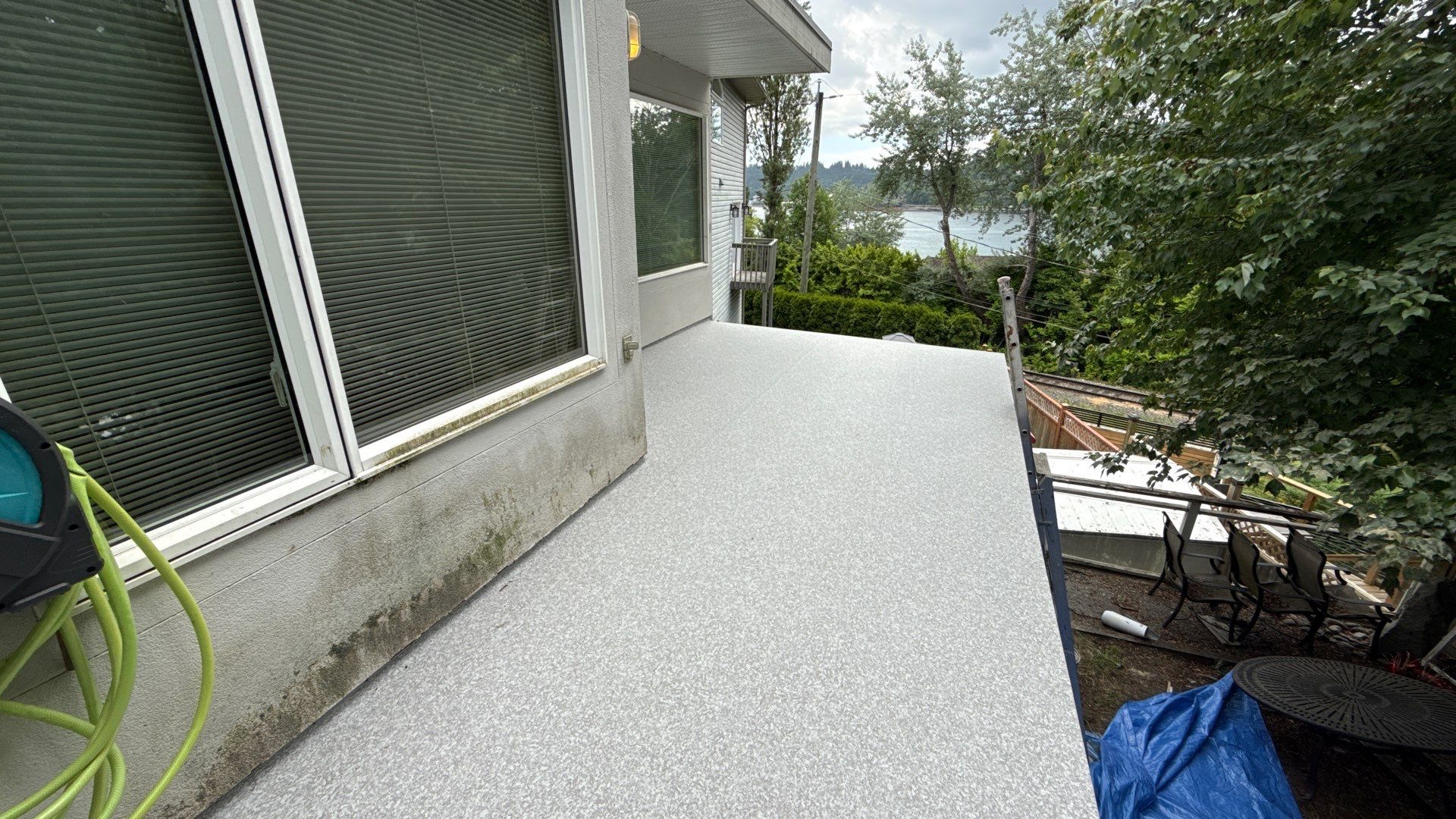
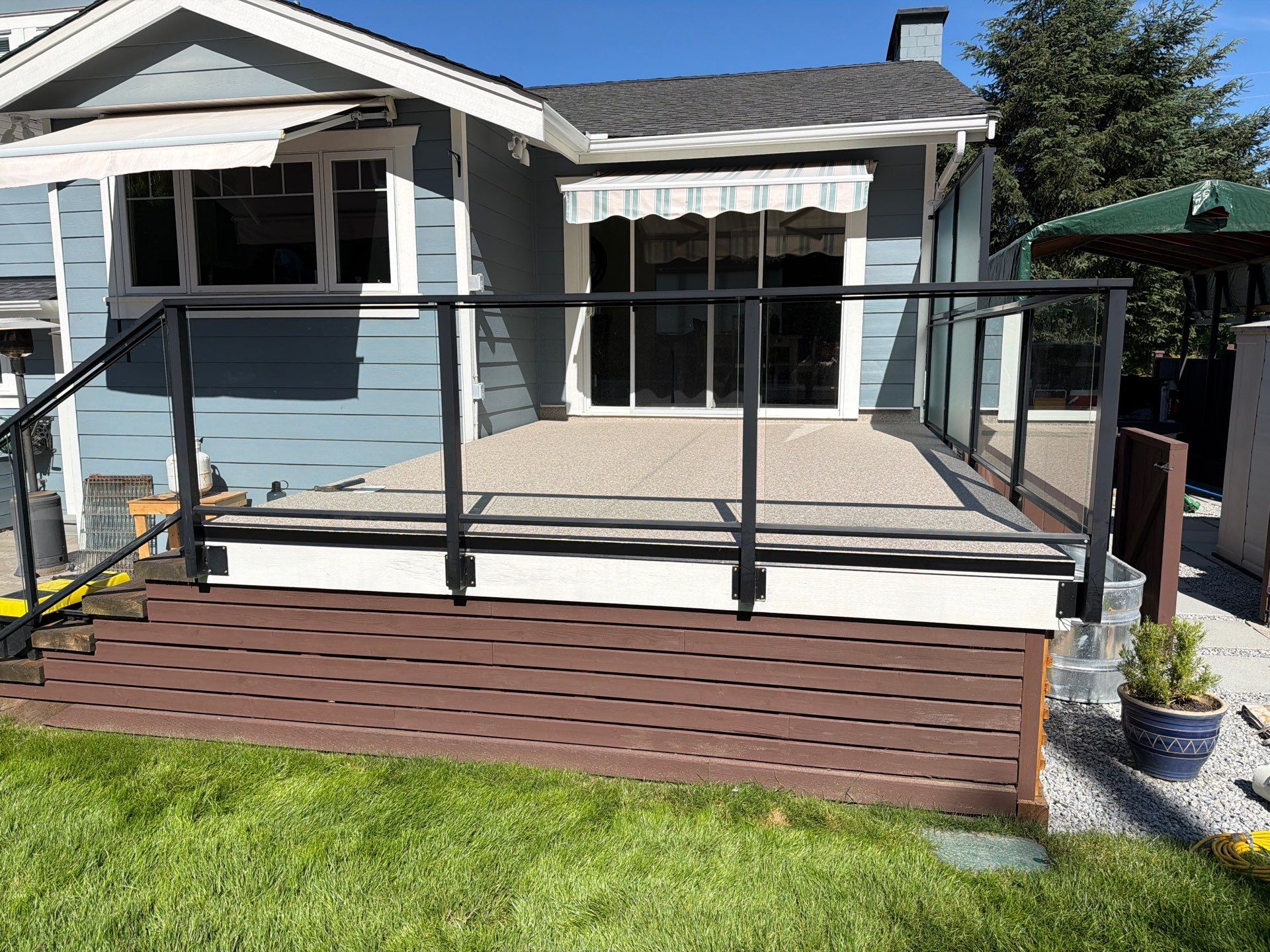
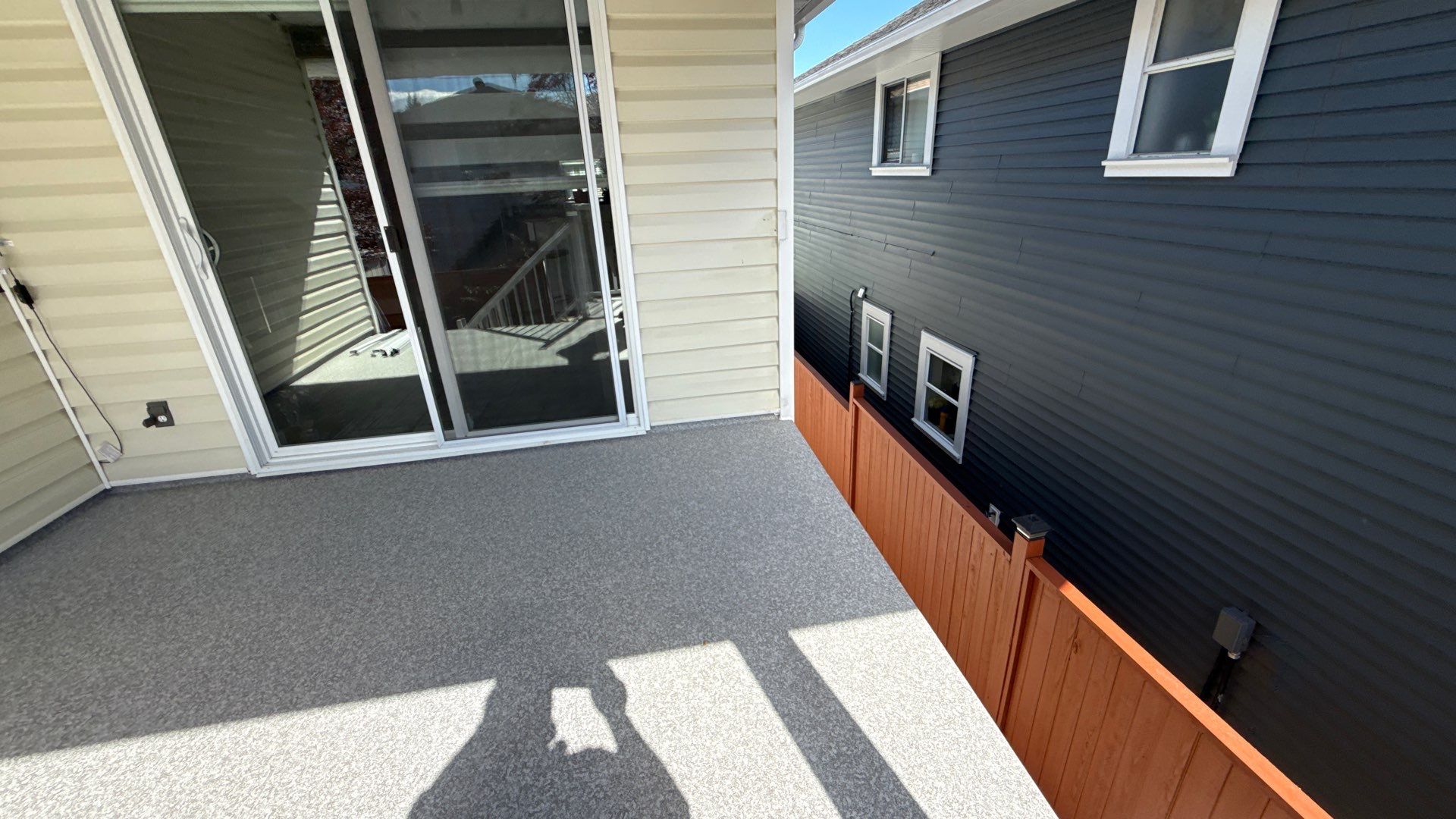
Deck drainage systems move rainwater off a deck or balcony surface and away from the structure beneath it. The four main approaches are positive slope to perimeter scuppers, primary roof drains with overflow drains, under-deck (ceiling) drainage systems, and architectural pedestal-set decks with drainage gaps. Building codes require positive drainage on all elevated decks above occupied space, with a minimum slope of 1/4 inch per foot (2%) the standard target across Canadian and US codes. Drainage and waterproofing are two halves of the same system: a waterproof membrane without proper drainage will pond water and fail prematurely.
Drainage is the part of deck design that gets the least attention and causes the most failures. A correctly specified waterproof membrane installed over a flat substrate with no drainage path will fail. A correctly specified membrane installed with positive slope and properly flashed drains can last 15-20 years without intervention. The difference is not the membrane. The difference is the drainage system. This guide explains how each category of deck drainage works, what codes require, and how each approach interacts with the waterproofing layer. For Valordek's drainage accessories (scuppers, drains, overflow drains, and PVC flashing) see the accessories page.
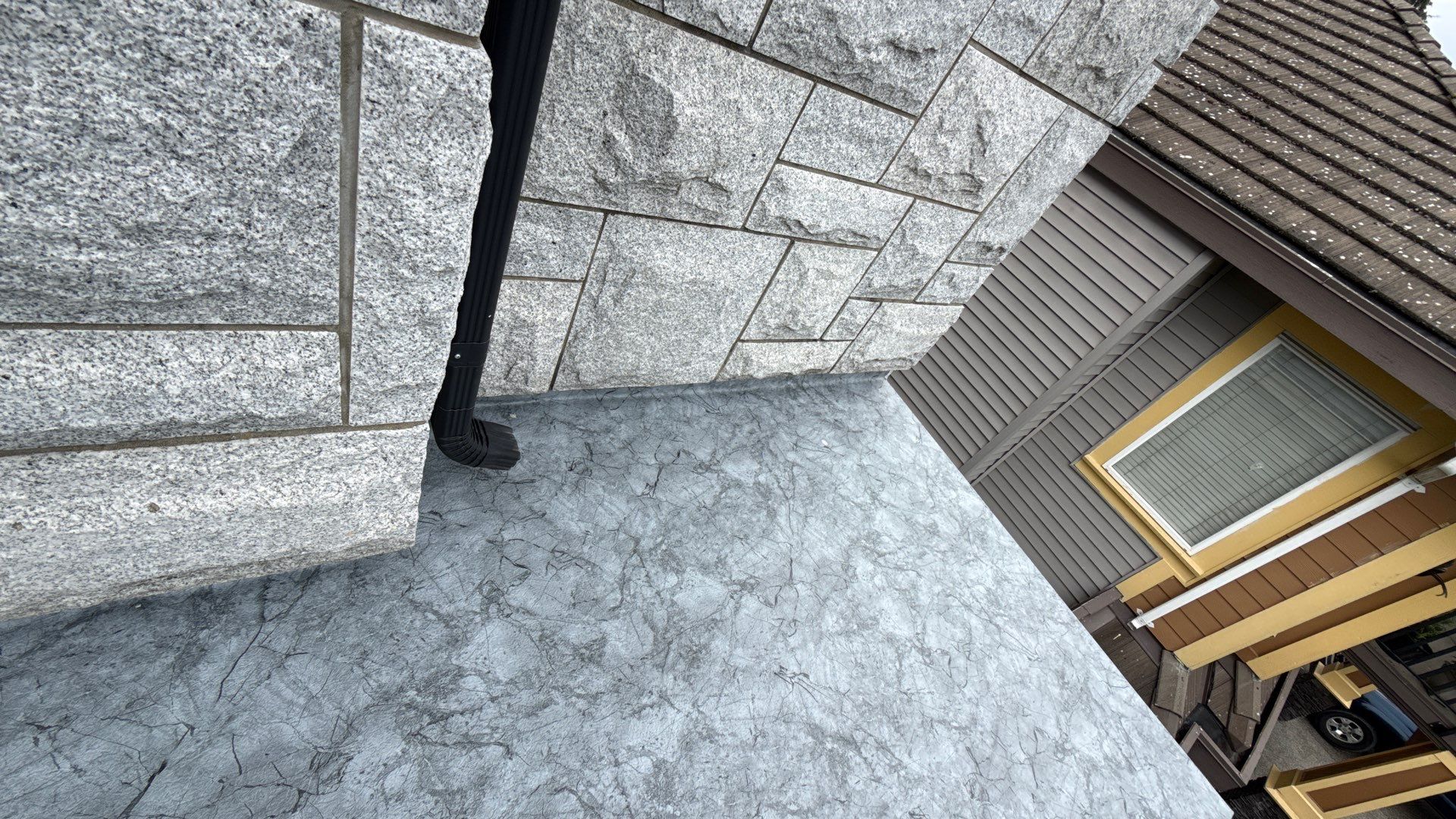
Why deck drainage is required by code
Building codes require positive drainage on every elevated deck above occupied space because standing water creates three failure modes: hydrostatic pressure on the waterproofing layer, accelerated UV and chemical degradation of the membrane, and structural loading from accumulated weight. The minimum slope target across most adopting jurisdictions is 1/4 inch per foot (2%, or 1:48). Some commercial codes require 1/2 inch per foot (4%) on roofing applications. Below 1/4 inch per foot, water ponds and code-compliance is at risk.
The specific code references:
- National Building Code of Canada (NBC) Part 5, Environmental Separation. Requires positive drainage on roof and deck assemblies above conditioned space. Minimum slope is project-specific but 1/4 inch per foot is the published industry standard.
- BC, Alberta, and Ontario Building Codes. Adopt NBC Part 5 with provincial amendments. Drainage requirements carry through.
- International Residential Code (IRC) Section R507.2.4. Requires impervious moisture barrier with positive drainage on decks above interior space.
- International Building Code (IBC) Section 1503.4. Requires every roof or deck above occupied space to be designed to drain water to drains or scuppers.
- IBC Section 1503.4.2. Specifically requires secondary (emergency overflow) drainage when primary drains can become blocked, with the overflow inlet set 2 inches above the primary drain.
The functional reason for the code requirement: standing water amplifies every other risk on a deck. A small membrane defect that would never leak under draining conditions becomes a serious leak under a pond of water with hydrostatic pressure. Accelerated freeze-thaw cycling on standing water destroys flashing details. Snow accumulation on a poorly drained deck adds structural load that the framing was not designed for. Drainage is not a finish detail. It is a structural requirement.
Approach 1: Positive slope to perimeter scuppers
Perimeter scuppers are the simplest and most common drainage approach for residential balconies and small rooftop decks. Water flows down the deck surface to outlets at the perimeter, typically through-wall openings that direct water to gutters, downspouts, or splash blocks below. The deck surface is sloped at 1/4 inch per foot toward the scupper side. The scuppers are integrated into the membrane with manufacturer-specified flashing details.
How perimeter scupper drainage works:
- The substrate is sloped during framing to direct water to the drain side
- The vinyl deck membrane is installed continuously across the slope
- PVC flashing wraps the scupper opening, creating a continuous waterproof seal between membrane and scupper
- Water flows along the membrane surface to the scupper, through the wall opening, and exits to a downspout or splash block below
- Most installations include a screen or grate over the scupper to keep debris out
When perimeter scuppers are the right choice: residential balconies, small rooftop patios under 400 sq ft, projects where the deck has a clear "low side" that drains naturally over the edge or through-wall to landscaping below. Valordek dealers routinely specify perimeter scuppers for condo balcony retrofits because the system integrates cleanly with vinyl deck membrane and the existing balcony structure usually accepts the slope without rebuilding the substrate.
Limitations: scuppers can clog with leaves and debris. They depend on the deck having a clear low side that drains to an acceptable location. They do not work on flat-substrate decks where the building does not allow a perimeter outlet (for example, a balcony that drains only to the wall facing a tenant unit below).
Approach 2: Primary roof drains with overflow drains
Primary roof drains are the standard drainage approach for commercial rooftops, large rooftop decks, and any installation governed by IBC. A drain assembly is installed at the low point of the deck, with the membrane sealed to the drain ring using manufacturer-specified flashing. Water flows by positive slope to the drain, then down through interior plumbing or external downspouts to the storm drainage system. A secondary (overflow) drain is required by code for any deck where blockage of the primary drain would cause water to back up onto the deck or into the building.
How drain-and-overflow drainage works:
- The substrate is sloped to the drain location (typically the geometric low point of the deck)
- The vinyl deck membrane is bonded to a manufacturer-specified drain ring (PVC-compatible) using heat welding or contact adhesive
- The drain assembly has a sump that captures water and routes it to plumbing below
- An overflow drain is installed 2 inches higher than the primary drain, in a separate location or as part of a combination drain assembly
- The overflow exits to a visible location (a wall scupper, an external pipe with daylight discharge) so building owners can see when the primary is blocked
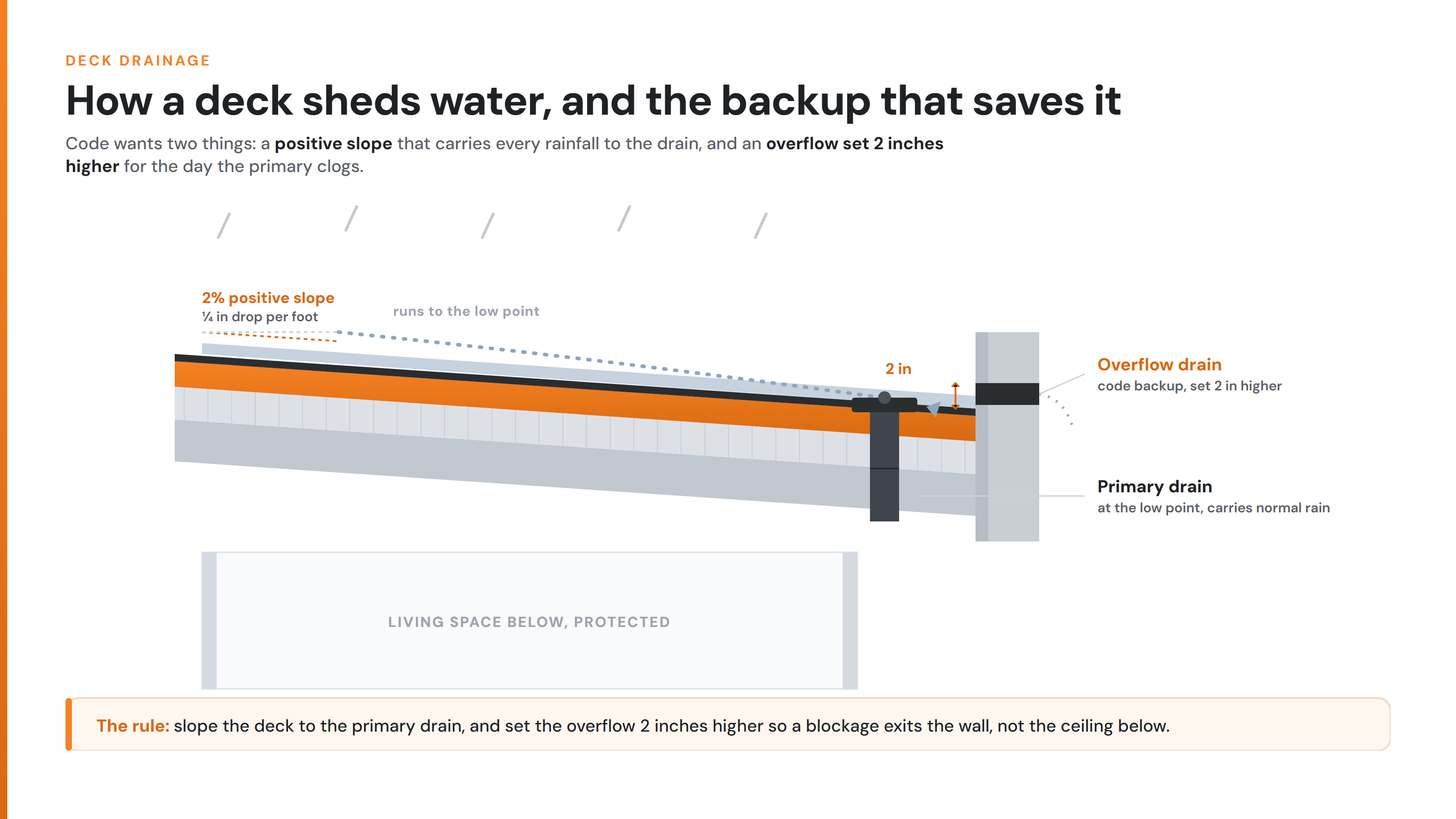
When primary-and-overflow drainage is the right choice: commercial rooftop decks, residential rooftops over 400 sq ft, multi-unit buildings where IBC governs, projects where through-wall scuppers are not architecturally acceptable, projects with significant snow or rainfall load. Valordek's PVC-coated drains and overflow drains are designed for direct integration with both Fuzzy-Back and Smooth-Back membrane lines.
Limitations: more expensive than perimeter scuppers due to the drain hardware and plumbing connections. Requires interior or exterior plumbing routing. Drain selection must match the membrane manufacturer's flashing specification. Generic roof drains designed for built-up roofing may not integrate properly with PVC vinyl deck membrane.
Approach 3: Under-deck (ceiling) drainage systems
Under-deck drainage systems are aftermarket additions installed below the deck framing to capture and divert water that has already passed through gaps in the walking surface above. These systems are typically used on wood or composite decks at ground level over a usable space below, for example a deck over a covered patio. They are NOT a substitute for waterproofing on elevated decks above occupied space, and codes do not accept under-deck systems as the primary waterproofing layer for that application.
How under-deck systems work:
- Sloped panels (usually aluminum or PVC) are installed below the deck framing, between or beneath the joists
- The panels capture water that drips through the deck boards above
- Water is channelled to gutters and downspouts at the perimeter
- The space below the deck stays dry enough to use as covered outdoor living area
When under-deck systems are the right choice: ground-level wood or composite decks where the homeowner wants to use the space below as a dry covered patio. Under-deck systems make sense as an aesthetic and functional add-on for that scenario. They do not solve any waterproofing problem on a balcony or rooftop above occupied indoor space. Those projects need a continuous waterproof membrane on the deck surface, not a catch-tray below it.
The marketing on under-deck systems sometimes positions them as waterproofing solutions. They are not. A 1/8-inch gap between deck boards passes most of the water that hits the deck. The under-deck panel catches it. But the water is still passing through the deck, the structure between the boards and the panels is still being wetted, and the long-term durability of the framing depends on whether that wetting can dry out between rain events.
Approach 4: Pedestal-set decks with gap drainage
Pedestal-set decks (also called "structural pavers" or "tile-on-pedestal" systems) use composite or stone tiles set on adjustable plastic pedestals above a continuous waterproof membrane below. Water drains through the gaps between tiles, runs down the membrane underneath, and exits to drains at the membrane level. The walking surface and the waterproofing layer are physically separated, which is the architectural distinguishing feature.
How pedestal drainage works:
- A continuous waterproof membrane is installed first (vinyl, EPDM, or modified bituminous)
- The membrane is sloped at 1/4 inch per foot to drains at the perimeter or center of the deck
- Adjustable plastic pedestals are placed on the membrane (the pedestals have rubber feet that do not damage the membrane)
- Concrete pavers, porcelain tiles, or composite tiles sit on the pedestals with gaps between each tile
- Rainwater passes through the gaps, lands on the membrane, flows by gravity to the drains
When pedestal systems are the right choice: high-end residential rooftop decks where the architectural look of stone or porcelain pavers is required, commercial rooftop amenity spaces, projects where the deck must be perfectly flat to walk on regardless of substrate slope (the pedestals adjust to compensate), projects with significant budget for design and installation. The system can carry significant load and integrates with green roof systems on commercial buildings.
Limitations: most expensive of the four approaches. Membrane underneath is hidden and inaccessible without lifting tiles, making service difficult. Requires both a complete waterproofing system AND a complete walking surface system. Total installed cost is typically 3-5 times higher than a single-layer vinyl deck membrane installation.
How vinyl deck membrane integrates with each drainage approach
Vinyl deck membrane works as the waterproofing layer in three of the four drainage approaches: perimeter scuppers, primary-and-overflow drains, and pedestal-set systems. The membrane is the continuous waterproof field surface that water flows across before reaching the drain or scupper. The integration detail at the drain or scupper is the most important technical decision in the install. Most leaks happen at drainage terminations, not in the field of the membrane. See how vinyl decking is installed for the full field process.
For Valordek vinyl deck membrane installations, the drainage integration follows manufacturer-specified flashing details documented in our Resources section:
- Perimeter scuppers: Membrane wraps the scupper opening with PVC flashing. Heat-welded seams between the field membrane and the flashing piece create a continuous waterproof barrier. Membrane terminates 1-2 inches inside the scupper to prevent water bypass.
- Primary roof drains: Membrane bonds to a PVC-compatible drain ring using contact adhesive and heat welding. The drain manufacturer's specification must accept PVC vinyl membrane integration. Generic roof drains may require an adapter ring.
- Overflow drains: Same flashing pattern as primary drain, installed 2 inches higher in elevation. The membrane is pulled up over the elevation change and welded to the overflow ring.
- Pedestal systems: Membrane is installed across the entire substrate with normal field installation. Pedestals are placed directly on the membrane (vinyl is dimensionally stable enough to handle the localized pressure). Drain locations are flashed normally.
Common deck drainage failures
The most common deck drainage failures are not catastrophic events. They are slow, hidden problems that compound over years until a sudden water-damage event reveals what was wrong all along. Understanding the failure modes helps with both new construction specification and existing-deck audits. Many overlap with the broader balcony waterproofing failures we see in the field.
- Insufficient slope. Substrate sloped less than 1/4 inch per foot, or sloped in the wrong direction. Water ponds. Membrane fails earlier than warranty period.
- Drain clogged with debris. Most decks lack debris guards or have improperly sized guards. Leaves and dirt accumulate. Water backs up. Often invisible until a heavy rain event causes overflow.
- No overflow drain on a deck that requires one. Code requires overflow on most commercial and multi-unit installations. Single-drain decks fail catastrophically when the primary drain blocks.
- Membrane terminated short of the drain. Membrane ends an inch or two from the drain ring instead of bonding to the ring directly. Water finds the gap.
- Wrong drain type for the membrane. Built-up roofing drains used with vinyl membrane installations. The flashing pattern does not seal correctly because the drain was designed for a different waterproofing system.
- No flashing at scuppers. Scupper opening cut through wall and deck without proper PVC flashing wrap. Water enters the wall cavity at the scupper.
- Slope reversed by accumulated dirt and tile. On pedestal systems, dirt build-up under tiles creates micro-dams that reverse the local slope of the membrane.
Drainage approach comparison
| Approach | Best for | Cost (relative) | Code suitability | Service difficulty |
|---|---|---|---|---|
| Perimeter scuppers | Residential balconies, small rooftop decks under 400 sq ft | Lowest | NBC Part 9, IRC R507: fully compliant | Easy: scuppers visible and accessible |
| Primary roof drains + overflow | Commercial rooftops, large residential rooftops, multi-unit buildings | Moderate | NBC Part 5, IBC 1503.4: fully compliant when overflow installed | Moderate: drain hardware accessible from above |
| Under-deck (ceiling) systems | Ground-level wood/composite decks with usable space below | Moderate, but requires a separate primary deck surface | NOT a code-compliant primary waterproofing system for elevated decks | High: panels installed below framing |
| Pedestal-set with gap drainage | High-end rooftop amenity decks, architectural stone/porcelain finishes | Highest (3-5x single-layer) | Compliant when membrane below is third-party-tested and code-rated | Highest: membrane hidden under tiles, service requires lifting pavers |
What this means for specifying a deck
If you are specifying a deck above occupied space, the drainage decision should be made before the membrane selection. The drainage approach determines what membrane integration details are required, what slope the substrate must achieve, and whether the project budget supports a single-layer or two-layer system. Most residential balcony projects specify Valordek Fuzzy-Back vinyl deck membrane with perimeter scuppers because the combination is the lowest-cost code-compliant solution. Most commercial rooftop projects specify Valordek Smooth-Back with primary-and-overflow drains because the fire rating, the longer warranty, and the heat-welded seams are required by larger projects.
The drainage detail drawings for both Valordek product lines are published in our Resources section, including specifications for primary drains, overflow drains, perimeter scuppers, and wall-junction flashing. For project-specific drainage design, contact a certified Valordek dealer through find a dealer.