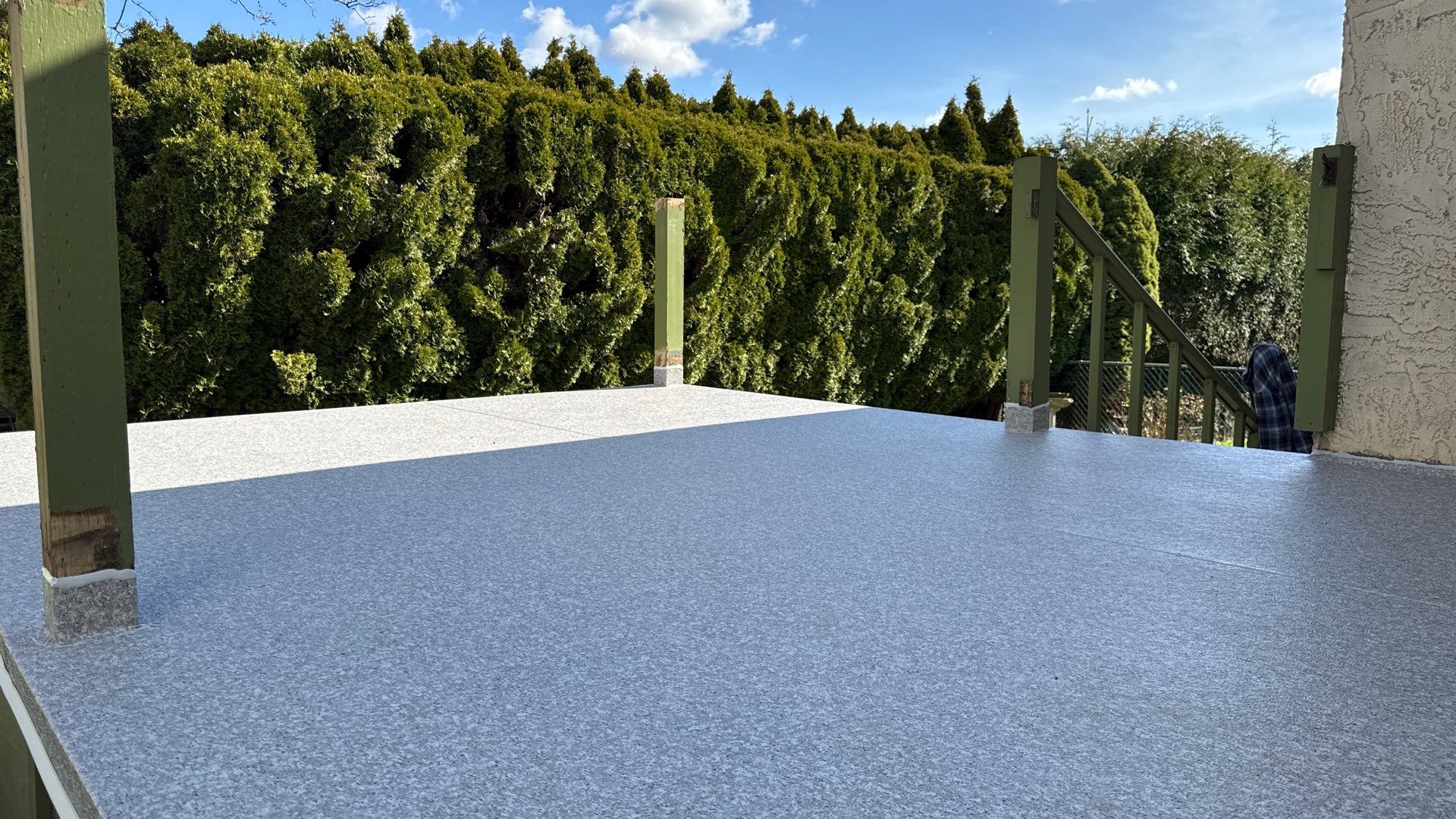
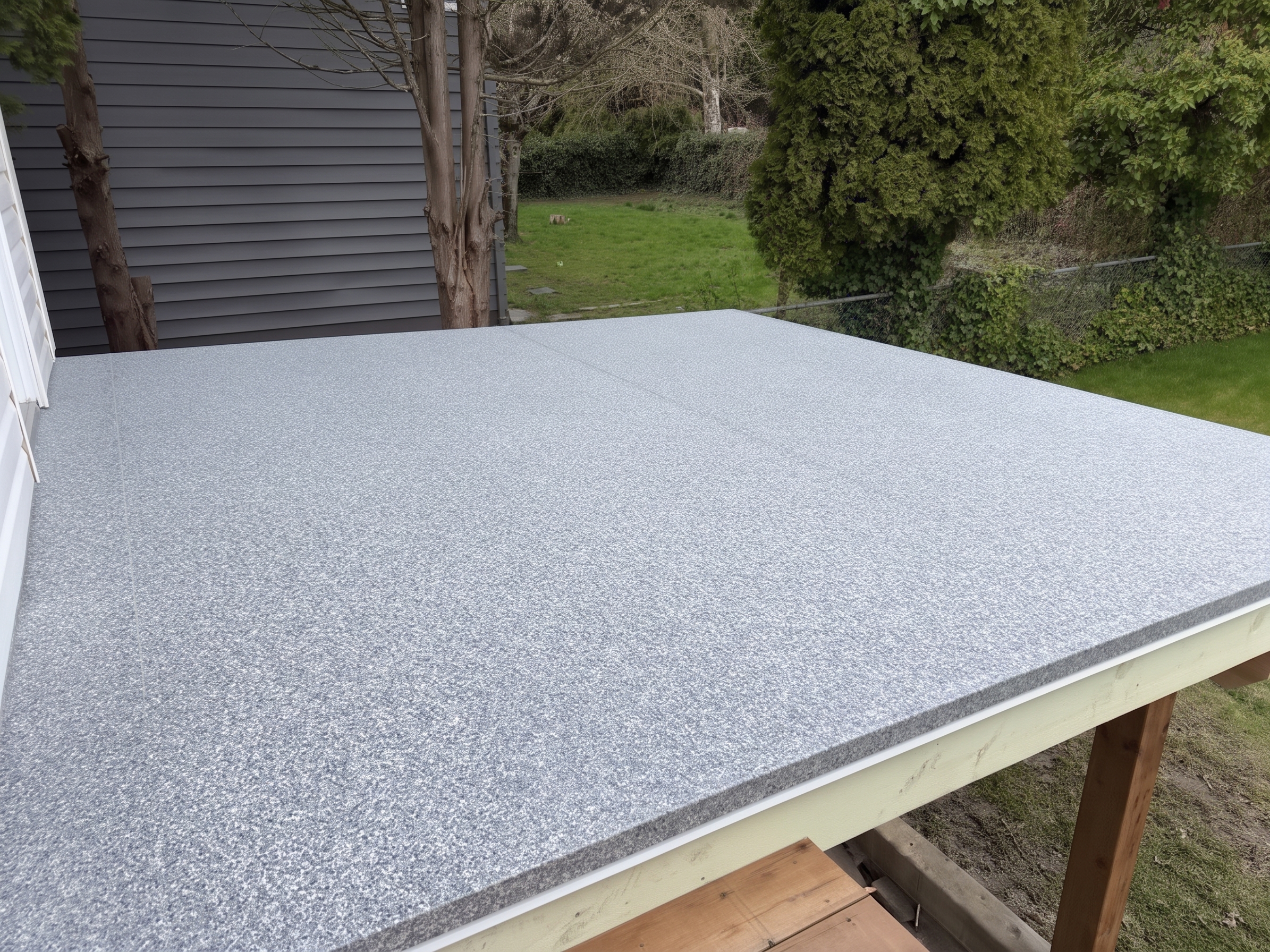
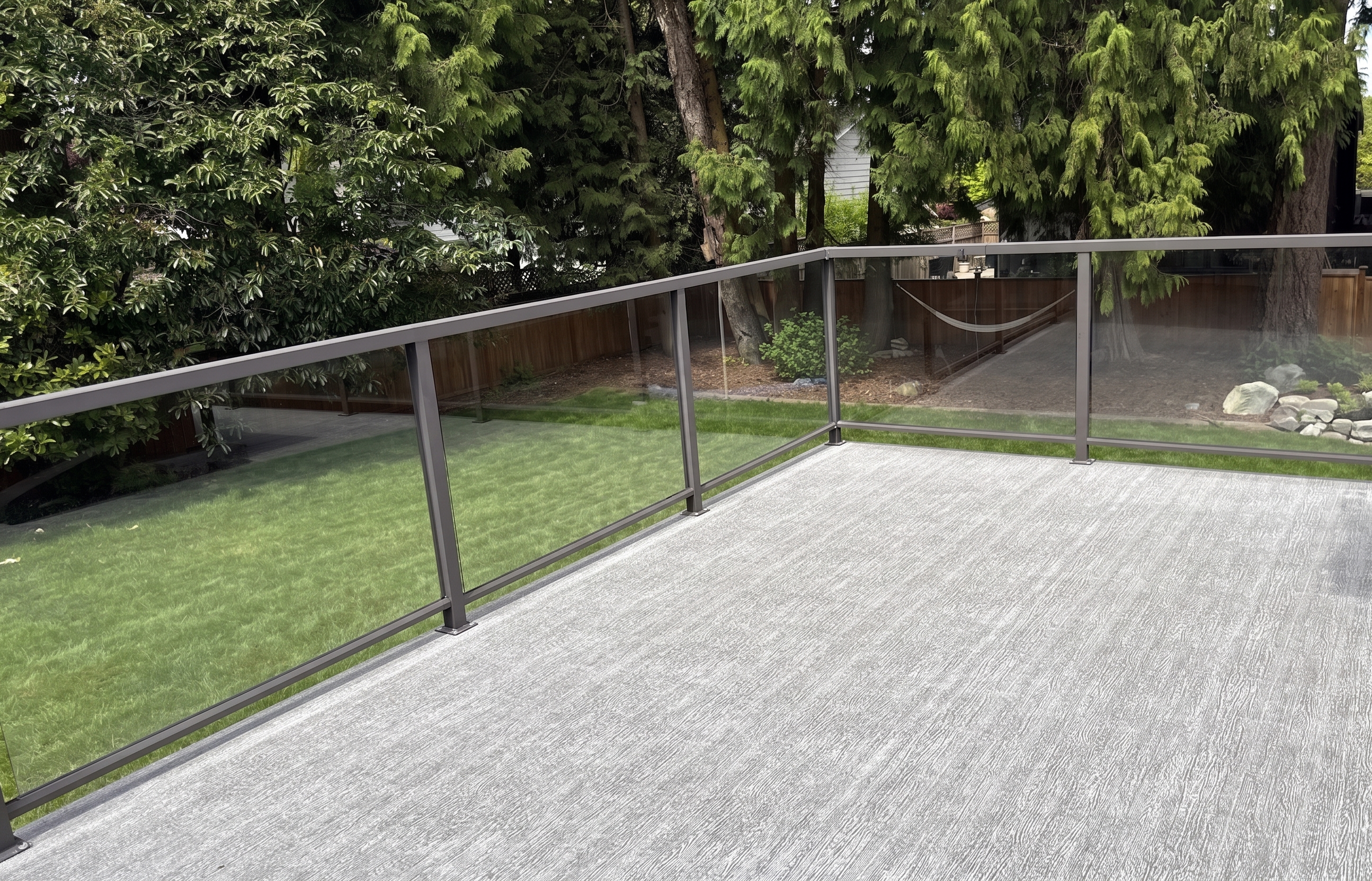
Drip edge flashing for a deck is a metal profile along the open edge that the vinyl membrane laps over. Its face turns down over the top of the fascia and a half-inch kick throws water clear. Valordek offers five profiles and holds the membrane with a PVC U-Lock clip or a heat weld to PVC coated flashing.
The edge matters because it is where the water goes. A vinyl deck is built with a slope of at least 1/4 inch per foot so rain runs off instead of sitting on the surface, which means nearly every drop that lands on the deck ends up at a drain or an open edge. At the edge, one detail decides what happens next: either the water drips clear of the building, or it clings to the edge, runs down the fascia and finds its way into the framing behind it. The flashing, the clip and the way the membrane wraps the edge are what make it the first outcome. Valordek supplies every part of that detail, listed with dimensions on the accessories page.
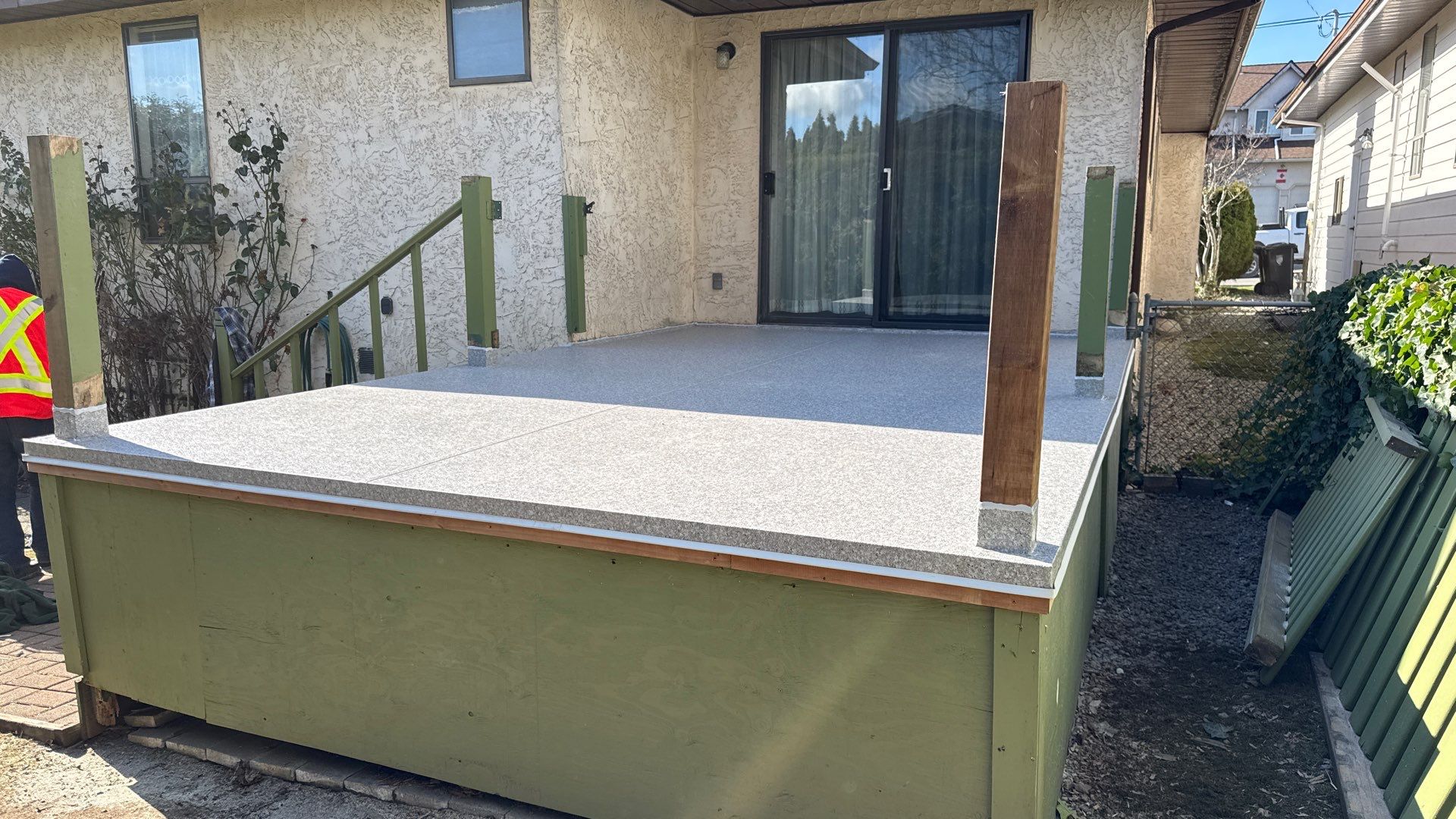
What does drip edge flashing do on a vinyl deck?
Drip edge flashing carries water off the open edge of a vinyl deck and releases it away from the fascia, so the wood behind the edge stays dry. Water does not simply fall off an edge. It clings to the underside of whatever it is running over and follows it, which is why a bare deck edge can leave a wet stripe down the fascia after every rain.
A drip flashing breaks that path in two ways. Its top leg sits under the membrane on the deck surface, so water crossing the deck runs onto metal instead of into the joint between the plywood and the fascia. Its bottom edge then kicks outward and down, so the water leaves from a point held off the face of the fascia rather than running down it. Valordek describes its aluminum drip flashing in exactly these terms: it "directs water away from the fascia."
The flashing also gives the vinyl a straight, rigid edge to wrap and somewhere to be secured: a clip on one system, a welded bond on the other. Valordek membranes are tested to perform from -40°C to 80°C, so the edge detail has to stay secure through the same seasonal swings.
The parts of a deck edge: top, face, kick and safety edge
A drip flashing profile has four parts, and Valordek's profile guide dimensions each one: the top, the face, the kick and the safety edge. Knowing the names makes a quote much easier to read.
- Top. The horizontal leg that sits on the deck surface under the membrane. Water crossing the deck runs over it.
- Face. The vertical leg that runs down the outside of the edge, covering the joint between the deck and the fascia.
- Kick. A short leg at the bottom of the face, angled outward, that throws water clear. On Valordek's drip profiles it is 1/2 inch.
- Safety edge. The folded edge on the end of the kick, included on every Valordek drip profile.
The membrane is the part you see. It runs across the deck, over the top of the flashing and is either locked into a clip or welded to the flashing, depending on the system. The flashing underneath is what turns that wrapped edge into one that sheds water.
Valordek's five flashing profiles
Valordek makes five deck flashing profiles: one L-shaped corner flashing and four drip flashings that differ in the size of their top and face. All four drip profiles share the same 1/2-inch kick and include a safety edge. The dimensions below come from Valordek's Deck Flashing Profile Guide, which has a dimensioned drawing of each profile.
| Profile | Top | Face | Kick | Safety edge |
|---|---|---|---|---|
| Valordek Corner Flashing (L) | 2" | 2" | None | Not applicable |
| Valordek Slim Drip Flashing | 2" | 1.5" | 1/2" | Included |
| Valordek Standard Drip Flashing | 2" | 2" | 1/2" | Included |
| Valordek Deep Drip Flashing | 2" | 3" | 1/2" | Included |
| Valordek Wide Drip Flashing | 4" | 2" | 1/2" | Included |
A longer face covers more of the edge below the deck surface, and the wide profile carries a 4-inch top leg onto the deck. Which profile suits a given edge depends on how that edge is built, so it is a choice your installer or Valordek dealer makes on site. On a quote, it is reasonable to ask which profile is specified and why.
Clip or weld: two ways to hold the membrane at the edge
Valordek offers two edge systems: aluminum drip flashing with a PVC U-Lock clip that holds the membrane mechanically, and PVC coated flashing that the membrane is heat welded to directly. Both finish the edge cleanly. The difference is how the membrane is held and what replaces what.
| PVC U-Lock Clip and Drip Flashing | PVC Coated Flashing | |
|---|---|---|
| How the membrane is held | Mechanically, by a PVC U-Lock clip | Heat welded directly to the PVC-coated surface |
| Waterproofing at the edge | The clip secures the membrane; the aluminum drip flashing directs water away from the fascia | A permanent welded bond between membrane and flashing, described by Valordek as a watertight edge |
| Clip needed | Yes | No, the weld replaces the U-Lock clip |
| Profile and length | 2" x 2" x 96" | 2" x 2" x 96" |
| Colours | U-Lock clips in grey and beige | Grey and beige |
| Warranty condition | Valordek's warranty is valid only when a certified installer uses Valordek-approved adhesives and system components | |
Both lengths are 96 inches, so a long edge is flashed in sections that are joined along the way, and corners need their own detail. Heat welding the membrane to PVC coated flashing takes a hot air welder and the training to use it, the same skill set used on the seams of every Valordek vinyl decking installation. The grey and beige options let the edge blend with the deck colour.
Drip edge or wall flashing: which detail goes where
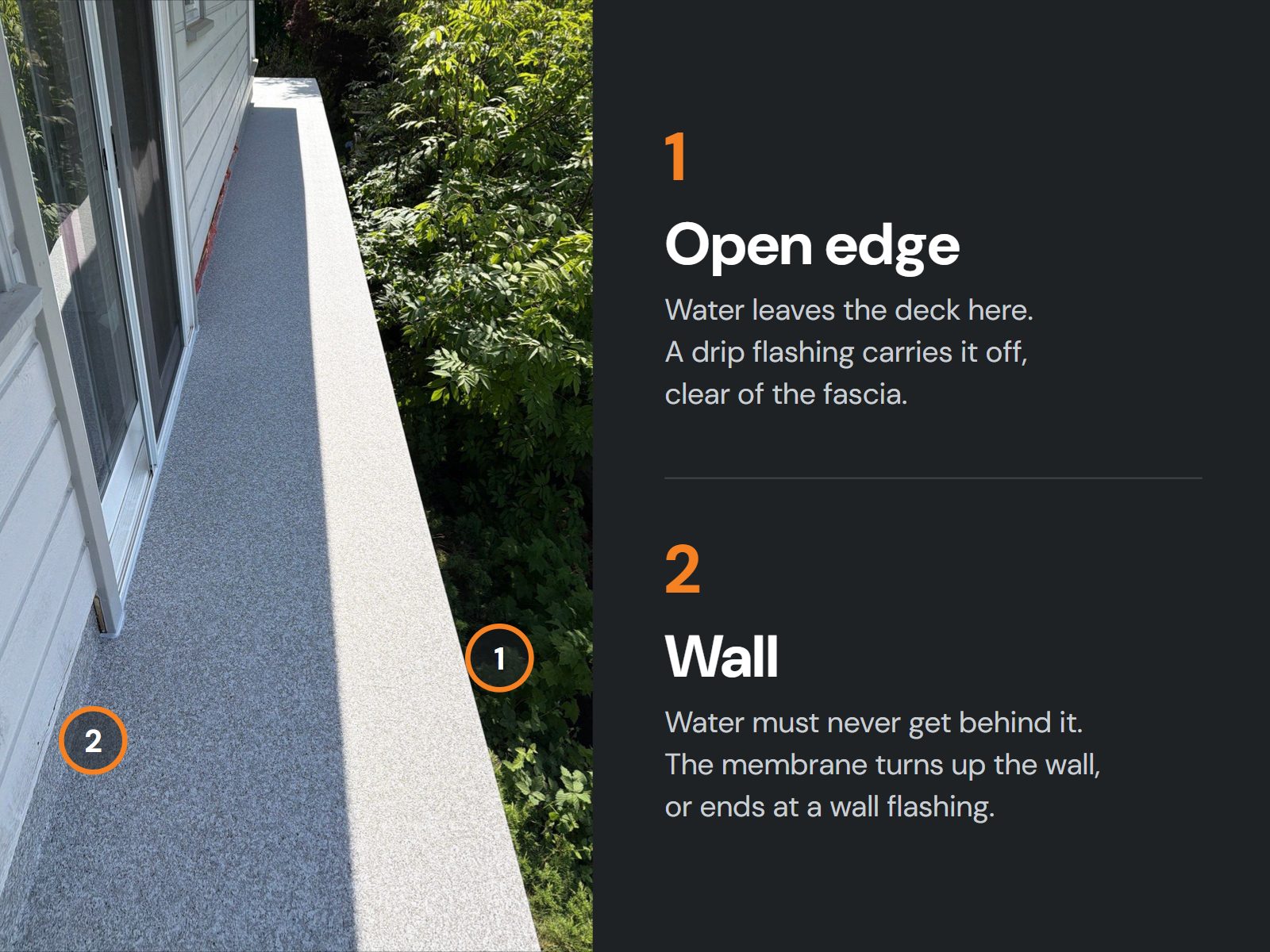
A drip edge belongs at an open edge, where water should leave the deck; a wall needs a termination that keeps water out of the building, so the two details are not interchangeable. One sheds water away; the other seals against a surface the water must never get behind.
At a wall, the membrane is normally turned up the wall. Where a full upturn is not possible, Valordek's Mechanical Fastener and Aluminum Wall Flashing gives the membrane a secure termination point, with a powder-coated fastener holding the membrane and the aluminum flashing making the transition to the wall. The wall line is one of the places balcony leaks most often begin, which we cover in where vinyl deck leaks actually start.
Drains and scuppers are the third kind of edge. Where water leaves through a wall or a deck drain rather than over an open edge, the membrane is welded to the flange of a PVC coated scupper or drain instead. How those fit into the bigger picture is explained in deck drainage systems explained.
Open decks and Smooth-Back: when PVC flashing is required
Valordek's 60 mil Smooth-Back membrane requires PVC flashing when it is installed on an open deck; the 68 mil Fuzzy-Back does not carry that requirement. This is a product-level rule, and it changes what a correct edge looks like depending on which membrane is on the deck.
Smooth-Back is the membrane Valordek makes for rooftop decks. It is installed with Sika 2170-R contact adhesive, carries Class A and C fire ratings and is tested by Intertek to exceed code 37.54.95. Valordek specifies professional installation for it, and its FAQ is direct about why: PVC flashing requires specialized equipment and training to ensure waterproof integrity. Fuzzy-Back, the membrane most balconies use, is CCMC tested to the same code, and Valordek's FAQ says it can be a DIY project with proper preparation, though the warranty applies only to certified installations. Either way, its open edges still need a proper drip detail. The full comparison of the two is in our guide to 60 vs 68 mil vinyl decking.
Signs the edge detail is failing
A failing deck edge usually shows itself on the fascia first: staining, peeling paint or soft wood just below the edge, often long before anything looks wrong on the deck surface. Because the edge sheds water outward, problems tend to appear on the outside face and on the framing behind it.
- Dark streaks or a wet stripe down the fascia after rain, which means water is running down the face instead of dripping clear.
- Peeling paint or swelling along the fascia and rim, a sign the wood behind the face is staying wet.
- The membrane edge lifting, curling or pulling out of its clip, which opens a path under the vinyl.
- Soft or spongy wood at the edge when pressed from below, which points to rot that has been developing for a while.
Rot near the edge can spread under the membrane before the surface shows it, which is covered in how to tell if there is rot under your vinyl deck membrane. Railing posts are often mounted at the edge as well, and they create their own leak path, explained in why balconies leak around railing posts. For the wider list of what goes wrong on balconies, see balcony waterproofing failures.
What to check on a deck quote
A good quote for a vinyl deck names the edge system, the flashing profile and how walls, corners and drains are handled, rather than folding the edge into one line called trim. These are the questions worth asking before you sign:
- Which edge system is used: PVC U-Lock clip with aluminum drip flashing, or PVC coated flashing welded to the membrane?
- Which flashing profile: slim, standard, deep or wide, and why it suits your edge?
- How the deck slopes: Valordek specifies a minimum of 1/4 inch per foot so water reaches the edge or drains.
- How walls are terminated: a full upturn, or a mechanical fastener with wall flashing where an upturn is not possible?
- How corners and drains are detailed, since every change of direction is a place water can get in.
- Whether every component is Valordek-approved and installed by a certified installer. Valordek's warranty, 15 years for waterproofing and 5 years for appearance on both membranes, is valid only under those conditions. Installation workmanship is the contractor's responsibility.
If you are replacing an old membrane, the edges are one of the details that get rebuilt, along with the walls and door pans; what replacing a vinyl deck involves walks through the full job. For a new deck, the installation process shows where the edge fits in the sequence.
Frequently Asked Questions
What kind of flashing does a vinyl deck need?
A vinyl deck needs drip flashing at its open edges and a proper termination where it meets a wall. Valordek supplies aluminum drip flashing with a PVC U-Lock clip, PVC coated flashing the membrane is welded to, and a mechanical fastener with aluminum wall flashing for walls where a full upturn is not possible.
Is deck flashing necessary on a vinyl deck?
Yes. The deck slopes so water runs to its edges and drains, and without flashing that water runs down the fascia and into the framing. On an open deck, Valordek's 60 mil Smooth-Back membrane specifically requires PVC flashing, and the warranty requires Valordek-approved components.
Can you use drip edge as flashing?
Drip edge is a type of flashing, used at open edges where water should leave the deck. It is not a substitute for wall flashing. Where a deck meets a wall, the membrane is turned up the wall or terminated with wall flashing so water is kept out rather than shed.
What does drip edge flashing look like?
It is a long angled metal strip with a top leg on the deck surface, a face running down the outside of the edge and a short kick at the bottom angled outward. Valordek's standard drip profile is 2 inches by 2 inches with a 1/2-inch kick.
How do I add flashing to an existing vinyl deck?
On a vinyl deck the flashing works together with the membrane edge, so it is not a strip you can caulk on afterwards. Adding or replacing it means opening and rebuilding the edge detail, which is a job for an installer or Valordek dealer.
How is vinyl deck edge trim attached?
Valordek edge trim is attached in one of two ways: a PVC U-Lock clip holds the membrane over aluminum drip flashing, or the membrane is heat welded straight to PVC coated flashing.