A depreciation report that flags balcony membranes is a planning forecast, not an engineering diagnosis. It tells your strata council that the membranes are approaching the end of their service life and that money should be set aside. It does not tell you the actual condition, the real scope, or the current price. The next step is a membrane condition assessment, not a vote.
This distinction matters more than any other point in this guide. Depreciation reports are prepared from visual review and industry-average unit pricing, and those cost figures commonly lag current Lower Mainland contractor rates by one to three years. A council that budgets straight from the report is usually budgeting from stale numbers. A council that commissions a condition assessment first gets the two things the report cannot give it: what the membranes are actually doing, and what the work actually costs today. If your building is in Metro Vancouver, this is likely your first report under the new phased requirement, which is exactly why so many councils are having this conversation at once.
Why is my strata getting this now?
British Columbia moved to a phased, mandatory depreciation report schedule, and Metro Vancouver and Capital Regional District stratas with five or more lots reached their compliance date on 1 July 2026. The rest of British Columbia, including the Southern Gulf Islands and Bowen Island, reaches the same requirement on 1 July 2027. Reports must be renewed on a five-year cycle, and the annual three-quarters vote that previously let a strata defer getting one has been eliminated. Stratas of four or fewer lots remain exempt.
The practical consequence is that thousands of BC strata councils received a professionally prepared capital plan in the same window, many of them for the first time. Balcony waterproofing is a standard line item in those reports because it is a finite-life building envelope component. Seeing it listed is normal. It is not an emergency, and it is not a finding of failure.
What does a depreciation report line item actually tell you?
A depreciation report estimates when a component will need renewal and roughly what that will cost, based on typical service life and average pricing. It is a 30-year financial planning document prepared under the Strata Property Act. The person preparing it is forecasting a budget, not inspecting your membranes in detail.
Here is what the report gives you and what it does not:
| Question | Depreciation report | Membrane condition assessment |
|---|---|---|
| Method | Visual review, service-life tables | On-site inspection, moisture readings, edge probe |
| Answers "when should we budget?" | Yes | Partly |
| Answers "what condition are they in?" | No | Yes |
| Answers "what is the real scope?" | No | Yes |
| Pricing basis | Industry averages, often 1 to 3 years old | Current contractor quotes |
| Identifies hidden substrate damage | No | Yes |
| Typical cost to the strata | Included in the report fee | Often free from an authorized dealer |
The last row is the one most councils miss. A membrane condition assessment from an authorized dealer is frequently provided at no charge as part of quoting the work, which means the single most useful piece of information available to your council is usually the cheapest.
Is the strata responsible, or is the owner?
In most BC strata corporations the balcony membrane is the strata's responsibility to repair and maintain, even when the balcony itself is limited common property assigned to one unit. Section 72 of the Strata Property Act places the duty to repair and maintain common property on the strata corporation, and the waterproofing assembly is part of the building envelope rather than a personal fixture.
Bylaws can vary this in specific ways, so the honest answer is that your bylaws and your registered strata plan decide the edge cases. What is rarely in dispute is the envelope itself. Misclassifying an envelope failure as an owner expense is one of the faster routes to a Civil Resolution Tribunal dispute, because the owner is being asked to pay for a component they do not control and cannot access. We cover the responsibility question, limited common property, and the approval path in detail in our guide to BC strata balcony waterproofing responsibility.
This article is general information, not legal advice. For an interpretation of your specific bylaws, speak to your strata lawyer or property manager.
What does a proper membrane condition assessment involve?
A real assessment establishes three things: whether the membrane is still watertight, whether the substrate underneath is sound, and how much of the deck actually needs work. That last point is where councils save the most money, because partial replacement is often viable and a depreciation report will almost never tell you that.
A competent assessor will check:
- Termination points first. Wall and door flashings, railing post penetrations, and drain edges are where balcony leaks overwhelmingly begin, not the open field of the membrane.
- Seam condition. Lifting, splitting, or previously patched seams indicate age and movement.
- Substrate soundness. Soft or spongy areas underfoot, staining on the soffit below, and moisture readings at the deck edge. A membrane is non-porous, so a wet substrate underneath cannot dry out and the damage progresses invisibly.
- Slope and drainage. Ponding water is a design or installation issue that will destroy a new membrane just as reliably as it destroyed the old one.
- Unit-by-unit variation. South and west exposures typically age faster. A 40-unit building rarely needs 40 identical scopes.
If the assessment finds rot in the plywood substrate, the scope and the budget both change materially. That is a good outcome to discover during planning rather than after a special levy has been approved at the wrong number. Our guide on why balcony waterproofing fails covers the failure modes an assessor is looking for.
How do we fund it, and does the report force us to act?
A depreciation report does not compel a strata to do the work. It removes the excuse of not knowing. The report is a planning instrument. The decision to proceed still runs through the normal governance path: contingency reserve fund draw, or a special levy approved by three-quarters vote where the reserve cannot carry it.
What the report does change is the council's exposure. Once balcony waterproofing is documented as approaching end of life, deferring it is a recorded decision rather than an oversight, and it becomes visible to buyers, insurers, and lenders reviewing the strata's documents. Prospective purchasers now routinely read depreciation reports before making an offer.
What does waiting actually cost?
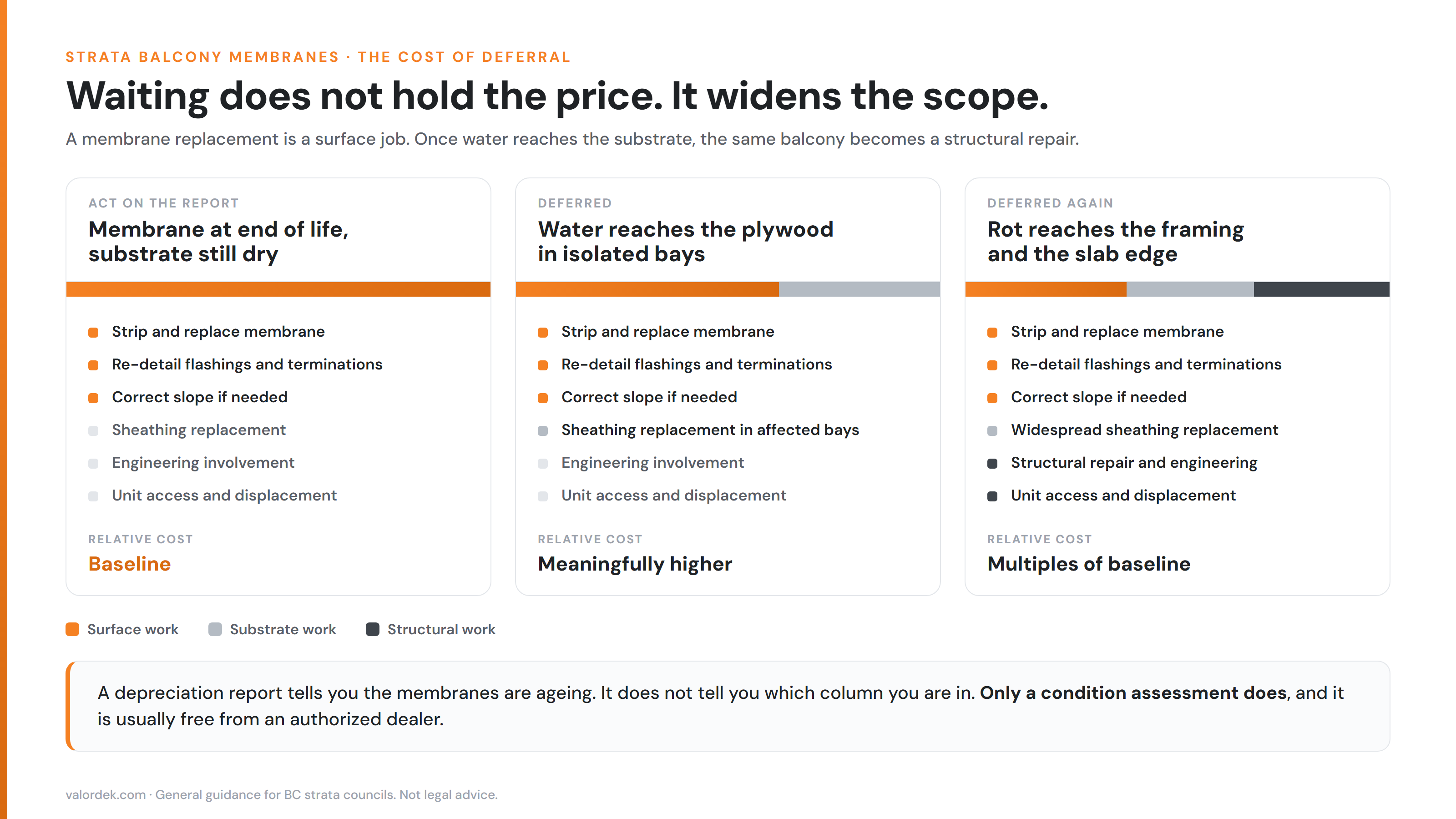
Deferral does not hold the price. It compounds the scope. A membrane replacement is a surface renewal. Once water reaches the substrate, the same job becomes a structural repair, and the cost difference is not incremental.
| Stage | What the work is | Relative cost |
|---|---|---|
| Membrane at end of life, substrate sound | Strip and replace the membrane. Materials from $3.74 per square foot. | Baseline |
| Localised substrate damage | Membrane plus sheathing replacement in affected bays | Meaningfully higher |
| Widespread rot, framing affected | Structural repair, engineering involvement, possible unit access and displacement | Multiples of baseline |
Documented BC cases bear this out. Councils that voted down a balcony repair at an early estimate have gone on to face per-unit costs several times the original whole-project figure once the work could no longer be deferred. The pattern is consistent enough to plan around: the cheapest version of this project is the one you do while the substrate is still dry.
For a like-for-like sense of material cost before quotes arrive, our vinyl decking cost guide and the material cost calculator will get a council to a defensible order of magnitude.
What does a good replacement quote look like?
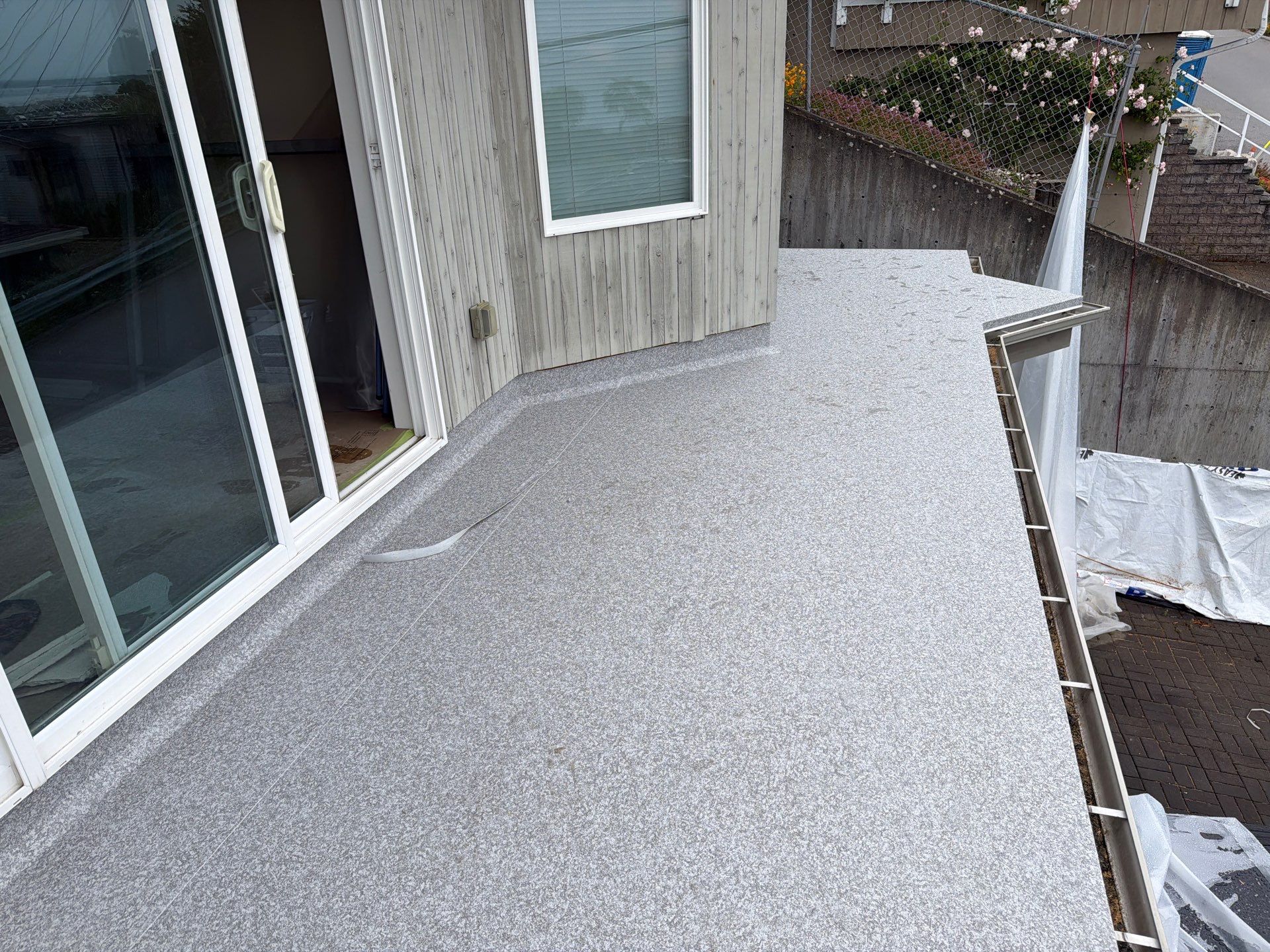
Compare quotes on scope, not on the bottom line. Two numbers that look 20 percent apart are frequently describing different jobs. A quote a council can actually evaluate will state:
- Substrate treatment. Whether existing sheathing is being kept, spot-replaced, or fully replaced, and what happens if rot is found once the old membrane is off. Ask for the unit rate for unforeseen sheathing replacement up front.
- The named membrane and thickness. Not "vinyl decking" but the actual product and mil thickness. Balcony applications typically use a 68mil fleece-backed membrane bonded to plywood.
- Slope correction. If the assessment found ponding, the quote must say how slope is being corrected. A new membrane over an unchanged flat deck will fail the same way.
- Terminations and flashings. Wall flashing, door thresholds, drain and scupper details, and railing post penetrations, itemised.
- The two warranties, separately. The manufacturer warrants the material. The contractor warrants the installation. These are different parties and different documents, and a quote that blurs them is hiding something. Valordek's membranes carry a 15-year waterproofing warranty plus 5-year appearance coverage, identical on both product lines. Installation workmanship remains the contractor's liability. See our warranty terms.
- Certification and code evidence. Ask for the product's CCMC evaluation and Intertek testing. For a strata council documenting a capital decision, third-party certification is the defensible basis for a spec.
Ask each bidder for two or three BC strata references of similar size and age. A contractor who works on stratas regularly will produce them without hesitation. If your council wants to understand the product category before reading quotes, start with our overview of vinyl decking systems and the waterproof decking system the membrane forms part of.
A realistic timeline
From first assessment to completed installation, a straightforward strata balcony membrane project typically runs four to nine months, and the constraint is usually scheduling rather than the work itself. Membrane installation on an individual balcony is measured in days.
- Weeks 1 to 4. Condition assessment and scope definition.
- Weeks 4 to 10. Quotes from two or three qualified contractors.
- Weeks 8 to 16. Council review, owner information meeting, funding decision or special levy vote.
- Months 4 to 8. Scheduling. Quality installers in the Lower Mainland book well ahead, and the work is weather-dependent.
- Installation. Days per balcony, phased across the building.
Councils that begin the assessment in autumn are positioned for the following spring and summer construction season. Councils that begin in spring are generally scheduling for the year after.
Frequently Asked Questions
What is section 72 of the BC Strata Property Act?
Section 72 of the Strata Property Act requires a strata corporation to repair and maintain common property. Balcony waterproofing membranes are part of the building envelope, so in most BC stratas the corporation carries that duty even where the balcony is limited common property assigned to a single unit. Bylaws can vary the arrangement in defined ways.
How often does a BC strata need a depreciation report?
BC strata corporations must obtain a depreciation report and update it every five years. The requirement is phased by region and strata size, with Metro Vancouver and Capital Regional District stratas of five or more lots reaching their date on 1 July 2026 and the rest of BC on 1 July 2027. The former three-quarters-vote waiver has been eliminated, and stratas of four or fewer lots remain exempt.
Does a depreciation report mean we have to replace the balcony membranes?
No. A depreciation report forecasts renewal timing and budget. It does not authorise or require work. The decision runs through the normal path of a contingency reserve fund draw or a special levy. What the report does is document that the component is approaching end of life, which makes deferral a recorded council decision.
How much does it cost to replace a strata balcony membrane?
Valordek vinyl membrane starts at $3.74 per square foot for materials, so a 100 square foot balcony is roughly $375 in membrane before accessories and labour. Installed pricing depends on substrate condition, slope correction, and access. Get current quotes, because depreciation report figures often lag contractor rates by one to three years.
Can a strata use the contingency reserve fund for balcony waterproofing?
Yes, where the work is repair and maintenance of common property and the reserve holds sufficient funds. When the contingency reserve fund cannot carry the project, the Strata Property Act path is a special levy approved by three-quarters vote. A current depreciation report strengthens the case for either route.
What happens if we defer the work?
The membrane keeps ageing and the scope grows. Once water reaches the plywood substrate the project changes from a surface replacement into a structural repair involving sheathing, engineering, and unit access. Documented BC strata cases show per-unit costs escalating to several times the original whole-project estimate after repeated deferral.