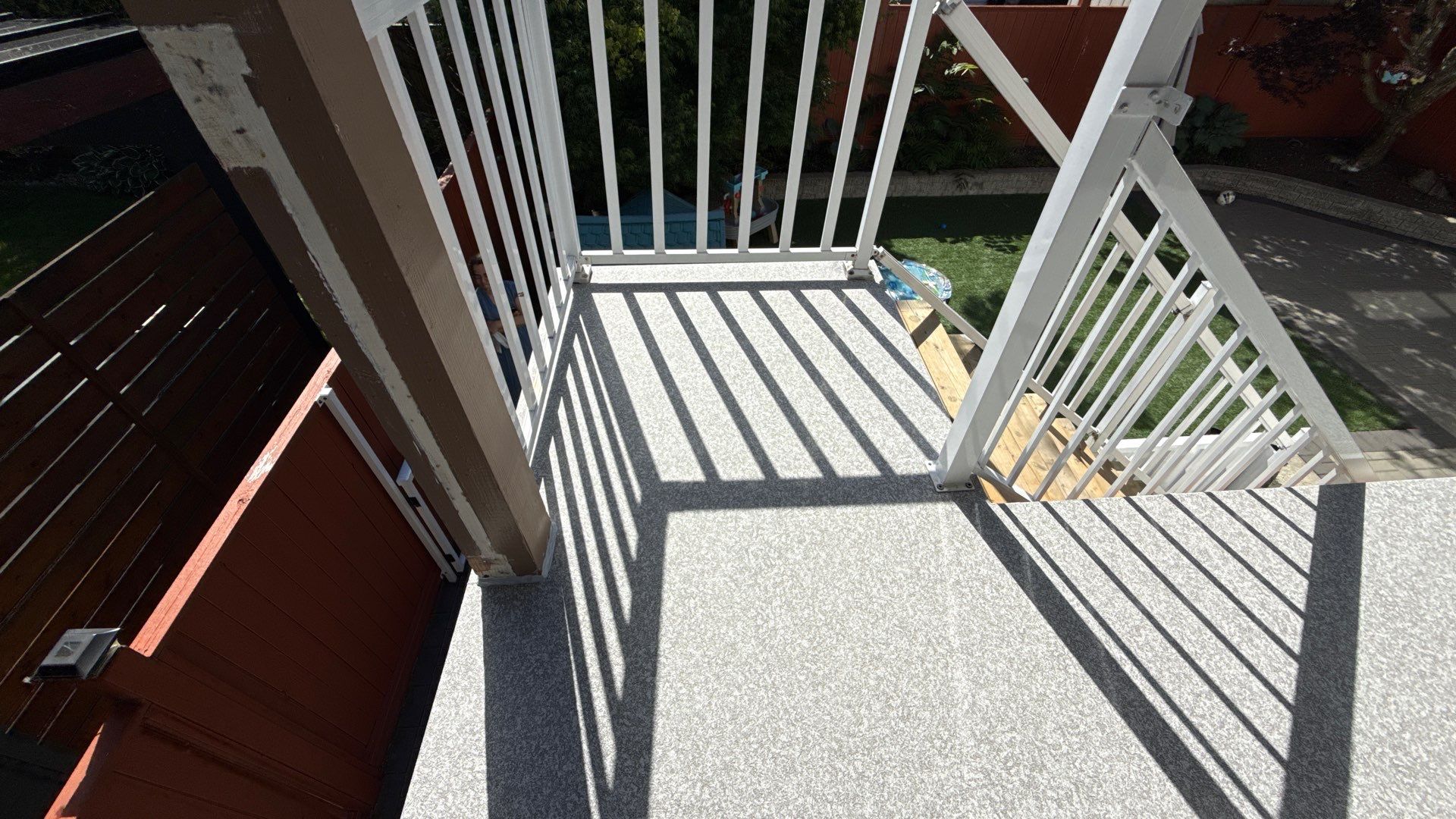
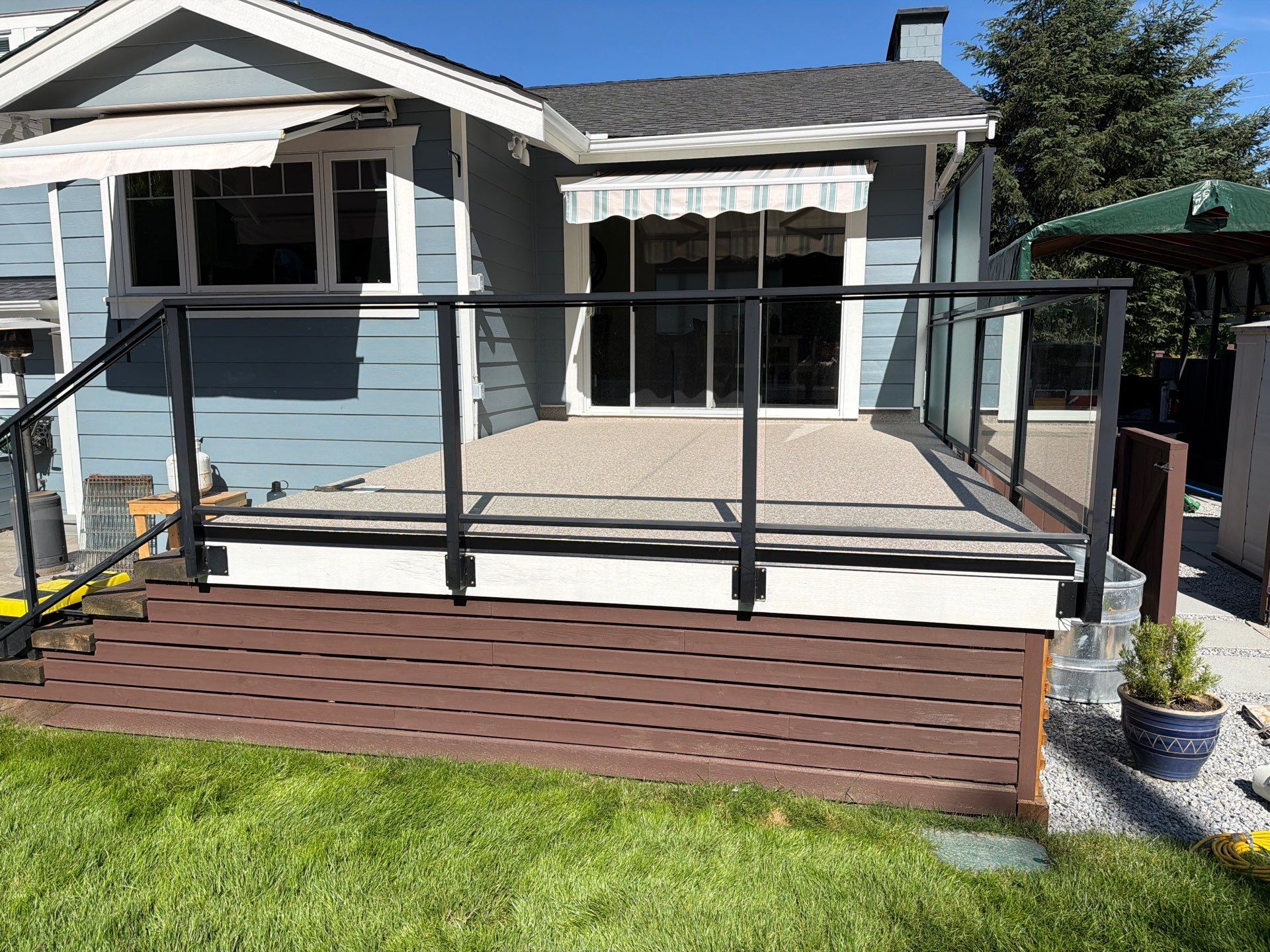
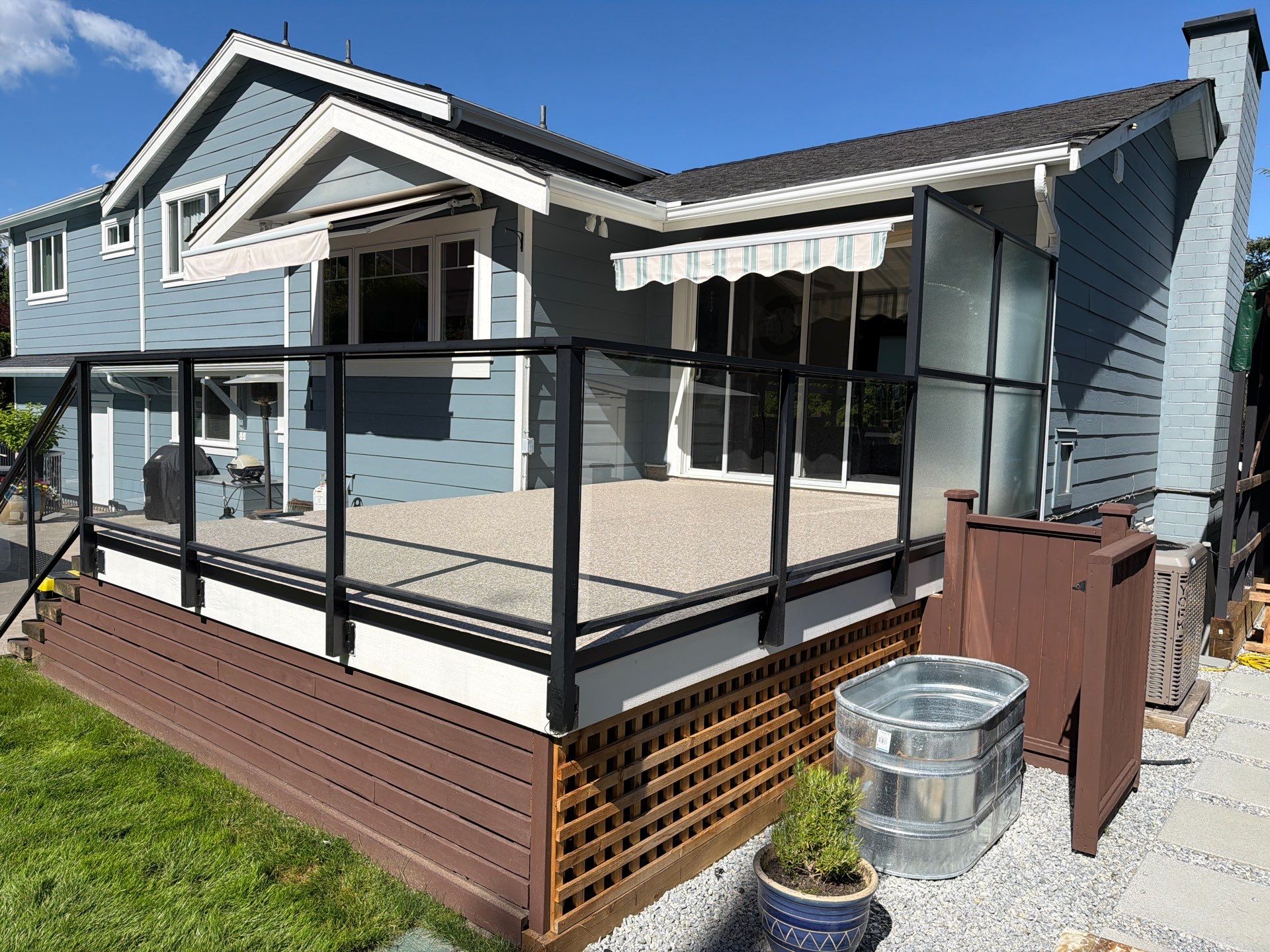
Most aging decks don't need to be torn out and rebuilt. If the structural framing (joists, beams, posts) is still solid, vinyl decking membrane can resurface your existing deck for a fraction of the cost of a full replacement. Valordek vinyl membrane starts at $3.74 per square foot for material. A full deck tear-out and rebuild typically runs $30 to $60 per square foot. For a 200 square foot balcony, that's the difference between roughly $750 in material versus $6,000 to $12,000 for a complete rebuild.
The surface is almost always what fails first. Wood boards split, warp, and grey out. Old coatings peel. Paint chips and traps moisture underneath. Meanwhile, the pressure-treated joists and beams below are often structurally fine for another 20 years. Resurfacing with a vinyl decking membrane gives you a brand-new, fully waterproof surface over your existing substrate, without the cost, waste, and disruption of ripping everything apart.
Here's how to figure out whether your deck needs resurfacing or a full replacement, and why vinyl membrane is the most cost-effective resurfacing option available.
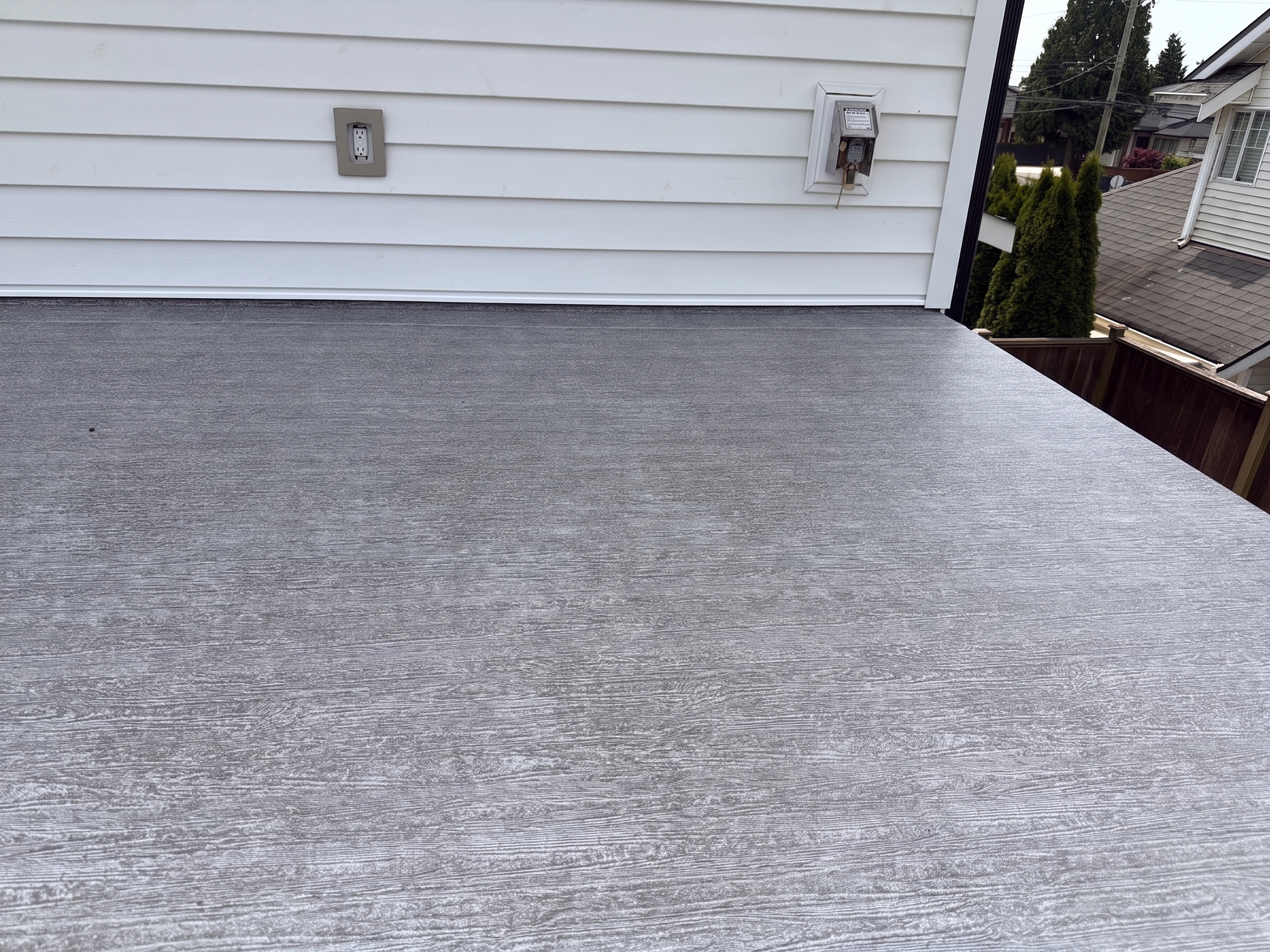
Signs Your Deck Needs Attention (But Not Necessarily Replacement)
Homeowners often assume the worst when their deck starts looking rough. But cosmetic deterioration and surface-level damage are not the same as structural failure. Here are the signs that point to resurfacing rather than a full rebuild:
- Splintering or cracking deck boards. Wood naturally splits over time from UV exposure and moisture cycling. The boards are failing, not the structure underneath.
- Faded, peeling, or flaking coatings. Old stains, paints, and sealers break down after a few years. Recoating is a temporary fix that fails again. Vinyl membrane is a permanent surface replacement.
- Soft spots in the surface only. If a board feels soft underfoot but the joist below is solid when you tap it, the decking material has absorbed moisture while the framing remains intact.
- Standing water after rain. Poor drainage or worn surfaces that no longer shed water. A vinyl membrane with proper slope creates a fully waterproof surface that directs water to drains or scuppers.
- Mould or algae growth on the surface. This is a surface moisture issue. Vinyl decking resists mould growth and cleans easily with soap and water.
- Visible nail pops or loose fasteners. Board movement from seasonal expansion and contraction. This is a surface material problem, not a framing problem.
If your issues fall into these categories, you're looking at a resurfacing project, not a replacement. The structure is doing its job. The surface isn't.
When You Actually Need a Full Replacement
There are situations where resurfacing won't solve the problem. A full tear-out and rebuild is necessary when the structural framing itself has failed:
- Rotted joists or beams. Push a screwdriver into the wood. If it sinks in easily, the framing has decayed and cannot support a new surface.
- Visible sagging or bounce. If the deck feels springy or you can see the frame dipping, the structural members have lost their load-bearing capacity.
- Post connections pulling away. Where the deck connects to the house (the ledger board) or where posts meet beams, failed connections are a safety issue that resurfacing cannot address.
- Code violations in the original build. Undersized joists, missing joist hangers, or inadequate footings. These require structural correction before any new surface goes on.
- Widespread rot below the surface. If removing a few boards reveals rot in more than 20% of the framing, the cost of selective repairs starts approaching full replacement.
The good news: most decks built in the last 20 to 30 years with pressure-treated lumber have framing that's still structurally sound, even when the surface looks terrible. A qualified contractor or Valordek dealer can assess your substructure in a single site visit.
What Deck Resurfacing with Vinyl Membrane Actually Means
Vinyl deck resurfacing is not a coating, paint, or topical sealer. It's a complete surface replacement. A vinyl decking membrane is a thick PVC sheet (Valordek's primary membrane is 68mil) that gets permanently bonded to your prepared substrate using contact adhesive. Seams are heat-welded to create a continuous, fully waterproof surface with no gaps, no joints, and no fastener holes.
The process works on existing decks because the membrane goes over a flat substrate, typically 5/8" tongue-and-groove plywood. If your current deck has wood boards with gaps, those boards get removed and replaced with plywood sheeting over the existing joists. If your deck already has a plywood surface (common on balconies and covered decks), the vinyl membrane can go directly over the prepared plywood after proper cleaning and patching.
This is the same installation method used on new construction. There's no compromise in quality or waterproofing performance when resurfacing versus building new. The membrane doesn't know or care whether the joists underneath are brand new or 25 years old. It bonds to the plywood substrate and creates the same waterproof barrier either way.
For a detailed walkthrough of the substrate preparation and installation process, see our guide on installing vinyl decking over plywood.
Cost Comparison: Resurfacing vs Full Replacement
This is where the decision becomes clear for most homeowners. The numbers for a typical 200 square foot balcony in British Columbia:
| Cost Category | Vinyl Resurfacing | Full Tear-Out and Rebuild |
|---|---|---|
| Decking material | ~$748 (Valordek at $3.74/sq ft) | $2,000-$4,000 (wood or composite) |
| Substrate prep/plywood | $400-$800 (if new plywood needed) | Included in rebuild |
| Adhesive and accessories | $200-$400 | Fasteners, flashing, etc. included |
| Labour (professional install) | $1,500-$3,000 | $4,000-$8,000+ |
| Demolition and disposal | $0-$500 (surface boards only) | $800-$2,000 |
| Typical total | $2,800-$5,000 | $6,000-$12,000+ |
Vinyl resurfacing typically costs 40% to 60% less than a full deck replacement, and the result is a fully waterproof surface that wood and composite decking cannot match. Wood boards and composite planks have gaps between them by design. Water, debris, and moisture pass through to the structure below. A vinyl membrane is a continuous sealed surface. Nothing gets through.
The savings come from keeping the structural framing in place. Demolition is the most expensive and disruptive part of any deck project. When you resurface, you skip the tear-out, skip the new framing, and skip the permit costs that come with structural work in most municipalities. For a deeper breakdown of vinyl decking pricing, see our vinyl decking cost guide or estimate your project with the cost calculator.
How Vinyl Resurfacing Works on an Existing Deck
The resurfacing process follows the same steps whether your deck is 5 years old or 25 years old. What matters is the condition of the substrate, not its age.
Step 1: Assess the Structure
A contractor or dealer inspects the joists, beams, posts, and connections. Any damaged framing members get repaired or replaced individually. This is targeted repair, not wholesale demolition.
Step 2: Prepare the Substrate
Old deck boards or failed coatings are removed. If the existing surface is plywood in good condition, it gets cleaned, sanded, and patched. If the surface needs replacing, new 5/8" tongue-and-groove plywood is installed over the existing joists. All screw heads are countersunk and holes are filled with patching compound.
Step 3: Establish Proper Slope
Water needs somewhere to go. The substrate is checked for proper slope (minimum 1/8" per foot) toward drains or the deck edge. On balconies, scuppers or drains are installed to direct water away from the building envelope.
Step 4: Apply the Membrane
Contact adhesive is rolled onto both the plywood and the back of the vinyl membrane. Once the adhesive reaches the proper tack, the membrane is carefully positioned and pressed into the substrate. Valordek's 72-inch-wide rolls mean fewer seams on most residential installations. All seams are heat-welded to create a monolithic waterproof surface.
Step 5: Finish the Details
Edges are wrapped and sealed. Flashing is installed at wall transitions. Drains and scuppers are integrated into the membrane. The finished surface is inspected for any bubbles, wrinkles, or adhesion issues.
The entire resurfacing process for a typical residential balcony takes one to two days. Compare that to a full rebuild, which can run one to three weeks depending on the scope, permits, and weather. Less disruption, less noise, less waste in the landfill.
What to Expect After Resurfacing: Lifespan, Maintenance, and Warranty
A resurfaced deck with Valordek vinyl membrane performs identically to a new-build installation. The membrane's waterproofing, UV resistance, and durability are properties of the material itself, not the age of the structure underneath.
Lifespan
Valordek vinyl decking is engineered to withstand Canadian conditions from -40C to 80C. The PVC formulation includes UV screens and stabilizers that prevent degradation from sun exposure. With proper installation and basic maintenance, vinyl decking membranes last 15 to 25+ years before replacement. Read more in our guide on how long vinyl decking lasts.
Maintenance
Vinyl decking requires almost no maintenance compared to wood. No annual staining, no sealing, no sanding. Regular cleaning with soap and water keeps the surface looking new. An annual inspection of sealant joints is recommended per the Valordek Cleaning Guide. That's it.
Warranty
Valordek's 68mil Fuzzy-Back membrane carries a 15-year waterproofing warranty and a 5-year appearance warranty. The 60mil Smooth-Back membrane (used on rooftop deck applications) carries a 15-year waterproofing warranty and a 5-year appearance warranty. Both are backed directly by Valordek as the manufacturer. Full warranty terms are published on the warranty page.
Waterproofing Performance
This is the most significant advantage of vinyl resurfacing over other deck repair options. A waterproof decking system with heat-welded seams creates an impermeable barrier over the entire deck surface. Water cannot penetrate to the plywood or framing below. This is particularly critical on balconies above living spaces, where even small leaks cause expensive interior damage. For more on why waterproofing matters, see our article on balcony waterproofing failures.
Why Vinyl Beats Other Resurfacing Options
Vinyl membrane is not the only way to resurface a deck, but it is the only option that delivers full waterproofing. Here's how it compares to common alternatives:
| Resurfacing Option | Waterproof? | Lifespan | Maintenance |
|---|---|---|---|
| Vinyl decking membrane | Yes, fully sealed | 15-25+ years | Soap and water |
| New wood boards | No, gaps between boards | 10-15 years | Annual staining/sealing |
| Composite boards | No, gaps between boards | 15-25 years | Periodic cleaning |
| Deck paint or coating | Temporary at best | 2-5 years before recoat | Recoat every few years |
| Rubber membrane | Yes | 10-15 years | Periodic recoating |
Wood and composite boards leave gaps between every plank. Water, dirt, and debris fall through to the structure below. Over time, this trapped moisture is exactly what causes the joist rot that leads to full replacement. Vinyl membrane eliminates that problem entirely. For a full comparison between vinyl and wood decking surfaces, see our vinyl vs wood decking guide.
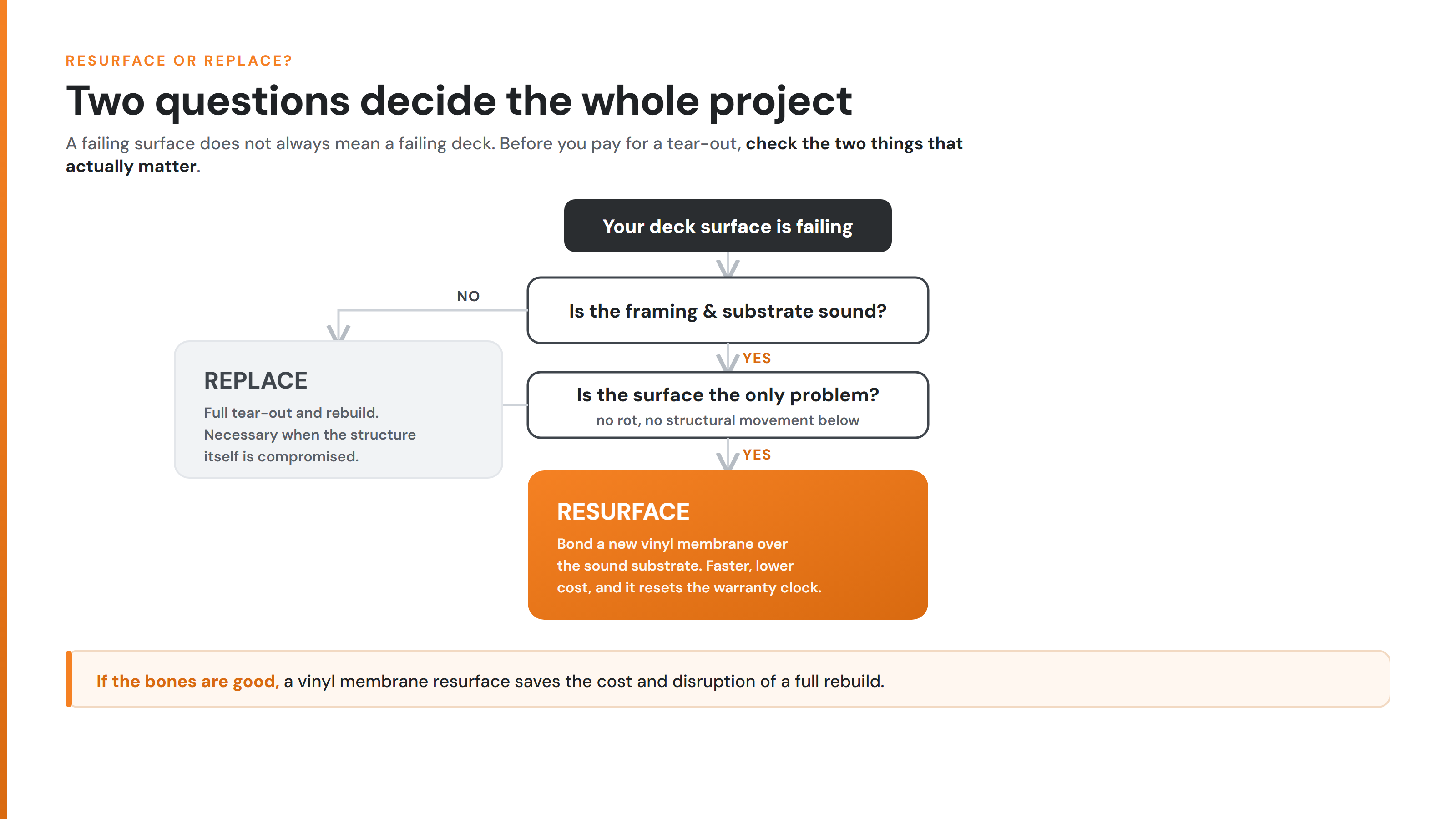
Is Resurfacing Right for Your Deck?
If you can answer "yes" to these three questions, your deck is a candidate for vinyl resurfacing:
- Are the joists, beams, and posts structurally sound? No rot, no sagging, no failed connections.
- Is the deck surface the problem? Cracking boards, peeling coatings, standing water, surface deterioration.
- Do you want a waterproof, low-maintenance result? Not just a cosmetic refresh, but a surface that protects the structure below for the next 15 to 25 years.
If the structure is solid and the surface is the issue, resurfacing with Valordek vinyl decking gives you a better result than what was originally built, at a fraction of the replacement cost. You get a continuous waterproof membrane, 12 colours across wood look, stone look, and classic styles, and a manufacturer-backed warranty.
Find your nearest Valordek dealer for a free site assessment, or call 1-888-400-6155 to talk directly with the team that manufactures the membrane.
Frequently Asked Questions
How much does it cost to resurface a deck with vinyl compared to replacing it?
Vinyl resurfacing a 200 square foot deck typically costs $2,800 to $5,000 including materials and labour. A full tear-out and rebuild runs $6,000 to $12,000 or more. Valordek vinyl membrane starts at $3.74 per square foot for material. The savings come from keeping the existing structural framing in place and avoiding demolition, disposal, and new framing costs.
Can vinyl decking be installed over my existing deck surface?
Vinyl membrane bonds to a flat plywood substrate, not directly to deck boards with gaps. If your deck has individual boards, they need to be removed and replaced with 5/8" tongue-and-groove plywood over the existing joists. If your deck already has a plywood surface (common on balconies), the membrane can go directly over it after proper cleaning and preparation. See our vinyl decking over plywood guide for details.
How do I know if my deck structure is still good enough for resurfacing?
Check for three things: joist rot (push a screwdriver into the wood; it should resist), sagging or bounce when you walk on the deck, and secure connections at the ledger board and post bases. A Valordek dealer can perform a professional assessment during a site visit. If the framing is sound, resurfacing is the better option.
How long does vinyl deck resurfacing take?
A typical residential balcony resurfacing takes one to two days. This includes substrate preparation, membrane installation, and finishing the edges and details. A full deck replacement takes one to three weeks. The shorter timeline means less disruption to your home and your neighbours.
Will a resurfaced deck last as long as a brand-new one?
Yes. The vinyl membrane's performance depends on proper installation and substrate preparation, not the age of the framing. A Valordek membrane installed over 25-year-old joists performs identically to one installed over brand-new joists, provided the structure is sound. Valordek's 68mil membrane carries a 15-year waterproofing warranty and a 5-year appearance warranty. Expected functional lifespan is 15 to 25+ years.