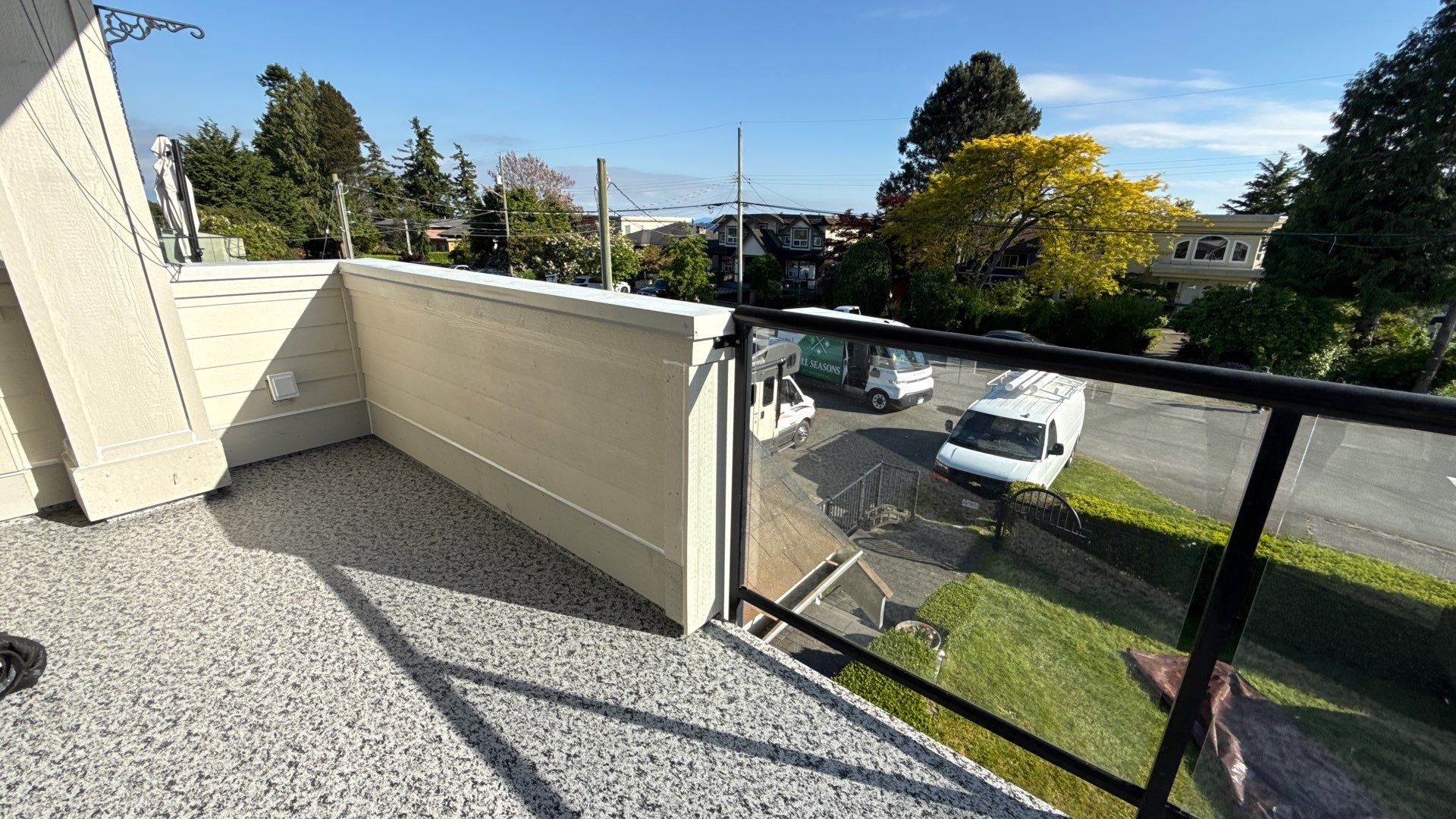
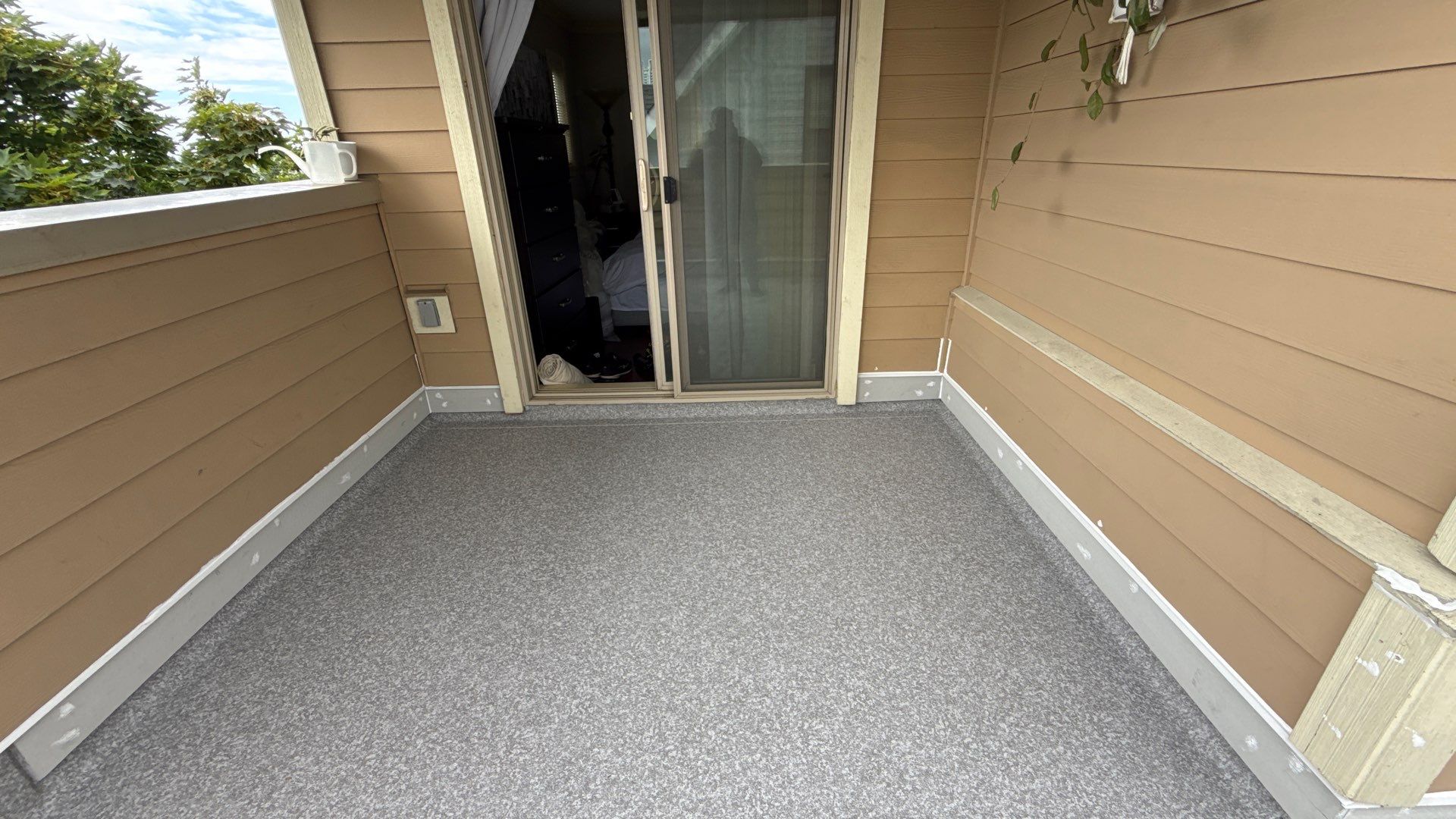
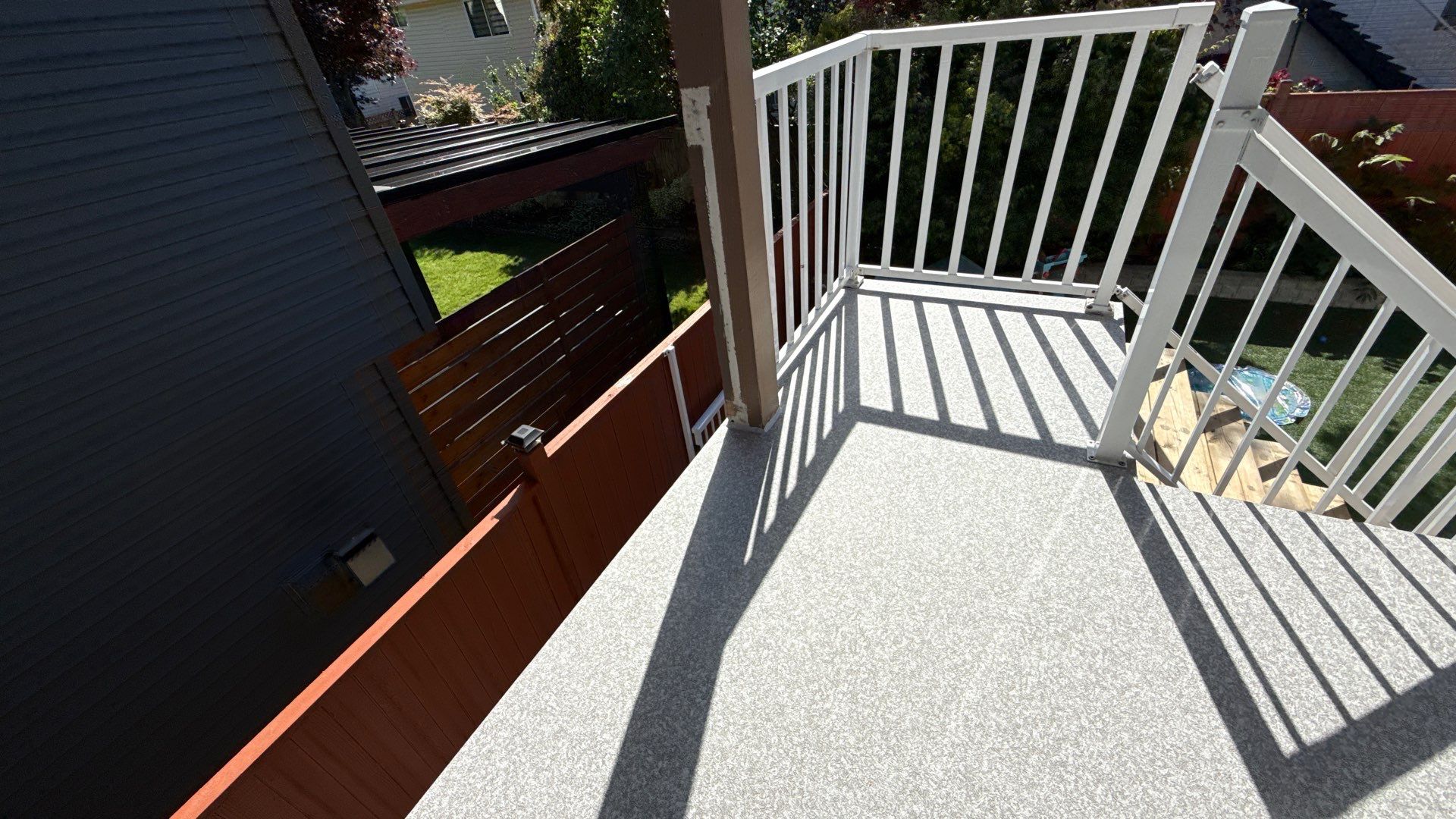
Vinyl decking is a waterproof PVC membrane bonded to a plywood or concrete substrate. Wood decking uses natural lumber planks fastened to a frame. The key differences: vinyl is fully waterproof and requires only soap-and-water cleaning, while wood needs annual staining and sealing at $1 to $3/sq ft and is not waterproof. Valordek vinyl membrane starts at $3.74/sq ft with a 15-year waterproofing warranty. Wood decking starts lower per square foot, but its annual maintenance costs compound every year you own it.
If you are weighing these two options, you are asking the right question. Wood is the traditional choice, and it has genuine advantages. Vinyl solves specific problems that wood cannot. This comparison breaks down the real differences so you can choose based on your project, not marketing claims. If you are also weighing composite boards, see our vinyl vs composite comparison.
The Wood Deck Maintenance Reality
Annual wood deck maintenance costs Canadian homeowners between $1 and $3 per square foot for staining and sealing alone (HomeAdvisor, 2024 averages). That expense begins within the first year and never stops.
Wood decking looks beautiful on day one. The challenge is keeping it that way. According to the National Association of Home Builders (NAHB), pressure-treated wood decking has an average lifespan of 10 to 15 years before requiring major structural repair or replacement. But the real cost is not the wood itself. It is the maintenance cycle that starts almost immediately.
Annual staining and sealing is not optional if you want to protect your investment. Wood absorbs moisture. Without a protective sealant, it swells, warps, cracks, and eventually rots. Most deck stain manufacturers recommend re-application every 1 to 2 years. For a 200 sq ft deck, professional re-staining runs $200 to $600 per application (HomeAdvisor, 2024).
Over 10 years, that maintenance spend accumulates. A homeowner who re-stains every two years at $2/sq ft on a 200 sq ft deck will spend approximately $2,000 in staining alone, before any structural repairs.
Other wood deck problems that drive maintenance costs:
- Rot and decay. Even pressure-treated lumber develops rot at cut ends, fastener points, and areas where moisture sits. The Canadian Wood Council notes that horizontal surfaces are especially vulnerable because they hold standing water.
- Splintering. As wood ages and dries, it develops surface splinters. This is a safety concern for bare feet, children, and pets.
- Warping and cupping. Moisture absorption causes boards to twist, bow, and cup. Warped boards create uneven walking surfaces and gaps where water pools.
- Insect damage. Carpenter ants and wood-boring beetles can compromise structural integrity, particularly in BC's coastal climate.
- UV fading. Untreated wood greys within months of sun exposure. Even stained wood fades and needs refreshing every 1 to 2 years.
None of these are defects. They are the natural behaviour of wood when exposed to weather. The question is whether you want to manage that behaviour year after year.
What Vinyl Decking Offers Instead
Vinyl decking eliminates the annual maintenance cycle entirely. A properly installed vinyl membrane requires only soap-and-water cleaning a few times per year, with no staining, sealing, sanding, or chemical treatments.
Vinyl decking is a PVC membrane system, not individual boards. It is manufactured in rolls (72 inches wide, up to 480 lineal feet per master roll), then cut and bonded directly to a plywood or concrete substrate using adhesive or heat-welding. The result is a continuous, fully waterproof surface with no gaps, seams, or exposed joints.
Why that matters: Water cannot penetrate a properly installed vinyl membrane. Rain, snowmelt, and standing water stay on top of the surface and drain off. The structure below, whether it is a room, a carport, or a storage area, stays dry. This is why vinyl membrane is the standard waterproofing solution for balconies and rooftop patios across Canada.
Durability is engineered, not natural. Valordek vinyl decking is manufactured from UV-stabilized PVC rated for temperatures from -40C to 80C. It will not rot, splinter, warp, or attract insects. The material is formulated to resist the UV degradation and freeze-thaw cycles that destroy wood decking in Canada's climate.
Certifications back the claims. Valordek vinyl is CCMC-approved, Intertek-tested, and exceeds building code standard 37.54.95 for waterproofing performance. The Smooth-Back product line carries Class A and C fire ratings, meeting building code requirements for rooftop applications.
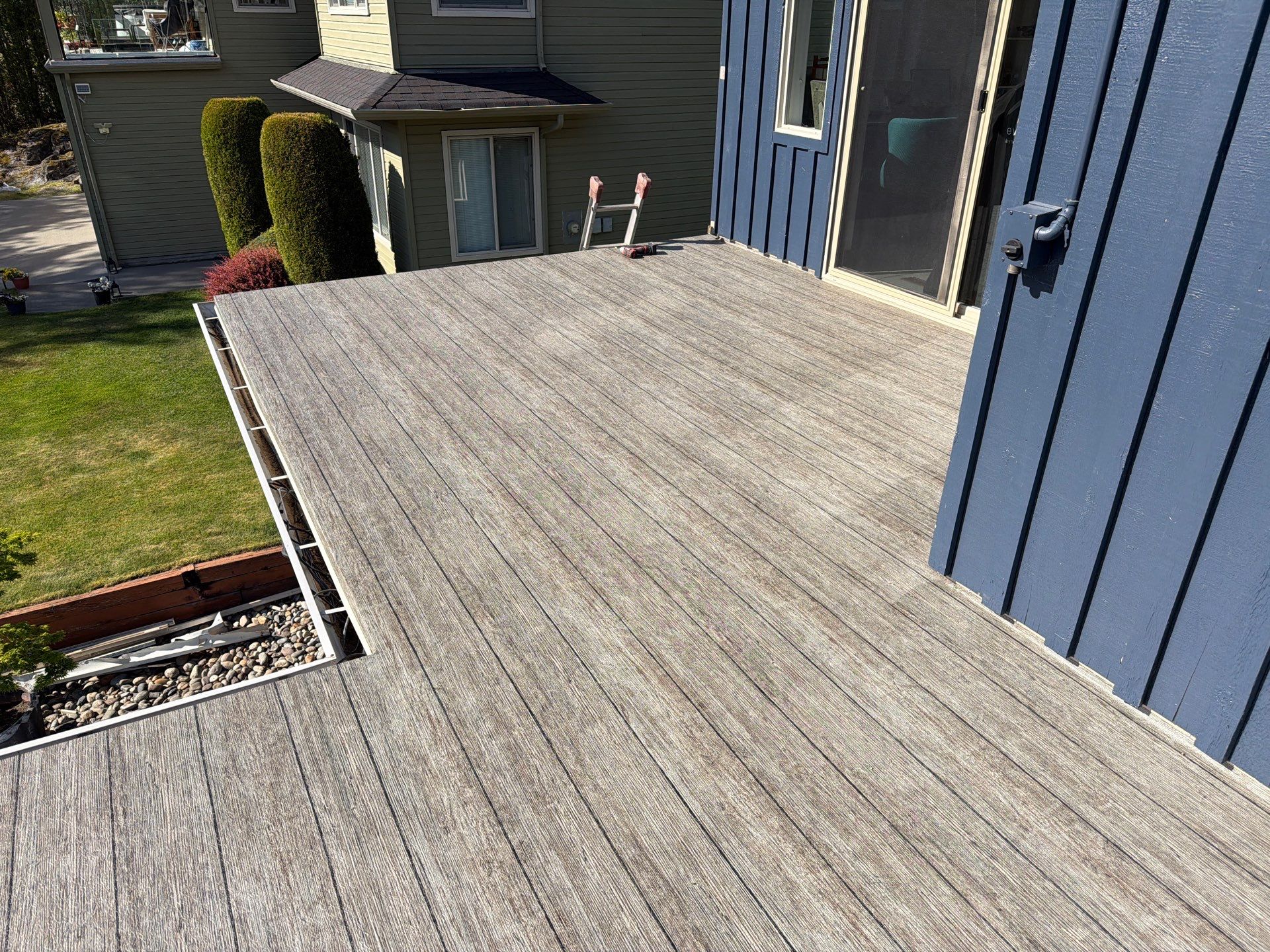
Style options exist. Valordek's Wood Look line offers three colours (Walnut Plank, Smoke Grey, Ash Plank) that replicate natural wood grain. It will not fool you at close range. Vinyl is a smooth membrane, not textured planks. But from a normal viewing distance on a balcony, the visual effect is convincing, and you can preview any colour on your own deck first. Stone Look and Classic patterns bring the total to 12 colour options across three style lines.
Head-to-Head Comparison
| Feature | Vinyl Decking (Membrane) | Wood Decking (Lumber) |
|---|---|---|
| Waterproofing | Fully waterproof, continuous membrane. No water reaches the structure below. | Not waterproof. Gaps between boards allow water through freely. |
| Maintenance | Soap and water, annual sealant inspection at edges. $0 in annual material costs. | Annual staining/sealing at $1 to $3/sq ft. Periodic board replacement for rot. |
| Lifespan / Warranty | 15-year waterproofing warranty + 5 year appearance warranty (Valordek) | 10 to 15 year average lifespan (NAHB), but significant maintenance starts at year 3 to 5 |
| Upfront material cost | Starting at $3.74/sq ft for membrane | $2 to $6/sq ft for pressure-treated lumber. $6 to $12/sq ft for cedar or redwood. |
| 10-year total cost (200 sq ft) | ~$1,350 to $1,950 total (membrane + accessories + labour) | ~$4,100 to $9,500 total (lumber + framing + annual staining + board replacements) |
| Aesthetics | Wood-look, stone, and classic patterns. Smooth, continuous membrane surface. Printed grain. | Natural wood grain and texture. Unique character. Knots and colour variation. Ages visibly. |
| Feel underfoot | Smooth, warm continuous surface. No splinters. No gaps. | Natural wood texture. Warm. Develops splinters over time. Gaps between boards. |
| Rot and decay | None. PVC does not rot, swell, or attract insects. | Significant risk. Requires ongoing chemical treatment to manage. |
| UV resistance | UV-stabilized PVC rated -40C to 80C. No annual treatment needed. | Fades and greys without treatment. Requires UV-blocking stain every 1 to 2 years. |
| Fire rating | Smooth-Back: Class A and C fire rated (Intertek-tested) | Combustible. Fire retardant treatments available but add cost. |
| Environmental | PVC manufacturing has environmental impact. Long lifespan reduces replacement waste. | Renewable resource if sustainably harvested. Shorter effective lifespan means more frequent replacement. |
| Installation | Adhesive or heat-welded to 5/8 TG plywood or untreated concrete substrate | Framing required. Boards screwed or nailed to joists. Standard carpentry methods. |
| DIY potential | Fuzzy-Back (adhesive) is DIY-friendly. Smooth-Back (heat-welded) requires professional installation. | Moderate to advanced DIY. Framing requires carpentry skills and tools. |
The 10-Year Cost Comparison
Upfront material cost is where wood appears to win. Pressure-treated lumber runs $2 to $6 per square foot. Vinyl membrane starts at $3.74 per square foot. On day one, wood can be cheaper.
But decking is a 10+ year investment. The total cost picture changes significantly once you factor in maintenance. Estimate your own project with the cost calculator, or see the full vinyl decking cost guide.
Sample scenario: 200 sq ft balcony deck over 10 years
| Cost Category | Vinyl Decking | Wood Decking |
|---|---|---|
| Material | $748 (membrane at $3.74/sq ft) | $800 (pressure-treated at $4/sq ft) |
| Substrate / framing | Existing plywood substrate (prep costs vary) | Framing lumber + hardware (~$400 to $800) |
| Accessories (adhesive, trim, drainage) | ~$200 to $400 | Screws, brackets, flashing (~$100 to $200) |
| Installation labour (if not DIY) | $400 to $800 | $600 to $1,200 |
| Year 1 to 10 maintenance | $0 (soap and water) | $2,000 to $6,000 (staining every 1 to 2 years at $1 to $3/sq ft) |
| Board replacement (rot/damage) | $0 | $200 to $500 (10 to 20% of boards typically need replacing) |
| Estimated 10-year total | $1,350 to $1,950 | $4,100 to $9,500 |
Sources: HomeAdvisor deck staining costs (2024), NAHB material lifespan data, Valordek published pricing. Labour costs are regional estimates for Western Canada.
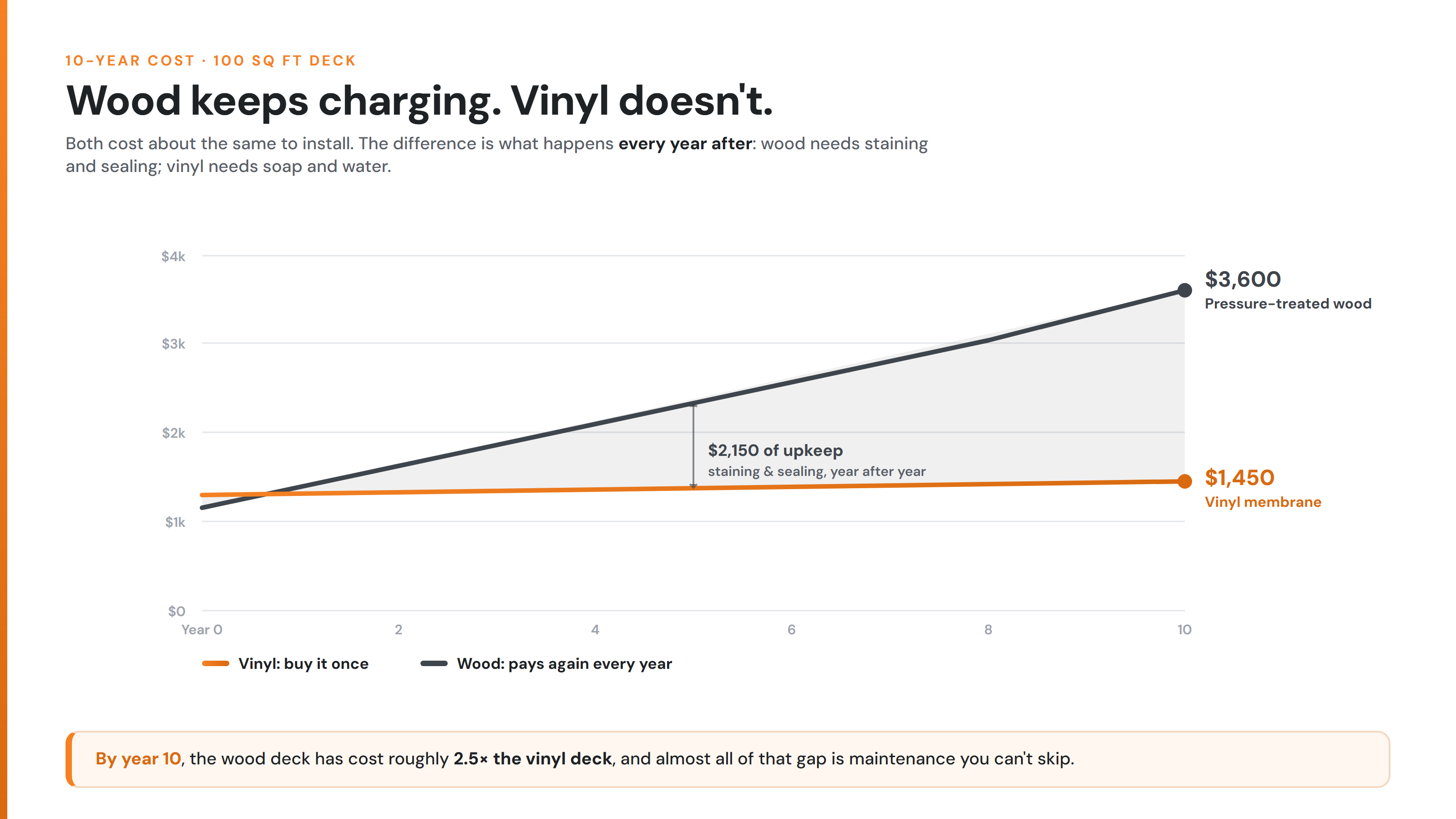
The takeaway: vinyl decking's higher initial material cost is offset by near-zero maintenance over its warranty period. Wood's lower entry price is offset by compounding annual maintenance. The break-even point typically occurs within 3 to 4 years, after which every dollar spent on wood maintenance is money vinyl would have saved you.
When to Choose Vinyl Decking
Vinyl membrane is the right choice when the deck surface needs to prevent water from reaching the structure below. These are the specific situations where vinyl outperforms wood.
Balconies over living space. If there is a room, carport, hallway, or storage area below your deck, waterproofing is not optional. A single winter of water penetration through a wood deck can cause thousands of dollars in structural damage, mould remediation, and interior repair. According to restoration industry data, water damage remediation for a single balcony leak averages $3,000 to $10,000 depending on the extent of damage. Vinyl membrane eliminates this risk entirely.
Rooftop patios. Rooftop applications demand waterproofing, UV resistance, and often fire-rated materials for building code compliance. Valordek's Smooth-Back system (60mil, heat-welded PVC) provides Class A and C fire ratings with a 15-year waterproofing warranty.
Low-maintenance priorities. If you do not want to spend weekends staining and sealing your deck every year or two, vinyl eliminates that cycle. Canada's freeze-thaw cycles accelerate rot and warping in wood. Vinyl is engineered to handle temperature extremes from -40C to 80C without degradation.
Replacing a failing deck surface. If your existing wood deck or coating has failed, vinyl membrane applied over properly prepared plywood substrate provides a long-term solution rather than another round of patching and re-staining.
When to Choose Wood Decking
Wood decking has genuine strengths. Being honest about them makes this comparison useful rather than one-sided.
Ground-level decks with no space below to protect. If your deck sits at grade or over open air with nothing underneath that needs to stay dry, waterproofing is not a requirement. Wood framing and boards are a proven, straightforward building method for ground-level outdoor living spaces. This is where wood excels.
Natural aesthetics are the top priority. Real wood has a warmth, texture, and character that no manufactured material fully replicates. The grain is unique to each board. The feel underfoot is distinctive. If you are building a backyard entertainment space and the natural look matters more than anything else, wood delivers that in a way vinyl does not.
Traditional deck structure is preferred. Wood decking creates a raised, framed deck structure with airflow underneath. This is a well-understood building method that any general contractor or experienced DIYer can execute. Vinyl membrane requires a solid substrate (plywood or concrete), which is a different construction approach entirely.
Budget is tight and maintenance commitment is accepted. If the upfront cost must be minimized and you are willing to invest the time and money in annual maintenance, pressure-treated wood offers the lowest initial price. Just factor the long-term costs into your decision before committing.
Can You Put Vinyl Decking Over an Old Wood Deck?
This is one of the most common questions from homeowners considering a switch from wood to vinyl. The short answer: not directly over the deck boards, but yes over a plywood substrate.
Vinyl decking membrane requires a smooth, solid substrate to bond properly. It installs on 5/8 inch tongue-and-groove plywood or untreated concrete (see our guide on installing vinyl decking over plywood). It cannot be applied directly over individual deck boards because the gaps, joints, and uneven surface would prevent proper adhesion and compromise the waterproof seal.
The typical conversion process:
- Remove the existing wood deck boards (keep the structural framing if it is sound).
- Inspect the substructure for rot, insect damage, and structural integrity.
- Install 5/8 inch tongue-and-groove plywood over the joists.
- Apply vinyl membrane to the plywood substrate using adhesive (DIY-friendly for Valordek Fuzzy-Back) or heat-welding (professional installation for Smooth-Back).
If the existing deck already has a plywood surface, which is common on balconies, the conversion is simpler. Remove any old coating or membrane, repair or replace damaged plywood, and apply the new vinyl membrane directly.
A qualified contractor or Valordek dealer can assess whether your existing structure supports the conversion. This is an especially practical option for balconies where old waterproofing has failed and the homeowner wants a permanent fix rather than another temporary coating.
Key Specs: Valordek Vinyl Decking at a Glance
For readers evaluating Valordek specifically, here are the product details that matter for this comparison.
Fuzzy-Back (68mil)
- Application: Balconies
- Installation: Contact adhesive (DIY-friendly)
- Warranty: 15-year waterproofing + 5-year appearance
- Substrate: 5/8 inch TG plywood or untreated concrete
- Certification: CCMC-approved, exceeds code 37.54.95
Smooth-Back (60mil)
- Application: Rooftop patios
- Installation: Heat-welded PVC (professional installation required)
- Warranty: 15-year waterproofing + 5-year appearance
- Fire rating: Class A and C (Intertek-tested)
- Substrate: 5/8 inch TG plywood or untreated concrete
Both product lines:
- Material: UV-stabilized PVC with UV screens and stabilizers
- Temperature range: -40C to 80C
- Membrane cost: Starting at $3.74/sq ft
- Roll width: 72 inches wide
- Available styles: Wood Look (Walnut Plank, Smoke Grey, Ash Plank), Stone Look (Marble Grey, Marble Beige, River Rock), Classic (6 colours)
- Manufactured in North America
- Available through 19 dealers across Western Canada
Frequently Asked Questions
Does vinyl decking look like real wood?
Modern vinyl decking offers realistic wood-grain patterns that look convincing from a normal viewing distance of 3 to 4 feet. Valordek's Wood Look line replicates natural plank patterns in three colours: Walnut Plank, Smoke Grey, and Ash Plank. Up close, the difference is visible. Vinyl is a smooth, continuous membrane surface, while wood has natural texture, grain variation, and depth. If close-range natural texture is your top priority, wood is the better choice for aesthetics.
Is vinyl decking cheaper than wood in the long run?
Yes, for most applications. While pressure-treated wood can be cheaper upfront ($2 to $6/sq ft vs $3.74/sq ft for Valordek vinyl membrane), wood requires $1 to $3/sq ft in annual staining and sealing. Over 10 years, a 200 sq ft wood deck can cost $4,000 to $9,500 when you factor in maintenance and board replacements. A Valordek vinyl deck of the same size runs approximately $1,350 to $1,950 total over the same period. The break-even point typically occurs within 3 to 4 years.
Can I install vinyl decking over my old wood deck?
Not directly over the boards. Vinyl membrane requires a smooth, solid substrate like 5/8 inch tongue-and-groove plywood or untreated concrete. You can remove the old deck boards, inspect the substructure, install plywood over the joists, and then apply vinyl membrane. If your deck already has a plywood surface (common on balconies), conversion is simpler. A local Valordek dealer can assess your existing structure and recommend the best approach.
How long does vinyl decking last compared to wood?
Valordek vinyl decking carries a 15-year (both Fuzzy-Back and Smooth-Back) waterproofing warranty, plus 5 years of appearance coverage on both lines. Wood decking lasts an average of 10 to 15 years (NAHB data), but significant maintenance starts within the first 3 to 5 years. Without consistent staining and sealing, wood deteriorates much faster. The practical difference: vinyl maintains its waterproofing performance with minimal upkeep, while wood requires ongoing investment to reach its full lifespan. For the full breakdown, see how long vinyl decking lasts.
Is vinyl decking slippery when wet?
Vinyl decking has a textured surface that provides traction in wet conditions, comparable to walking on a wet linoleum or laminate floor. It is not as grippy as rough-sawn wood when both are wet. However, vinyl does not develop the algae and moss growth that makes wet wood decks dangerously slippery over time. Regular cleaning prevents any buildup that could reduce traction. Valordek vinyl is rated for outdoor use in temperatures from -40C to 80C, including rain and snow conditions. For a closer look, see is vinyl decking slippery when wet.